Mongol Home

Mongol Home
Showing posts with label Hackmaster. Show all posts

Tuesday, August 26, 2014

What I have been doing lately...

Since last year, I've picked up a ton of OSR stuff in print- ranging from Expeditious Retreat Press' "Malevolent and Benign" to Lamentations of the Flame Princess' "Player Core Book: Rules and Magic", I also bought a whole lot of miniatures, mostly WWII and Ancient Romans and Gauls/Britons, for use with my B/X WWII game (still in early development) and 43 AD respectively. I also did something I expressly stated I wouldn't do, I bought the new Players Handbook (and the starter set, but even at 1/2 price I think it was a waste of money).  Oh, and I completed my 3rd edition Legend of the Five Rings RPG collection, and started on the 4th edition with the core rulebook.

Now, the new D&D surprised me, after Gen Con everyone was all raving about it, so curiosity got the better of me and I order it on Amazon, I haven't had a chance to look at really yet, because my lovely wife Mona has been reading through it.  Oh, and I also bought a ton of Pendragon stuff, from 1st edition through 5.1, I kind of felt like I had to when I found "The Great Pendragon Campaign" for a mere $60.00US in a game store in Germany, 1st (only?) printing, mint condition. I actually want to run some Pendragon now, but I haven't figured out how to go about it. I am considering PBEM because my gaming group has grown up and gone to college and moved out of the house. I only have my youngest, Ember, left here now and she'll be gone in a couple of years.


I suppose I should have seen it coming, this isn't the first time I've lost pretty much my whole gaming group because they grew up and moved away. The last time it was my brother Jon's friends, he's nine and a half years younger than me, so I was in my mid-to-late twenties when I ran AD&D (2nd edition, they were oddly reticent to play 1st edition) for those lads. Eventually I switched to 3rd edition, but they were mostly gone by then. I ran Hackmaster (4th edition)  for a while after I gave up on D&D, really it's the first retroclone though, right? Anyway, my oldest two children have moved on, although John is forced out of the dorm for holidays and between semesters, so I see him then. Ashli calls a couple of times a week usually.

 In theory I am still working on a super-hero genre RPG based on Joshua Guess' book Next (and it's impending sequels), but I haven't really been doing much of anything but playing "Civilization 5", "Mount and Blade" and the "Panzer General" clone "Panzer Corps", and by playing Civ5, I really mean working on a mod. "Mount and Blade" is great, because it's a sandbox RPG, but I became mightily peeved with it on Sunday when my saved game corrupted, why didn't I think to do alternating save slots? I tried starting over, but that kind of blows. I am accustomed now to being the most powerful lord in my Kingdom, who single-handedly  brought the other four Kingdoms (OK, one is a Khanate) of Calradia to their knees, commanding armies of 4-500 elite troops. I was an axe-wielding god of death, now bandits can beat my ass and take me prisoner.

"Panzer Corps" continues to please though, it has all of the good turn based strategy of "Panzer General"- even the maps look the same and the controls are identical, but the scenarios in the Grand Campaign are different enough from PG to be fresh and challenging.

Anyway, it's late here and I am rambling, so I'll just mention that I also got a couple of different flavors of "Swords and Wizardry" and bought everything available for the "Basic Fantasy" RPG. I am going to sign off for tonight and I'll try to start posting more again. Before I was blogging about gaming almost every day, but when you take year off the habit gets broken, now I have to reinstate it.

Friday, August 10, 2012

Breaking News


Hackmaster Basic is now free.

Download it here.

I failed to announce the awesome sale they had to get rid of the stock of HM Basic books a while back, so to make up for it I hope I am quick enough to be a news source here.

Between the Erol Otus cover art and the feel of the rules, it's a new old school game. It's a little heavier on the rules than I am looking for these days, but it is a good game and it was the first game my daughter GMed and everything worked out fine. Your PCs are definitely not superheroes, they work for their coin.

Thursday, July 12, 2012

Keeping you all up to date

I have not posted to my blog in a couple of days now because one of my players, Dalton, had his dad pass away. He's 19 years old and now both of his parents are dead. I turn 43 later this month and both of mine are still alive, in fact today is my mother's 68th birthday. I can not imagine being in Dalton's place. His loss has kind of made me think about a lot of different things, mortality being one, my mark on the world being another.

I am not saying that I am going to quit gaming or anything radical, it's just that this blog is, apparently, a part of the legacy I am going to leave behind, so too are the games I have DMed or played in; almost everything I have done in my adult life has been in some way a form of entertainment for, usually, a small group of people. I doubt more than a few hundred people have ever seen the low budget horror film I was in, and I haven't been in a play since middle school. But I have DMed, conservatively, over the last 30+ years, more than 1000 games of D&D of various editions up through 3.5 and Hackmaster 4th edition.

I have also run games in other systems, WEG D6 Star Wars and WotC D20, Twilight 2000 1st, 2nd and 2.2 editions, Boot Hill, Star Frontiers, Marvel Super Heroes, and who knows what else I can't remember off the top of my head. My wife tells me I should be a novelist, because I am a good GM. I think she's wrong, I set up good scenarios for people to react to, and I am quick on enough on my feet to counter-react in realistic ways. I've never carried anything very good, except academic papers, past about 20 pages. I can write decent short stories, not novels.


I don't know where I am really going with this, it's turning into one of my more rambling rambles, so I guess I will just wrap it up here and show you the picture of the book I got in the mail today.


I bought it so I'd have even more background material for my 43 AD game, but that doesn't seem likely to start soon now with Dalton's recent loss, he's a key player for me and I consider him a protege of sorts. I won't start anything until he's good to go.

Sunday, July 1, 2012

Character Questionnaires


This blog post over at Adventuring Archives got me to thinking about the whole idea of character back stories and how they fit in with the game world and all.

You see, I am of two minds about the subject, especially now that I am hardcore Old School; on the one hand I like the immersion that it brings a new character into the game world, on the other a single dagger blow might wipe that same character out wasting all the time and energy put into a decent, campaign immersive back story.

There were periods in my DMing over the years where I would give bonuses to people for coming up with a good back story for their character, anything from 100-250 XP to start out with, or an "Heirloom" of some sort that would be helpful, but not campaign breaking for a low level character to have that their class could use. Now, there were downsides to this too, I had to give DM approval to any back story. Some were so poorly written that they were just dreadful to read, others were written with power-gaming in mind, a lot of them seemed to skip over the part where I gave them extensive notes about the campaign world and were entirely inappropriate from that angle, and then some players just didn't care enough to try and either turned in crap or nothing, because the reward wasn't worth the effort.

Now, if you really want to go old school on this, just use the "Secondary Skills" table from the DMG and assume that's either what your father did or what he apprenticed you to do at a young age. Unearthed Arcana adds some tables to cover family and social status. Oriental Adventures is where random family generation and family history really shine, but rolling up an OA character can take a while, so you're adding time to character creation to draw the character into the setting, and that character still may not survive the first encounter.

Taking an old school approach, but of newer vintage, both versions of Hackmaster do the job pretty well. The parody version 4th edition Hackmaster, can be played straight, I have done it, but you have to rely less on randomness and more on point buys for Quirks and Flaws, otherwise it can go south fast. Hackmaster Basic is a lot more realistic in it's Quirk/Flaw random assignment. Both versions also build a family for you, so you can rip that section directly to your Old School D&D game if you want, hack D&D with Hackmaster. Now I'll put in a good word for Hackmaster, both 4th edition, which saved me from 3e D&D and Hackmaster Basic, which I have a lot of things I like about it, but it is a little too rules heavy for my current tastes. Seriously, if it wasn't for Hackmaster, I would have quit gaming probably.

So I guess I'd like everyone to come equipped with a basic idea of who their character is and how he or she fits into the world, the Character Questionnaire is a nice idea, it asks not just for a pysical description of your character, but also about your hometown, your place there, your friends and family; all stuff I can use as a DM to make a more immersive experience for my players, but I guess I can see this questionnaire being abused too. Making your acquaintances all Arch-Mages and yourself a Prince and stuff like that.   

Saturday, January 28, 2012

Moldvay Basic Observations Part 3-

Sorry I missed a couple of days, I had some real life get in the way of blogging, not all bad, some gaming was involved. I figure I should probably provide a link back to parts one and two in case you missed them before.

Now, we only really got through the first 18 pages of the book in the last two parts of my Moldvay Basic Observations, but I am confident that we can make it through the rest of the book here in part three because, despite the fact that we still have another 46 pages to go, there really aren't all that many more observations, and most of them are from the next few pages.

Part 4: The Adventure starts on page 19, and is a bunch of useful information for the beginning player and the beginning DM. I was both amused and impressed by the first paragraph, it has the heading beginning the adventure and essentially states that once the players have rolled up their characters and bought their equipment, the DM will tell them what the Adventure is going to be, where they are headed, what they're after, who is with them and what they know about the place. I found this amusing because I have had players over the last three decades that were such a pain in the ass that I wondered why they showed up at the table. I'd drop adventure hooks, usually some sort of hire, and they'd be all "Nope, I'd rather not take your excellent commission to go clear out the Dungeon of Doom, I'd rather sit at the inn doing nothing for the next six hours"; here they pretty much tell you that kind of nonsense doesn't fly.

Next it moves on to optimal party size and composition, pretty standard stuff for old school; it tells you that you should probably have 6-8 characters in the party, that's what pretty much every module said on the cover back in the day; and that you should have a mix of character classes, all the human classes should be represented and, if possible, get some Demi-Humans in the party too for their special skills. The most noteworthy thing here is that it suggests that some players, at the DMs discretion, might be allowed to play multiple characters. I am pretty sure that this was, if not outright forbidden, at least heavily frowned upon in AD&D. It also point's out here that if you don't have enough players you can fill in the ranks with retainers, but I'll get back to them in a bit.

Next we move on to organizing a party; setting your marching order is mentioned first and it mentions having several different marching orders for various tactical situations, which is something I always thought that me and my nerdy friends came up with on our own, but here it is in black and white. Then comes the Caller. Is this where the Caller comes from? I just looked through Holmes and didn't see any reference to a Caller, but I may have missed it, and in AD&D's PH it says that party's should have a leader who will "call" to the DM the party's actions. I never played in a D&D group with a formal Caller and damned few with formal Leaders, although informal leaders often existed. This is the first place I question whether or not people actually played this game with the rules as written.

After the Caller, there is a section on the importance of mapping and how one player should be designated the Mapper, this is a D&D job that I used to see a lot more in the old days than I do now. I can't decide if it's just because every DM on earth got sick and tired of having to describe the room over and over again, or draw sections of map for the "Mapper" to copy or if it was just because D&D moved away from dungeon based adventuring over the last three decades, either way, mapping is practically a lost art and it is frustratingly difficult to reinvent. I do like the way it says here that you maps aren't going to be exactly perfect and not to worry too much about making a perfect, detailed map though.

Next it brings up a controversial subject, use of miniature figures. They are clearly optional, but can enhance play. However, many of us OSR types, no matter how much we loved our old lead miniatures back in the 1980s are still a little gun shy about being slaves to the battle grid. Me, I can go either way, I hated being a slave to the battle grid and it did take me forever to wean my kids off of using miniatures even when we were playing 1st edition AD&D. I haven't used them yet with Moldvay Basic, but I may. I used miniatures pretty much the whole time I played D&D from Holmes through 3e, I only wanted to quit after 3e and now that I have had a break I am OK with them again. The only thing that bugs me is when 3e-isms crop up in an old school game when we're using miniatures, I know it's because we're using miniatures; someone will say something like "Shouldn't I get an attack of opportunity here?" and make me want to smack them.

The last things on the page are Time & Movement, there's not much of note there, except the note at the end that you need a 10 minute break every hour or you'll start getting fatigued and suffer a -1 to hit penalty until you do rest. I don't ever recall seeing that rule anywhere else. The only other fatigue rules I remember seeing in a version of D&D were in Hackmaster 4th edition.

Flipping the page brings us to encumbrance, which fills the entire page and is an optional rule. Sadly encumbrance gives us one of the worst and most enduring game-isms of D&D, the idea that all coins regardless of metal or purity weigh the same, and that the weight of a coin is 1/10 of a pound. Here in Moldvay Basic the basic unit of weight has gone from the Gold Piece (gp) to the more generic Coin (cn). I never really understood why we couldn't just measure weight in pounds, or ounces if necessary, but there you have it. I hear Lamentations of the Flame Princess has a better encumbrance system, and I did buy it in December during their PDF sale, but I haven't gotten around to reading it yet; if it is vastly better I will most likely adopt it for my B/X game.

Page B21 starts us off with Light, points out that most dungeons are dark and tells us how long torches last and how long a flask of oil will last in a lantern, reminds us that you need to pay attention to who is carrying the light sources because you can't fight with a sword & shield if you are the one holding the torch and then talks about how Infravision works. Now, when 3e hit the market and we lost Infravision in favor of Low-Light Vision and Dark Vision, I hated that as much as the next grognard; but over time I have come to actually prefer them to Infravision and I'll tell you why- there is always some jerk trying to screw with Infravision, either a player who has seen the movie predator or a DM that realizes that undead are the same ambient temperature as the air surrounding them. Giving a scientific explanation for how the eyesight of fantasy races work is stupid, plus have you ever looked through an infrared camera? Seeing everything like Geordi LaForge or the Predator isn't really all that helpful, plus why does it only work for X number of feet? An Elf or Dwarf's ordinary eyesight will allow them to see pretty much to the horizon, but their Infravision only works for 60'? Sixty feet of visibility is pretty crappy, especially if you can only see stuff that gives off heat. Realistically, deep enough underground the stone and the air are going to be about the same temperature, so the subterranean dwelling Dwarf is still screwed without a light source; he'll be blind, bumping into cavern walls*.

Next we move on to Doors, which has three sections Normal Doors, Secret Doors and Listening at Doors. Normal doors are pretty interesting in Moldvay Basic, because they kind of have some weird mojo going for them. First, they are usually closed, that's cool, I usually leave my doors closed too; but additionally they are often either stuck or locked. Stuck doors any character can take a shot at, but higher strength characters are better at unsticking them, this is where the "Kick in the Door" meme in D&D comes from. Locked doors have to be picked open by a Thief, and the text here kind of implies that if your party Thief fails here, you are just screwed; which makes sense from the description of the Thief and his lock picking ability, but not from the point of view of a dungeoneering party that probably has at least one axe with them. The other odd, semi-magical qualities of dungeon doors are that they automatically swing shut after you open them unless you specifically jam them open and that they will automatically open for monsters unless you spike them shut; and these are the "Normal" doors.

Secret doors have fewer rules regarding them, but there is the interesting clarification that a Character only gets one chance to find a secret door. I remember playing AD&D and having the party know there must be a secret door in an area and just keep searching forever until they found it, that was annoying. Listening at doors gets a mention at the end of the doors section, I am amused by that because that's another one of those semi-lost dungeoneering skills, like mapping. When I DMed last weekend the party remembered to check for traps about 70% of the time, but only listened at one door. This section also has a rules clarification that a character may only listen once at any given door, and that the undead do not make noise.

The bulk of this page though is taken up by rules regarding Retainers, which brings me to a mini-rant- What is the deal with the inconsistent terminology between editions of D&D for the hired help. That's just confusing, why does every damned edition need to change the name? Here Retainers are, mostly**, what you would call Henchmen in AD&D, in 3e they'd be called Cohorts. Why on earth couldn't they pick a term and stick with it? That said, they are a little more interesting to hire on than they are in other editions, they have their own reaction table, which I assume the PC's Charisma modifier applies to, although it doesn't expressly say so. I also find it interesting that they have to check morale after every adventure to see if they will stick with you. Charisma would not be a dump stat in this version of D&D even if the rules supported stat rearrangement.

Skipping way head to combat, did anyone use the rules as written? The DM rolls all the damage dice? Why? Just because only one set of dice shipped with the boxed set? I like the morale rules, they are simple and easy to use, every monster has a morale value. Would I have preferred it to be on a D20 instead of 2d6? Yes, but Moldvay has a lot of 2d6 tables, so I am getting used to it. AD&D didn't get a decent monster morale system until 2nd edition.

Moving on to the monsters in general, there is more variety in low level monsters than in previous editions of D&D or than in AD&D, even some more mid-level ones than I would have expected; and many that weren't in any previously published D&D. The AD&D Monster Manual was only published four years earlier, so I would not have expected too much deviation from it's list, but there is. All of the standard humanoids are there, as are all the minor undead and a bunch of other "standard" D&D monsters, like Stirges, Rust Monsters and Ochre Jellies. Dragons are here too, surprisingly, since the book only covers levels 1-3. There are a bunch of new monsters and monster variants though that I never saw really until I read through this book, different types of Giant Lizard, Snakes, Giant Spiders and the Thoul to name a few.

What else did I skip over before?

Paralysis can be cured with a Cure Light Wounds spell? Does that happen in AD&D? I never heard of it if it does. Here it gets mentioned in the spell description and in the description of pretty much everything that causes paralysis.

The Monster Reaction Table, not every encounter needs to be a combat encounter and another reason why Charisma wouldn't be a dump stat even if the game rules allowed for it. Sometimes a monster might help you out.

Individual Initiative is an optional rule. I can't decide whether or not to use it, because my current group is less wargamer heavy, and therefore less rules crunchy and combat oriented than most previous D&D groups that I have played with, so I think that it might just be too much of a stress builder on combat and make combats more chaotic and lengthy, but on the other hand I think it really helps open up the combat options for high Dexterity characters like Thieves to be able to maneuver into position for Back Stabs, which is never actually called back-stabbing here, but instead "striking unnoticed from behind", or just getting to go first in combat.

Experience points, you get WAY more of them for treasure than for killing monsters, that kind of sets the tone for what's important here, now doesn't it? I actually noticed this when I was figuring experience points for the game I ran last Sunday, gold piece value is king when it comes to XP, killing not so much, magic not at all. AD&D was kind of like this, except that you got the XP for magic and monsters were worth a little more, Goblins in B/X D&D are worth 5XP each in AD&D they are going to be worth an average of 13XP.

Overall thoughts- There is still a great deal of customizability to Moldvay Basic, like there was in OD&D. The number of rules that are presented as optional is reminiscent of 2nd edition AD&D and the rumors of 5th edition D&D's multi-edition compatibility; for example- if you use none of the optional rules presented in Moldvay you have a game that is more similar to OD&D, if you use them all, it becomes much more distinctly it's own version. As an introduction to D&D, and RPGs in general, I think it does a much better job than Holmes basic did, and I mean no disrespect to Holmes Basic, it had a different design agenda; I am told Mentzer Basic did a better job still, but I haven't seen it to say for myself. What I can say is that all of the rules you need to play D&D are in this book, it's only flaw, and this is by design, is that it tops out at 3rd level and then you have to buy the Expert boxed set to go to level 14; which is past "name" level, the theoretical end game stage of D&D, so you really never needed the Companion boxed set, that never got published, that promised levels 15-36.

Now, I suppose I'll have to do some posts on my observations about the Expert side of the B/X equation too, but at least this will be more mixed with review, I had that set back in the day and I used stuff out of it pretty liberally with my Holmes Basic set and my AD&D until everything was taken over by AD&D eventually. I'll need to finish reading it


* unless the assumption is made that Infravision is very, very good and he can see the heat from his body and breath emanating around him and it outlines the walls and stuff, but then you still have the problem of jerks trying to blind Infravision scientifically because they can.

**They might be a 0-level torchbearer, that dude would be called a hireling in AD&D which has entire classes of standard and expert Hirelings. I looked ahead in the Expert book and some of the Hirelings in there are overlapped with the Hireling types in the AD&D DMG, but it didn't include any of the standard 0-level porters and torchbearers that AD&D parties have available to them.

OK, these EBay items arrived today.


Everyone in the OSR raves about this old Judges Guild stuff, I never had any, so when I saw I could snag some cheap I grabbed these.


I know I swore off buying Star Wars stuff, but it was a bargain and I was bidding on a bunch of other stuff from the same seller, I figured if I caught this at the minimum bid and got the combined shipping with any of the other stuff it's be like getting a free item almost. This was the only item I won though, but I got it for the minimum bid.

Tuesday, January 24, 2012

Moldvay Basic Observations Part 1-

When I started reading through the 1981 Moldvay Basic rules I really didn't expect that I would find anything new or exciting to me, especially considering how many times I have looked things up in that book just for the sake of comparing it to something in AD&D, OD&D or Holmes. I assumed what I was going to find was a rules-lite version of AD&D, the "Kiddie-D&D" I had always been biased against since I was a kid myself. I am delighted to say I could not have been more wrong. I have stated on a number of occasions that I started out with Holmes Basic, and it is, more or less, just a re-edit of OD&D, less confusing than OD&D, but not by much and with a few funky house rules Holmes threw in there of his own, that's cool. AD&D was just OD&D all house ruled to hell for E. Gary Gygax's Greyhawk campaign and then declared official TSR, tournament style, never house rule this D&D again, D&D anyway*, right? That and a way to separate it from Dave Arneson's contribution to the hobby in a legal, financial way; or so I have heard.

Anyway, on to my observations about the red book. Right from the get go I could see that this was a different beast than Holmes, it was not simply a restatement of OD&D rules, but an evolution of them; sure they were clearly descended from their immediate ancestor, but they were a new creature, sleeker and more graceful than the one that had come before. I am currently so enamored of Moldvay's rules set that I am seeking out a Mentzer Basic set too, just so I can check it out and make that comparison too.

I was specifically asked by a blog reader to break this analysis of Moldvay down into easily digestible parts, so I will try to not cover too much in this post. I will also attempt to NOT simply compare Moldvay too much to it's immediate predecessor, Holmes Basic, or to 1st edition AD&D, which I am much more familiar with, but I can't promise anything simply because sometimes the only, or at least the easiest way to illustrate is through comparison. I should also mention that this blog post has been a beast to write, I have written and rewritten several sections, switched parts around and, in general, done more work on this post than any other blog post I have ever written; usually I just put out my thoughts as they come to me, do a quick fact check if necessary, look for obvious spelling or grammar errors and send the post on out. This one seemed like more of a special occasion post. I took notes for this one.

On to character generation then. It's totally old school; 3d6 in order (Str, Int, Wis, Dex, Con, Cha) with a slight ability to modify based on what class you choose, you can drop an ability score by 2 points to raise your prime requisite by 1, but you can't drop anything below a 9 and Dexterity, Constitution and Charisma may not be lowered at all, but depending on class Dexterity may be raised. Ability scores are way less fiddly than in AD&D, there is almost a universal stat modifier like in 3e. Except for Humans race equals class, another old school concept that's been gone since the AD&D 1st edition days from my world view, but there it is. I think that may be the biggest hurdle for more modern gamers to accept, and this includes 1st edition AD&D players**.

The classes available are Fighter, Cleric, Magic-User, Thief, Dwarf, Elf & Halfling; a short and simple list. It's the same list, with a slight change in terminology, as the one in Holmes Basic, but way shorter than the list in AD&D. It also doesn't lead us to believe that this is the gateway to AD&D, this version of the Basic book comes right out and tells us that there is an Expert book coming (Spoiler Alert: I looked in the Expert book and it said there was a Companion book coming too), it doesn't ever imply that we should be moving on to AD&D.

So, you rolled your Abilities picked your class, modified if you wanted to or it was possible, now you roll your Hit Points. The bad news here is that if you are used to AD&D your Hit Die shrunk. A Fighter or a Dwarf get a D8, a Cleric, an Elf or a Halfling get a D6 and the Magic-User and Thief get the D4. I kind of felt bad for my players so I let them roll against me for starting Hit Points, that is to say, we both rolled the appropriate die and kept the higher result. Hit Points are still modified by Constitution and there isn't any of AD&D's preferential treatment given to Fighters, so you could possibly have a 7 HP 1st level Magic-User or Thief.

Next we pick Alignment, there are only three to choose from which is actually a step backwards from Holmes Basic, which had five, but really the whole nine Alignment spectrum was there, just not filled in and defined; anyway, Lawful, which is more or less "Good" or allied to civilization, Chaotic is the opposite of Lawful, generally considered Evil, uncivilized, and selfish. Neutral falls in between the other two, either as unintelligent, and therefore unaligned in anyway, or actively preserving some balance between Law and Chaos, or just kind of libertarian and trying to survive.

Anyway, the thing that struck me right away about the classes was that they were both weaker and slightly stronger than their AD&D counterparts; what I mean by this is that AD&D kind of institutionalized the first iteration that all Player Characters were Heroes, not just average Joe's trying to better their existence through adventuring, AD&D gives you a whole bunch of different character creation methods, but the most common/popular one is probably 4d6 rearrange to taste; that's your first character build right there. AD&D is the first D&D where every player can sit down before the game and discuss what character they are going to play before character generation, that doesn't happen in Moldvay, in Moldvay, as in Holmes and in OD&D, you play the character you roll, it's actually kind of liberating. I had forgotten how much I liked that, much in the same way that I had forgotten how much I liked playing without miniatures when I quit playing 3e.

Now, that, and the fact that they get a smaller Hit Die type than AD&D, shows how they are weaker, so how are they stronger? First, they get an average higher amount of starting money than their AD&D counterparts because every character gets 3d6x10 starting gold; everyone except for Fighters makes out better, and the lower cost of better Armor even helps them out with better AC. They were going to get an AC boost anyway because there are only 9 ACs instead of 10. The thing I think makes Player Characters clearly tougher than their AD&D brethren though is the Morale rules in combat, two Morale checks in every combat encounter means that every encounter is not necessarily a slaughter, especially against the weaker low Hit Die Monsters like Goblins. Sure, when I played this past weekend the four Goblins the party encountered fought to the death, and killed the party's Magic-User in the process, but it was just bad luck there.

Every class has some clearly listed restrictions and special abilities; I could quibble with some of the restrictions, particularly considering the fact that variable weapon damage is an optional rule, but I won't for now. One thing I noticed today, after I'd already read through this section several times, was that Halflings DO NOT have infravision in B/X D&D, I went back and looked it up in Holmes and saw no mention of it there either, so EGG apparently decided in the AD&D PH that all Halflings got infravision, in the AD&D MM only Stouts have it and there is no mention in any book that I have before then; I mention this as a case in point of how hard this project has been, to read through rules text that greatly resembles rules text that you are very familiar with looking for the differences.

Of all the classes and racial classes, the one that I think gets hosed is the Thief. They get the d4 for a Hit Die type, no Dexterity adjustments for their Thief skills and their Thief skills are generally worse than they are for a first level Thief in AD&D. In a statistical anomaly, they are actually worse at finding traps than any other characters, despite it actually being one of their class specialties; a first level B/X Thief can find a trap 10% of the time, any character searching for a trap has a 1 in 6 chance or roughly 16.6% of the time, a Dwarf under the right circumstances doubles that to 2 in 6 or 33.3% of the time. Similarly, Halflings can hide in shadows better, 2 in 6 or 33.3% anywhere, 90% outdoors vs. the Thief's 10% chance at 1st level.

Having rolled our Abilities and chosen a Class then, possibly, adjusted them, picked an Alignment, and rolled for starting money, we move on to buying equipment. Fewer choices, quicker to play. There are literally 40 items on the entire list, I could type the entire thing here, with the prices in about a minute. 3 types of armor, Leather, Chain and Plate. 3 types of sword, Short Sword, Sword (normal) and Two-Handed Sword, I might have named them differently, but I am cool with the choices. Variable weapon damage is an optional rule, although I'd recommend it's use. Crossbows are far less screwed than in AD&D, they only get to fire every other round, but at least it makes more sense given the shorter rounds (10 seconds vs AD&D's 1 minute) and they aren't penalized on damage like in AD&D; that was one of the things that always bugged me about AD&D crossbows are vicious, deadly killers in the real medieval period in AD&D they are just a poor choice of ranged weapon.

Right after the equipment page is a page with Languages, Inheritance, "Hopeless Characters" and the run through of Character Generation. Languages are just a list of suggested languages for all of those characters that rolled a high enough Intelligence score to know any additional languages (13+). There are 20 of them listed so it could be easy to make it a random pick if you were indecisive or didn't care. Inheritance is a rule for inheriting the possessions of your previous character. The only place I have seen a similar rule before was in Hackmaster. This rule curiously applies to the player and is once only per player, so, presumably most older gamers that have played B/X are screwed, they probably used this rule back when they were 12 years old so they could keep their cool items from the Monty-Haul days. There is a 10% inheritance tax applied though. "Hopeless Characters" are a little more loosely defined in Moldvay than they are in AD&D or later editions, a Hopeless Character here is "below average in every ability" or has "more than one very low (3-6) ability score" in which case the DM may declare the character hopeless and allow the player to roll up a new one. The run through of Character Generation is cool for a couple of reasons. First, it is concise and easy to follow. Second, it assumes a girl will be playing D&D; I have rarely been part of a D&D group that didn't have some female players, and most of my players are women these days. I guess I missed the part where D&D was supposed to be girl repellant.

There are a few pages of spells listed after character creation and equipment, I suppose now would be a good time to mention the two things about spell casters that are different than AD&D. First, Clerics don't get a spell at first level, I thought this would be a huge weakness in play for the party but it really wasn't. Second, Magic-Users and Elves get to choose their spell, one first level spell, for their spell book, that's it. AD&D Magic-Users get them assigned semi-randomly, but they get four starting spells, Read Magic, an Offensive, a Defensive and a Miscellaneous spell for their spell books. At second level, the Magic-User or Elf will get a second first level spell, at third level they will receive a second level spell. Now I shall end for today, but I want to talk about the actual spells some next time.


*Not that anyone ever played it that way, but that was the intention, to get everyone playing by the same "official" set of rules for the purposes of tournaments. That's what old Dragon Magazine articles said anyway. I might not be imagining things if I thought there was a more mercenary motive in pushing the AD&D product line over the D&D product line, but then again I might be too.

**I am aware that, technically speaking, 1st edition AD&D predates Moldvay Basic; the Basic D&D line represents an older lineage of D&D gaming, AD&D was the more "modern" descendant.

Oh, and it was D&D bargain week on EBay-


A much better copy of the Cook Expert Book, my other one the cover fell off of.


The Mentzer Expert Book, I never had this one, so I am looking forward to reading through it too.


AC2- Combat Shield & Mini-Adventure, the 1984 publication date indicates it's a Mentzer era D&D product, is it compatible with B/X? I'll have to check the charts and see. When I bought it I was hoping so.


Grenadier's Dragon Lords Monster Manuscript, this one is pretty much just an AD&D monster manual for Grenadier's Monster Manuscript line of miniatures released in 1986-7; still more monsters with unique stats is always a good thing, eh?


Dwarf with a Torch, not too much to say there, I just usually throw down a minimum bid on any miniature I find that's carrying a torch or lantern or backpack or chest. Hireling types are hard to find.


Four Knights with a bonus Thief and Warrior, I really didn't expect to win these guys on the minimum bid either, but I did, I already had at least two of that Grenadier Thief. The Knights are nice, but kind of scrawny even for old 25mm scale, and the Warrior I'll need to strip and repaint, anyone recognize the company?


The High Level Campaign Book I grabbed because it was cheap and I never even saw it before, much less read it.


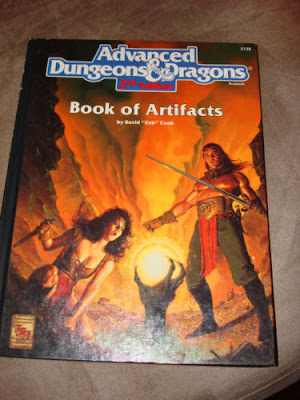
Ditto the Book of Artifacts, same seller, I must have been asleep for that part of 2nd edition AD&D's life cycle.
Thursday, January 19, 2012

GM Questionnaire

So, I decided to fill out Zak's Questionnaire, here are my answers.


1. If you had to pick a single invention in a game you were most proud of what would it be?


I am apparently a one trick pony, I can come up with good campaign settings. I can fill them with interesting NPCs and get some action started via plot hooks, after that it's all on the players. I don't really invent stuff like tricks, traps, spells or monsters.


2. When was the last time you GMed?


December 18, 2011, but that session and the one before it weren't all that great.


3. When was the last time you played?


Sometime in 2009? Right after Hackmaster Basic came out, my Daughter Ashli decided to debut as a gamemaster using that system, it went well for the first couple of sessions while she had pre-prepared material to work with, but once she had to start working with her own material and we started to do things that weren't covered in the book, things started to go bad; it ended shortly after that while we waited for the release of Frandor's Keep. I bought that for her when it came out, but we never went back to Hackmaster Basic, I think that the ultra-busyness of her senior year of high school and the bad memory of how it had ended before turned her off to the system. No, I forgot, it was last Spring when Lee's 1/2 Orc died, she DMed my campaign for a few sessions while I recharged my DM mojo.


4. Give us a one-sentence pitch for an adventure you haven't run but would like to.


B/X Pendragon, more of a campaign really though.


5. What do you do while you wait for players to do things?


Eat, drink, chat with the other players; eventually roll a random encounter.


6. What, if anything, do you eat while you play?


Usually Beef Summer Sausage, a variety of Cheeses, Ritz Crackers and Ranch Dressing or A couple of Different Types of Mustard make the standard "During the Game" snack tray, also Coffee (always), Hot Tea (Black, Green, or some types of Herbal- upon request), Hot Cocoa (upon request), usually some type of soda, always with a couple of diet options for soda. Sometimes the snack tray will include vegetables or other cold meats, this week's game will have Smoked Herring, for example. Since my game is every other week, I have the opportunity to stock up on snack foods when I find them on sale for a good price, so various Potato Chips and flavors of Doritos make their way here pretty frequently too. Since we always break for dinner, we almost always have some kind of food that is either easy and quick to make, or that we can throw in the oven or on the stove and not have to watch too closely, at recent game sessions we have had Beef Stew and Chili Con Carne; or alternately we order Pizza & Wings or Subs. Players are free to bring whatever other snacks they want to as well, as long as they bring enough to share, so this usually adds some Chips, Cookies and Soda to the mix too.


7. Do you find GMing physically exhausting?


No, but I'm not 16 anymore either. I can't play D&D for 16 hours straight and then take a 5 hour nap before another 16 hour session.


8. What was the last interesting (to you, anyway) thing you remember a PC you were running doing?


Planning a tactical assault on a well guarded and somewhat fortified urban mansion with a party of low level PCs? I played a 1st level Magic- User. Seriously, I don't get to play much.


9. Do your players take your serious setting and make it unserious? Vice versa? Neither?


Sometimes they do, sometimes I do. It's a game. Sure I may get a little ticked off when one of the players decides to not take the game as deadly serious as I am, at the moment, but aren't we all doing this to have fun and blow off a little of our real life stress and hang out with our friends, and, in my case, my family too? Sometimes this game just takes a turn for the absurd, and there is nothing you can do to turn it around. When it's one player, it CAN get contagious, when it's the DM it WILL get contagious. The less said about the gay Orc discotheque, the better or the naked no-thumbed Orcs. Why do these things keep happening to Orcs?


10. What do you do with goblins?


After what happened to the Orcs, do you really want to know? Seriously, they're mostly evil cannon fodder.


11. What was the last non-RPG thing you saw that you converted into game material (background, setting, trap, etc.)?


The floor plan of a Korean bath house.


12. What's the funniest table moment you can remember right now?


Funny things happen all the time at my game. We have a pretty fun loving group of players, but nothing springs to mind specifically.


13. What was the last game book you looked at--aside from things you referenced in a game--why were you looking at it?


Moldvay Basic Book, reading it cover to cover for a blog post.


14. Who's your idea of the perfect RPG illustrator?


Tough choice here, but I am going to go with Dave Trampier.


15. Does your game ever make your players genuinely afraid?


I would have to say no. Occasionally a little creeped out, but really scared, no; again, it's just a game.


16. What was the best time you ever had running an adventure you didn't write? (If ever)


Tough to say, I almost always heavily rewrite adventure modules anyway, because if I don't I am afraid I'll forget something important because I didn't write it, and the potential problem of players having read the adventure before hand. The only adventure I can run with a minimum of preparation AND be sure I am not forgetting anything is B2.


17. What would be the ideal physical set up to run a game in?


That would depend on the game now wouldn't it? An ideal set up for a WW II board game is going to be different than the ideal set up for a Star Trek RPG, but for the sake of argument I'll assume you meant ideal for D&D. Ideal for D&D would need to have some medieval ambiance in the room, a table large enough to seat 9 people at least, with room for books, snacks, an optional battle mat and minis. Good lighting. Access to a nearby rest room and kitchen facility, should probably be the DM's residence. Side table for the DM. Bookshelves are a plus, so reference books are in the same room. A good sound system would be nice too. Since we're going for ideal, I'd have a computer at the DM station too. The DM's chair would be more like a throne, so he sat higher up and in a nicer chair, projecting his more powerful status to the players. Actually with some redecoration, my old DM Marty's dining room where we used to play in his 2nd edition campaign comes pretty close, the only issues are that I am the usual DM now, his reference books were in an upstairs library room and it was a little on the small side.


18. If you had to think of the two most disparate games or game products that you like what would they be?


Star Fleet Battles and Munchkin, they have got to be sitting at opposite ends of the spectrum.


19. If you had to think of the most disparate influences overall on your game, what would they be?


Higher education, my 1st edition AD&D DMG, Conan the Barbarian, King Arthur.


20. As a GM, what kind of player do you want at your table?


People who follow the Wheaton Rule. Other than that be clean, no stereotypical gamers here; be on time and attentive to the game, it's respectful to the rest of the gamers here. It helps if we're already friends and would hang out with each other even if there wasn't a D&D game going on, because sometimes shit happens and we don't get to play D&D when we're supposed to and that can get awkward when there is a stranger that I only really know from D&D in my house.


21. What's a real life experience you've translated into game terms?


Armored Combat with Sword & Shield (and other weapons) both in singles tournaments and in mêlée.


22. Is there an RPG product that you wish existed but doesn't?


AD&D 2nd edition Oriental Adventures. I think it would have cleaned up a lot of the problems of the 1st edition version and probably would not have abandoned the Kara-Tur setting like 3e did.


23. Is there anyone you know who you talk about RPGs with who doesn't play? How do those conversations go?


I have in the past talked with people about RPGs that didn't play, but not with any regularity. Usually they either decide to give RPGs a shot themselves or we don't really talk about them after a while.


Monday, February 14, 2011

Wizards and armor.

Why can't Magic-Users wear armor? Because they can't that's why. I have read articles, most recently in the new issue of Footprints, that postulate that M-Us can't wear armor because of the restrictiveness of movement while in armor. This is often accompanied by the rationalization that you need to be trained to wear armor. D&D players ALWAYS get this wrong. I have been a heavy armored fighter in the SCA* for a long time and I can tell you that I have had clothing more restrictive than my armor. Armor is designed so that you can fight in it. It is not complex to get in and out of. I have never liked the idea that, say, Platemail makes you slow. It doesn't. It's not hard to move in. I have seen a guy do cartwheels wearing full plate. Plate is articulated to bend where the human body bends and it's weight is so well distributed across the body you barely feel it.

Learning to fight isn't easy, not being good at it anyway. Wearing armor is. I get the rationalization that M-Us can't use various weapons. I think they should suck more with the weapons they do get honestly, because learning to be good with a weapon takes time and time is what M-Us use to learn magic. I can understand the restrictions against shields. In a realistic game I wouldn't ban anyone from picking a shield up, but honestly, until you learn to use it, your shield is not your friend. Properly trained in the use of a shield it can become the keystone of your defense. I have not thought the shield was given it's due in any RPG I have ever played (or read, or heard about) but that's not the point here**.

Magic-Users should be weak fighters, they spend all their time in bookish pursuits. That they get any weapon skills at all is pretty unrealistic, it's like saying every M-U's hobby is a martial art, that's where they picked up the skill with the dagger (or staff or dart or whatever), they spent all their free time learning that. That's like saying every computer nerd has as his primary (or sole) hobby Kung-Fu. Simply unrealistic, but we allow it for the sake of the game. The armor restriction, whether it was placed for the sake of balance or just to differentiate the classes needs to be accepted for the same reason. Realistically, strapping on armor is simpler than learning the basics of fighting with a quarter staff, particularly since M-Us are pretty bright guys and they'd only need to be shown how to do it once, or if no one was around to show them they'd probably be able to figure it out on their own pretty quick. They are all geniuses after all.

Now somebody will be thinking that maybe it should just be because magic and iron can't be used together (actually that's a theme in Robin Hobb's Soldier Son trilogy, which I recently read), then it'll be rebutted with the fact that M-U's use iron daggers and iron tipped darts and, sometimes, iron shod staves. Then the argument will come forth that that's a small amount of iron and therefore no big deal to the magic. Then the proximity of the rest of the iron encased party members will be called into the debate, followed by the reasoning that they aren't actually touching the chainmail clad fighter while casting spells. This will be followed by someone suggesting that if this is the case then M-Us should be able to wear leather or bronze armor (and use shields), so it must be based on the freedom of movement necessary to cast spells being restricted by the armor, which isn't true. If anything I would think the voluminous robes and cloaks and large floppy hats would be restrictive to movement.

Accept that somebody, probably Gary Gygax, made it a rule for gamist reasons, not realistic ones. It probably had something to do with trying to enforce the wizard archetype, wanting the M-U to look and act more like Merlin or Gandalf than Lancelot or Conan. There are a lot of gamist decisions in D&D dating back to Chainmail; Gary was a history buff and a sword and sorcery genre fan, he got lots of little things wrong but we still revere his memory because he invented the hobby we love.

* I know, everyone hates an “expert”, they ruin the gamey goodness by bringing in their expert opinions on what-ever topic. I am worse then most that way as a D&D player when you get me going, because I am a trained medievalist, living historian and SCAdian.

** I could rant about shields for a long time. My favorite style of fighting is sword and shield and I believe that the shield, when properly employed, is probably the single most important part of your defense. Much more important than body armor; right up there with the helmet, which also gets no love from D&D. SCAdians get some wrong impressions about combat too, since our safety rules have made our shields invincible and ruled out certain less honorable, less chivalrous actions, but I stand by my love of shields and now have a new D&D house rule that takes their importance into effect. Hackmaster basic actually has the best shield rules going that I have read in an RPG, but I have a few issues with the gamism in combat there too.

Friday, January 7, 2011

Miniatures and D&D: My Thoughts

Ah, Grenadier's AD&D line, my first love. Like a lot of people my age, my first introduction to the use of minis with my D&D game came with Grenadier's official AD&D gold box line of miniature figures. My first box was the Dwarves set. I foolishly traded them away for some inferior unofficial minis so I could have a greater number of figures for my game. I immediately regretted that decision setting a pattern for my ownership of miniatures that continues to this day. I did manage to purchase a bunch of the other sets over the course of time though, coordinated with the other guys in my neighborhood D&D group so we could avoid too much overlap.

I had, ultimately, one large boxed set (5002 Monsters), and four small boxed sets (2001 Wizards, 2002 Halflings, 2004 Hirelings and 2007 Females). Tim M. (the regular DM) had one large boxed set (5009 Dragon's Lair) and six small boxed sets (2003 Dwarves [the reason I never replaced mine], 2005 Fighting Men, 2008 Thieves, 2010 Denizens of the Swamp, 2011 Orc's Lair and 2012 Dwellers Below), which I just fact checked at http://www.dndlead.com/Grenadier/Grenadier.htm .

We didn't have anyone else buying minis in our group (yet), and we preferred boxed sets to blisters since you got more bang for your buck, with a couple of caveats. I, for example, had terrible luck with the boxed sets between broken unfixable minis that clearly came from the mold messed up (Werewolf from the Monsters, Druid with dart from the Wizards), missing parts (again with the monsters, my poor wingless gargoyle, ) or just the wrong mini (Halflings box gave me the halfling thief from the thieves set instead of the slinger). It's like they had a 10% quota for messing with me. Only the Dwarves that I traded and the Hirelings came as they should have, I don't count the Females, they were a birthday gift.

Then there were the useless ones, the ones that were only good if you were planning to build a diorama. The Halflings gave us the lookouts, one standing on the other's head, the camp guard, lounging against a small tree and the lancer mounted on a pack-mule is of, at best, limited utility. The Thieves gave us the climbing thief, the thief opening the chest and the nearly useless thief with grappling hook. Just annoying. I loved them anyway though. I have a deep nostalgia for them. I would love to have them again, despite the fact that they are not up to modern standards as sculpts and they are small compared to today's pseudo-25mm scale minis (which are actually 28-32mm scale)

I sold all of mine off before the end of the 1980's because I wanted to get new minis that I could put better paint jobs on. I figured that I had like a decade of painting experience at that point and I could avoid all the old mistakes. When I first got them I had worked under the theory that I should just slap some paint on them and get them to the table. I mostly painted them with Testors model paints because that's what I had. After a few years of use they weren't looking good, so I sold them to my friends and used the proceeds to buy more minis (in theory anyway, I mostly used the money to buy beer, cigarettes and gas). My mini collection would recover eventually, but not with my beloved Grenadiers.

I have seen most of these miniatures recently, so I can attest to their primitive appearance when compared to newer minis. This leads us in to the story of Lance the lucky. Lance W., who was a member of my old neighborhood D&D group (actually 2 of them, after most of the old crew had graduated from high school and moved on he went out an recruited a new bunch to take their places, I was primary DM for the Dempster D&D group phase 2) went to Gencon about 10 years ago and spent most of his time at the auction (every time he has gone since he volunteers at the auction, he has gotten free admission more than once because of this), while he was there the auctioneers got a sealed suitcase for auction. It was late, they didn't open it up. The description of the contents was extremely vague. No one wanted to bid on it. Lance eventually bid five bucks for the suitcase. He won. The suitcase contained, among other things, a nearly complete set of Grenadiers AD&D miniature line still shrink-wrapped. Now you know why Lance loves the auction and why I call him, in this context anyway, Lance the lucky.

The funny thing is Lance had been buying old Grenadier lead all along. He had picked up the bulk of Tim's collection (although in real roundabout way, Darryl C. had bought them when Tim went through the same newer, better phase I did, Lance just managed to catch Darryl years later when he was in the mood to sell). I think he bought some of mine, and he had been hunting it at garage sales and flea markets since he got his first job. Lance even stayed with Grenadier into the 1990's as a loyal customer. Sadly Grenadier is no more. I wonder what happened to their old molds?

Scale Creep is the scourge of our time. It makes our old minis useless next to these huge minis produced today. Scale creep means that we have to either rely solely on old, no longer manufactured, increasingly expensive and difficult to find sculpts or replace our entire collections and start over. I blame Games Workshop and their Warhammer minis. I guess it's in their interest to try and get people to buy more, newer stuff all the time; and their bigger is better philosophy certainly seems to be popular, but I can't help but wonder- who gave control of the entire fantasy miniatures manufacturing industry to them? Historical miniature wargamers would never tolerate scale creep in their hobby. That's half of what the problem was with WotC's Axis and Allies miniatures line, the vehicle scales were inconsistent and not scaled to the soldiers. WotC had to re-issue all of the vehicle models redone to the proper scale to try and fix the problem and get the line taken seriously by what should have been the core audience they were marketed to.

D&D as a tactical miniatures skirmish game really irks me. Since 3e hit the market you haven't been able to play modern D&D with out minis. I really didn't care initially (when I started playing 3e, which was literally years after it's release) because I have played and enjoyed tactical miniature battles before. After a while it started to wear on me though, because all of the 3e rules are fiddly. I hate all of the conditional nonsense that I am likely to forget as DM. Attacks of opportunity were a good idea in theory, but in practice just make everyone move in a really super paranoid and weird fashion across the battlefield.

I didn't realize how much I had come to hate it until I eventually dumped D&D in favor of Hackmaster (4th edition, the D&D based one). The group I was DMing for played through a small, quick combat and it didn't occur to me to use minis for it or "battle-board" it up. It was like as a group we had some sort of catharsis. After that battle no one in the group wanted to use minis at all. We didn't and it was awesome. Don't get me wrong, we all had a long history of using minis with our D&D games, but I think they had become a symbol of the shackles of 3e and when we didn't need to use them we chose not to as a hallmark of our liberation from them. Kind of like how America drinks coffee instead of tea since the revolution.

Now minis have snuck back into my game, both because I loved them once so very much and because my kids were taught D&D using 3e (they insisted, they wanted the newest, best edition). I have bought a lot of WotC minis, both their D&D minis and their Star Wars minis. The D&D minis I bought for use with my FRPGs, the Star Wars minis partly because I love Star Wars and partly because I was hoping to entice John into my love of wargaming through a Star Wars gateway (unsuccessfully, I tried a similar tactic with Heroscape equally unsuccessfully).

I have previously mentioned D&D miniatures and their collectibility being a problem for me. It annoys me on the one hand to not know what I am getting, since I am old enough to remember buying minis that told you what was in a box, and I know that it is just a scheme by WotC to milk their customers of more of their hard earned money than a decent product should. What I have not mentioned before regarding WotC D&D minis is that they are moving farther and farther from being useful to an early edition player. New PC races are essentially useless to us, I mean we can use the dragon dudes for lizard men or draconians or something, but not what they are intended to be; the other elf looking people could be used for elves I guess, but they are not really producing suitable PC minis for some old school races (gnomes, cough, cough), not that 3e gnomes (or halfling for that matter) really looked right for old school games. They are also changing the appearance of a lot of older monsters. The Shambling mound comes to mind. It used to look like the swamp thing, now it looks like a poorly trimmed hedge.

Now, I am sure someone will point out that Otherworld miniatures has come to our rescue with awesome old school minis in a modern scale, and that's true. However they come at a premium price and they are made in England so the shipping adds to that. Now, I live in upstate NY, which is in the US, whose economy collapsed a couple of years ago. I also have 3 kids at home. I am a grown man and I can't really afford them, how are kids supposed to get them? Since I was a kid myself everyone I have ever played D&D with always wanted to have at least a miniature to represent their character. Many of those people were kids. Minis are too expensive for kids and they lack the instant gratification effect when you have to wait for them to be shipped. Plus they lack the appeal of pre-painted minis in that they are not ready to game with as soon as they arrive. Reaper is solving this problem a little bit with their new line of non-collectible pre-painted plastics, but they are typical reaper sculpts, not necessarily representing an early edition aesthetic.

Thursday, January 7, 2010

Hackmaster!

I love Hackmaster. I loved it's 4th edition and I love the new Hackmaster Basic. When I swore off 3e D&D I went straight to HM. I extolled it's virtues to every gamer I knew and I ran a game for a while. It ended mostly because I had some health issues and the group of players was starting to fragment- Steve always lived a good distance away, Matt and Heather were finishing grad school and moving out of state, John and Kevin both were hard to pin down for regular times to game, Melissa and John broke up and Tom was Kevin's high school aged son and dependent on him for a ride to the game.

When my daughter Ashli was old enough to become interested in gaming her and her friends wanted to play D&D, so that's where I went. Now, after several years of convincing, all of my kids game with my wife and me and we have gone retro. Getting my kids, my son John in particular, to see the benefit of non-video game style of play, with it's instant gratification power-ups was a challenge; but I finally did it.

Then HMB came out. We had been playing in a 1st Edition AD&D game when it was released, so we didn't get to play it right away. That game kind of guttered out amid the life-clutter of the new school year; Ashli is taking a pretty heavy course load and it took some time to adjust, John had football practice every day, only Em really had any time to spare. I managed to get a game started in November. Ashli is GMing! It's her first time trying and on a new system. She is doing a pretty great job. I really am liking the system, it has a really old school feel. However, Ashli only feels able to play every other week at most so I am picking up the extra time slot and running a 1st edition AD&D campaign.

Why AD&D? Because I can run it easily, off the cuff and my campaign world came from AD&D. I am sick and tired of converting stuff to match this game or that version. It was easy to run Hackmaster 4th edition there, it's just adding to AD&D; the new HMB is TSR-less, without D&D as it's base. Will I convert eventually? Maybe, hell probably even, but for right now, this next campaign, I am going old school with a vengeance.