Mongol Home

Mongol Home
Showing posts with label TSR. Show all posts

Thursday, April 2, 2015

Which version of D&D do I like better? How about you?


I have consistently second guessed myself while I run (A)D&D games for my group about which version (or retroclone) I like better for play. I range between the simplicity and adaptability of S&W Whitebox and the complexity and completeness of 1st edition AD&D (sometimes including “Unearthed Arcana”, but rarely anything later). Sometimes I decide a particular retroclone looks like it'll be good for what I want to play- I just started playing S&W Complete for instance, or I'd really like to play “Lamentations of the Flame Princess” (and so would a couple of my players) sometime soon.

I guess what it comes down to is that I like the adaptability of the early edition stuff based on OD&D and it's semi-gonzo SF additions to our standard fantasy fare. I like the simplicity and lower power level of OD&D, B/X and their clones. I have written a few rules sets now using S&W and B/X as a template. However, something in my head keeps dragging me back to 1st edition AD&D (or Labyrinth Lord+ Advanced Edition Companion- more on this later). I suppose it's because that's my old default. When I was just starting to play AD&D was just arriving on the scene and B/X wasn't quite here yet (I actually started with Holmes Basic).

Now, the power creep/edition (larger HD, more powerful magic items, more special abilities) is what pulls me away from AD&D towards OD&D or B/X. The absolute familiarity with (and perhaps even mastery of) the rules set is what drags me back. My D&D formative years ran from 1980-85ish, AD&D OA makes it under the wire, and UA slips a bit in sometimes, but my core system has always been PH, DMG and MM.

I guess the power creep is something I never noticed before the 3e era, probably because my default system was 1st edition and I never really looked at it objectively compared to the Holmes Basic and Cook/Marsh Expert sets. 2Nd edition was largely the same as 1st, only with a lot of inconsistent or unused (I am looking at you weapon vs. AC) rules being either tossed or overhauled. With this in mind, perhaps I should be playing either LL-AEC or straight 2nd edition AD&D, but I can't fully commit to either of those systems because I know 1st edition, with all it's warts & weirdnesses, it's Gygaxian purple-prose (a feature, not a bug- it immeasurably increased the vocabulary of pretty much everyone I knew), I have it practically memorized, even after all these years and anything I don't have memorized I can find in seconds in the book- no lengthy searches or game stoppage, and I know how to house rule it without breaking it in any way. Plus, I own multiple copies of all the books (including the premium reprints I got cheap on Ebay). I have given away complete core sets to my players that don't have them (another feature of Ebay- when I feel I am running low on extras for my table, I can usually find them really cheap there), and each of my kids has gotten a complete core set+ OA. My wife came with her own set.

But then I think about sub-classes, particularly Fighter sub-classes, which irritate me; why should a Fighter not be the best at fighting? Every other sub-class loses something, or at least fundamentally changes something, from the core class to make up for gaining their new abilities, not Rangers or Paladins though, so what's up with that? It's not that I hate the idea of Rangers and Paladins, and I get that it's harder to get the stats to be one of them and that they level slightly slower, but they still make better fighters than Fighters do, and that's what irks me. I don't take issue with creating a new subclass for the purposes of playing exactly the character class that you want to play even, I've made them in the past and I probably will again in the future. I am pretty sure that was the impetus behind the design of every AD&D sub-class. Think of them as customized class options for your role-playing needs.

Now, Labyrinth Lord +Advanced Edition Companion is a game that plays functionally identical to my experience with 1st edition AD&D, my only real problems with using it as a go-to system are that I already own multiple copies of AD&D and it's B/X based, which means that I need 2 rulebooks and have to ignore a bunch of stuff from the first.

I guess what was trying doing here was get all of these stray thoughts down where I can see them and mull over my options, what it has, apparently, done was talk myself into running 1st edition AD&D again, with the option of using retroclone ideas as house rule options. Thanks for reading, I am still open to suggestions and differing opinions, because I will, most likely, go back and forth on this for the next day or so before I run something for my oldest daughter Ashli and her boyfriend Rae who are coming to visit this weekend.

Now some other stuff that's been on my mind- if you were going to run a single adventure for three to five players and had access to pretty much every adventure published by TSR for Holmes Basic, B/X, BECMI and 1st edition AD&D what would you run? I am missing a few from the end of the era, but I have most of them. I was thinking something tournament style, that'll give the group focus and a sense of urgency, plus they won't have to worry about losing a beloved character because these types of modules usually have a bunch of pregens included. I was also thinking something a little higher level, because we never get there in campaign play and I think that they might enjoy playing characters at level 9+ for a change. Not The Tomb of Horrors though, that's a straight out meat-grinder and I've seen parties with all experienced players die in the entryway.

Also, I was thinking about other game systems recently, especially the ones like GURPS that pretty much mandate during character creation how you are going to role-play your character and that's one of those things I've never actually seen the need to have enshrined in rules. Some people think that alignment is unrealistic and too much of a straight-jacket to your role-playing, in my experience these are the same people that want to see at least part of your character creation include at least some options for deciding how you must role-play your character. GURPS has a bunch of these, off the top of my head I can recall codes and berserkerism and addiction as role-playing options that grant you some tangible character creation bonus with a few rules on how you must then play your character as a trade off. I am not a huge fan of point-buy systems in general anyway, I kind of like some randomness in character generation and I don't think all PCs should be created equal (but with the option for a master min-maxxer to really work the rules to make a Frankenstein's monster of a PC).

I am also not a big fan of skill systems, I never saw the point. The way I see it, if you want to do something, you ask your DM if it's possible and he figures out whether or not it's at all possible and then determines how it should work. I guess it helps if you have some sort of background, like the secondary skills in the DMG; although those work best for humans, those are some tables that could use a redesign based on a PC's race, the region they come from (or where the campaign starts) and maybe the general tech level. I guess they'd be best tailor made for every DM's campaign world. Not that I don't use skill systems where appropriate, just not a fan. This is likely because of 2nd edition AD&D's poorly thought out and ill-named Non-Weapon Proficiency system, which, while optional, was both over used and miss-used in my experience, all the while being extremely unnecessary. Yes, I realize that the 2nd edition system is a direct descendant of the 1st edition system which premiered in my beloved Oriental Adventures book, it's just that I am that contrary. Also, I hate that system and have eliminated it in my upcoming retroclone Samurai!, wherein I replace them with a set of backgrounds that grant you the ability to do certain things. But generally speaking, if you can give me a halfway decent reason why you should be able to do something, I usually let you. I base this on the fact that I can speak, read and write English, and to a lesser extent, French and Spanish. I can swim pretty well, do math (even some higher math) and all the other stuff I learned in public schools and just living in rural upstate NY. Usually, no matter how well I min-max a character, there is no way I can come close to what I could do even when I was a teen-ager, much less as an adult, and on top of all that, I am a pretty decent fighter, both armed and unarmed, and an ordained clergyman. That's right folks, I am dual-classed...

What about Henchmen, Hirelings, and other Retainers? I swore by them in the early days of playing D&D, not so much for the extra swords in the fight, but for handling the mundane stuff like carrying the light sources or acting as bearers for the loot we found, but we usually had a couple of “special” guys too, usually a Thief hired on to open locks and search for traps- oddly enough, even when we had Thieves in the party. You can't be too careful in the dungeon. Later, as the games started having more overland and wilderness type adventures, we started having people just for helping out with the horses (and staying with them while we went into dungeons) and some extra muscle to help out with guarding our camp. Now it seems like even the people I played with back in the day avoid them like the plague. I can understand (although not agree with) the notion that Henchmen are experience point and treasure leeches, but what about the ones that only get paid a pittance and don't get a ½ share of experience points? Plus it makes Charisma less of a dump stat if they are included in the game.


What's the deal with people not liking (A)D&D for more pure role-playing type game sessions? There's nothing stopping you from going all thespian with a D&D character, as a DM I actually will give an XP award or some other type of bonus as a reward for good role-playing, it's within my purview as DM. But some players insist that there is something inherent about D&D in particular that stunts role-playing. I don't get it. Sure D&D evolved from wargaming, and there was a certain wargame mentality to the role-playing by association. I don't hate that to be truthful, but I think that it is making less of the game than it can be. That said, there are some things that I can't stand to role-play like, say, buying equipment or any other mundane, somewhat boring task. Who wants to role-play mucking out stables or brushing down their horse? I don't, not as a player and not as DM; some stuff can be glossed over pretty easily and we don't lose anything by doing so. You probably want some real interaction the first time you meet the duke though, and maybe a bit when you are invited back for dinner. These role-playing vignettes are a great opportunity for mini-information dumps as a DM and I think that players and DMs alike should grasp the opportunity to try their hand at being more of a thespian. The exchange between DM and players there can lead to some really cool ideas for your campaign heading down the road.

Saturday, August 4, 2012

Only 10 RPG books and a few other things


I have been meaning to jump on the OSR bandwagon meme of picking out which 10 RPG books I would take with me to a desert isle, presumably with a group of fellow gamers, and I realized that if I am limited to hard copies of books I actually own, while I have an extensive collection, it's going to be mostly, if not all, TSR (A)D&D books; and thus, a pretty boring list. Essentially it's the books on my desk- 1st edition AD&D DMG, PH, MM, OA and module OA1 Swords of the Daimyo, Holmes Basic, Moldvay Basic, Cook/Marsh Expert and modules B2 Keep on the Borderlands and X1 Isle of Dread. Now, if I get to assume that the last 2 modules are part of the boxed sets they come with, I'll pick James Pacek's "The Wilderness Alphabet" and the D&D Cyclopedia. I'll also have an extra copy of B2, unless I am allowed to switch out and put my copy of B1 in the Holmes box. There's only one non-TSR product on the list, and it's an alternate; it is an excellent book and I picked it over every other OSR product because of my preference for DMing wilderness adventures. More people should buy it.

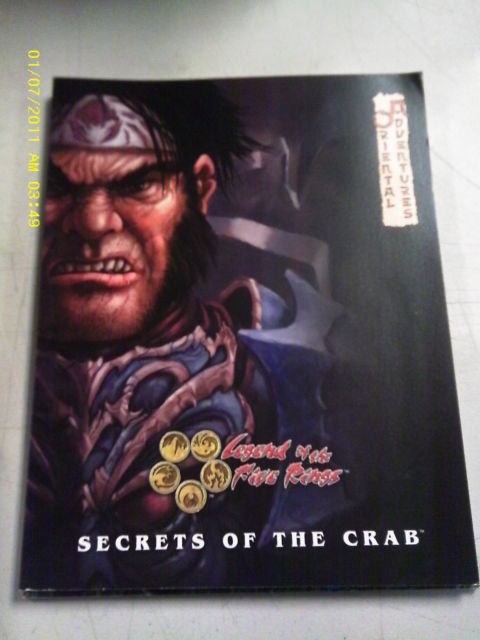
Next, I have been doing a lot of reading. Legend of the Five Rings 1st edition RPG stuff, because I am GMing a campaign of that now apparently. I didn't think this one would take off as more than a one-shot, but everyone seems pretty into it. Roman & Celtic history and historical fiction because I am GMing a 43 AD campaign too, and I like to be both well informed and able to steal ideas from real history and from good authors. This game is off to a good start, even if some of the rules range from a bit to extremely unclear. Anyway, I have got more long days and nights of reading ahead of me, I just got these books over the last couple of days-


The First Man in Rome is actually a replacement of a replacement copy, it's one of those books I keep lending out and not getting back.


I liked Pompeii, so I am giving this one a chance too.


Miranda Green is just a great scholar when it comes to the Celts. 

Obviously the Yurt book and the book on Khubilai Khan are not for the 2 currently running RPG campaigns, they are for my Yurt building project and my long standing love of Mongol history respectively; I just felt that I should add them for completeness' sake.

I have also been working on my Garnia campaign world, I have two different areas that I am detailing right now. One area, I am waiting on art for from my wife, I forget from time to time that I usually fall to the bottom of her priority list for art projects. I want to strike while the iron is hot for me, while I am inspired to write about a particular topic, she needs to wait for the inspiration to strike her to illustrate that same topic. When we are in sync, things are great, when we aren't it is an agonizing wait for me; because it's always me waiting on art, I can't ever remember a time when she was waiting for my writing. The other area I want her art for too, because I want to move away from using public domain art or just pictures I found on the net; I figure if I ever get around to publishing any of this stuff it should have it's own illustrations and she's a great illustrator. She just doesn't appear to prioritize my projects over her own, which annoys me.

So while I have been cooling my heels and NOT working on those projects and NOT reading for 24 hours a day, I have fallen off the wagon and indulged in a few games of Civilization. I say a few games because I haven't played in a couple of years now and I apparently am not the Civilization powerhouse I used to be, that's a humbling experience. I had to drop down two levels of difficulty while I get my Civilization bearings back again and I am still not doing great, just not getting trounced. I used to play the game all the time heavily modded, I tried that and couldn't remember what all the mods did, other than make the game harder. I had to switch back to vanilla Civilization IV + Warlords + Beyond the Sword. I used to create mods for this game, I made an awesome Scotland Civilization, now if I make it to the modern age I am likely to be a 3rd rate power.  

Thursday, July 12, 2012

It's a good thing my Mail Carrier has a car.


To be fair, growing up in the country mail carriers always did, but for the years I lived in the city they had a car, but walked the block delivering the mail anyway, and I am pretty sure I'd have been left off the route today. Here's why-


OK, Greyhawk Adventures is post Gygax TSR, but it is still 1st edition and I didn't have a copy. I have read it before, back in the day, my buddy Darryl's dad used to buy him all the new books for birthdays and Christmas and stuff. My parents got religion though and cut me off, so I had to buy my own stuff, TSR quality dropped after Oriental Adventures (some might say before), so I spent my allowance money on stuff I could use; like Dragon Magazine and miniatures and new games.


I actually already owned a copy of this 2nd edition AD&D Celts book, but it was given to my by a friend who had bought it used and the douche-bag he bought it from kept the map and cut the monster section out of the book. Now I have a pristine copy, and I'll be passing this copy on to my buddy Darryl, who might use it as a resource for the Warband 1/2 of our dual 43 AD/Warband campaign.


OK, I know I swore off Legend of the Five Rings RPG stuff because no one else wants to play, but I already have the 2nd module in this series.


And these 2 books were $4.99 each.


These 2 came wrapped in a glittery cotton or polyester protective coat. I got the 1st edition book for Dalton, since I already have 3 and he was interested in the game maybe for his own group.


And this is a board/card game, so I can play it with my friends and family; it's only tangentially related to the RPG I want them to play with me. Plus, at 59.99 on the website, it's probably the most expensive game I own, via the MSRP. I got it for less than 1/2 that with free shipping!


Tuesday, June 19, 2012

So when did FRPG Dwarves all become Scots?


Obviously, not all of them are, but enough that it is starting to really annoy me. I am not an anti-Dwarf racist or anything, but when I was looking for Scottish Highlander miniatures on EBay today I found these guys-


Apparently they are for a game called Dwarf Wars, and only one of the factions is Highlander Dwarves, but it got me to thinking. Dwarves aren't part of Scottish Highland folklore, not D&D type Dwarves anyway. D&D type Dwarves come straight from Norse and other Germanic sources via Tolkien's works, and I rather prefer them to stay more Nordic; or at least be the short bearded guy in the party that is otherwise indistinguishable from the rest of the party in dress and weapons, maybe preferring the axe, or the crossbow.

Now I understand there is a miniature battle game put out by Fantasy Flight Games, their stuff is usually top notch, right? This one, called Battlelore, is a fantasy version of the Hundred Years War, where you get to hire Dwarf and Goblin mercenaries, or so the box says, I haven't played it.

Their Scottish Wars Expansion pretty much makes the case that all the Scots are Dwarves.


So does the Dwarven Battalion Expansion.


I think I remember reading something in a TSR novel set in the Forgotten Realms back in the early 1990s with some Scottish Dwarves too, but I can't remember which one, if it ever really happened at all.

Then I remembered Games Workshop and their Warhammer Fantasy RPG and the ginger, Mohawk sporting Dwarves there, so I did an image search and found this-


A definite Scottish look to him. I might not mind this; although I have a buddy that's of Irish extraction an only 5'8" and he has to deal with Leprechaun jokes constantly from another friend of ours who is lucky she's a woman, because he's kind of a bad-ass; but I might not mind Scottish Highlanders being associated with Dwarves if I wasn't 6'6" tall. I know it's stupid of me to take this as a personal affront, but I kind of do anyway. Even my little brother is 6'3". My sister is 5'9".

Friday, May 25, 2012

Games That Define Us- Great Khan Edition


Obviously, since this is an OSR blog, I feel like I should open with D&D/AD&D. I saw the ads for the Holmes Basic Set in "Boy's Life", the Cub Scout magazine and I was hooked, it took me something like a year to find a store that sold that D&D boxed set, sometime in early 1980. My next D&D purchase was the AD&D Monster Manual, then the Cook/Marsh Expert Set, followed by a Christmas present of both the AD&D Players Handbook and Dungeon Masters Guide, this set the tone for some confused rulings over the years as a DM, since I was playing a hybrid of Holmes, the X half of B/X and AD&D, but over the years I started to fall more in line with AD&D orthodoxy, with a few exceptions. Then, in 1985, I pre-ordered Oriental Adventures and it has been almost an obsession ever since.


Chess- Chess had to make the cut here because it is one of the first thinking man's board games that I ever learned. I learned how to play when I was in second grade, just because it was one of the quite games on the shelf in my classroom we got to play during recess time when it was raining or the weather was otherwise too bad to go outside and play. I really didn't learn the game until high school though when I played regularly with my principal, who was a ranked player, and occasionally I'd even win. My real claim to fame though is that I once played chess against a guy who had played against Bobby Fischer, I met him through my buddy Darryl's dad. Totally got my ass handed to me, it was worth the experience.


Risk- Ah, Risk, the game of world conquest. You taught me that the Ukraine was gigantic and the names of other exotic places. You were wrong about the Ukraine, but I guess a game produced during the cold war wasn't going to give Russia it's due, right? This game taught me two things, basic strategy and the importance of luck. Play with good strategy, take a few chances, and hope your luck holds; I was Risk champion of my dorm. On the other hand I have been beaten by people that had NEVER played the game before, so there you have it.


Axis & Allies (The Game Master edition from the 1980s)- Axis & Allies wasn't the first in this series that I played, that honor goes to Conquest of the Empire; which we also played quite a bit; but Axis & Allies we played more and better. Axis & Allies was the better game right out of the box, even it's recommended optional rules made sense. By the time Axis & Allies hit the scene, I was already a veteran wargamer, but this managed to take a lot of wargame elements and make them accessible to the masses, like a gateway wargame.


Dawn Patrol- This should come as no surprise, since I am currently engaged in a new Dawn Patrol campaign, but it was my first and is still my favorite aerial combat game. I bought it because TSR put it out, and I was a young TSR fanboy at the time, it's taken me this long to get good at it.


Star Fleet Battles- I never really understood why this game got a bad reputation as highly complex to the point where you needed a PhD in Mathematics to play it. I am not a math guy, and I have played a lot of SFB, if filling out the energy allocation sheet is too hard for you I advise going back to remedial 4th grade math. I bought the Commanders edition boxed set the year I turned 14, since my birthday is in July I don't remember if it was before or after I turned 14. I taught myself and my friends how to play, we made a few mistakes along the way in learning, but we had it down after a few games; it says right on the box "1,2 or more players Ages 12 and older". Sure it got a little more complex with each additional boxed set (or module, which I never bought), but it was building on knowledge that you had already mastered.


Up Front- The Squad Leader card game, picking on Avalon Hill title to add to the list was really hard to do, then I remembered the one we always played when we had extra time on our hands, it's quick to set up and play, even when you build you own squads with the point buy system, and it is one of the only games that I have that'll bring Lance and Darryl into the same room, although maybe not anymore, we used to have tournaments. Up Front is one of the few games I don't mind losing just because I had bad luck. Theoretically Multi-Man Publishing has the rights to it now, as part of the Squad Leader line, and they were considering making it a CCG, which would make me want them all to suffer horrible curses, but I would like to see a new edition. I have Up Front and it's official expansions Banzai and Desert War, but the cards have seen a lot of wear over the years.


Koei's Genghis Khan- Yeah, I know, it's a little odd to add a NES game to the list, and this title is really representational of all the Koei titles that were turn based war/administrative games from Nobunaga's Ambition through L'Empereur and including Romance of the Three Kingdoms; but my alter-ego here being the Great Khan, obviously I was going to pick Genghis Khan. I actually still own a NES and a copy of that game, I never play it, the battery inside it is shot so it doesn't save and I can't see leaving it on for the days that would take to complete the game. Darryl and I used to play the hell out of this game together too, in multi-player mode, usually one of us would pick England and the other Japan, since the four playable countries were Mongolia, Byzantium, England and Japan, we wanted as much space as possible between us before we had to start fighting each other.


Talisman- The 2nd edition before it got completely crapped up by the people at Games Workshop and used as yet another way to promote their Warhammer franchise, although this was sneaking into this edition too. This was a go-to game for us if we wanted to play something fantasy, fun and easy to teach/learn. I had, I am pretty sure, every expansion for this game that was released in the US except Timescape, we drew the line there. I always wanted to play in a D&D campaign set in this world, minus the out of place and silly characters. The board evoked a place that was both real and medieval, yet mythic at the same time. The only real drawback to this game was that it could get tedious after having died several times and starting over. I have played the new Fantasy Flight Games version, and while it is much, much nicer than the last Games Workshop edition, the 2nd edition still holds my loyalty, the FFG version is like a more polished, prettier version of my old 2nd edition, but it loses something in the transformation.


Warrior Knights- Have you ever razed a city to win a game? My old gaming group got in touch with the designer to ask him a few questions about the rules and our interpretations and we discovered we were doing the entire political phase wrong, apparently we were supposed to spend all of our votes on a single action. We didn't. We played a much more corrupt and Machiavellian version of the game than had been considered by the designer. We bought and sold votes, forged alliances to screw over whoever was in the lead, and fought over who would hold the wool concession. Games Workshop did a great job with this one, I hear that Fantasy Flight Games has put out a new edition, but, in the words of Lance, who has played it "It sucks. They screwed the pooch on this one". He tried it several times, just to try and get accustomed to the rules changes and that was his ultimate opinion; then he taught his Tuesday Night Gaming Group how we played the old GW version and they had a blast with it.

This was fun, maybe I'll do a part 2 that includes the games I cut from this list.

Tuesday, January 24, 2012

Moldvay Basic Observations Part 1-

When I started reading through the 1981 Moldvay Basic rules I really didn't expect that I would find anything new or exciting to me, especially considering how many times I have looked things up in that book just for the sake of comparing it to something in AD&D, OD&D or Holmes. I assumed what I was going to find was a rules-lite version of AD&D, the "Kiddie-D&D" I had always been biased against since I was a kid myself. I am delighted to say I could not have been more wrong. I have stated on a number of occasions that I started out with Holmes Basic, and it is, more or less, just a re-edit of OD&D, less confusing than OD&D, but not by much and with a few funky house rules Holmes threw in there of his own, that's cool. AD&D was just OD&D all house ruled to hell for E. Gary Gygax's Greyhawk campaign and then declared official TSR, tournament style, never house rule this D&D again, D&D anyway*, right? That and a way to separate it from Dave Arneson's contribution to the hobby in a legal, financial way; or so I have heard.

Anyway, on to my observations about the red book. Right from the get go I could see that this was a different beast than Holmes, it was not simply a restatement of OD&D rules, but an evolution of them; sure they were clearly descended from their immediate ancestor, but they were a new creature, sleeker and more graceful than the one that had come before. I am currently so enamored of Moldvay's rules set that I am seeking out a Mentzer Basic set too, just so I can check it out and make that comparison too.

I was specifically asked by a blog reader to break this analysis of Moldvay down into easily digestible parts, so I will try to not cover too much in this post. I will also attempt to NOT simply compare Moldvay too much to it's immediate predecessor, Holmes Basic, or to 1st edition AD&D, which I am much more familiar with, but I can't promise anything simply because sometimes the only, or at least the easiest way to illustrate is through comparison. I should also mention that this blog post has been a beast to write, I have written and rewritten several sections, switched parts around and, in general, done more work on this post than any other blog post I have ever written; usually I just put out my thoughts as they come to me, do a quick fact check if necessary, look for obvious spelling or grammar errors and send the post on out. This one seemed like more of a special occasion post. I took notes for this one.

On to character generation then. It's totally old school; 3d6 in order (Str, Int, Wis, Dex, Con, Cha) with a slight ability to modify based on what class you choose, you can drop an ability score by 2 points to raise your prime requisite by 1, but you can't drop anything below a 9 and Dexterity, Constitution and Charisma may not be lowered at all, but depending on class Dexterity may be raised. Ability scores are way less fiddly than in AD&D, there is almost a universal stat modifier like in 3e. Except for Humans race equals class, another old school concept that's been gone since the AD&D 1st edition days from my world view, but there it is. I think that may be the biggest hurdle for more modern gamers to accept, and this includes 1st edition AD&D players**.

The classes available are Fighter, Cleric, Magic-User, Thief, Dwarf, Elf & Halfling; a short and simple list. It's the same list, with a slight change in terminology, as the one in Holmes Basic, but way shorter than the list in AD&D. It also doesn't lead us to believe that this is the gateway to AD&D, this version of the Basic book comes right out and tells us that there is an Expert book coming (Spoiler Alert: I looked in the Expert book and it said there was a Companion book coming too), it doesn't ever imply that we should be moving on to AD&D.

So, you rolled your Abilities picked your class, modified if you wanted to or it was possible, now you roll your Hit Points. The bad news here is that if you are used to AD&D your Hit Die shrunk. A Fighter or a Dwarf get a D8, a Cleric, an Elf or a Halfling get a D6 and the Magic-User and Thief get the D4. I kind of felt bad for my players so I let them roll against me for starting Hit Points, that is to say, we both rolled the appropriate die and kept the higher result. Hit Points are still modified by Constitution and there isn't any of AD&D's preferential treatment given to Fighters, so you could possibly have a 7 HP 1st level Magic-User or Thief.

Next we pick Alignment, there are only three to choose from which is actually a step backwards from Holmes Basic, which had five, but really the whole nine Alignment spectrum was there, just not filled in and defined; anyway, Lawful, which is more or less "Good" or allied to civilization, Chaotic is the opposite of Lawful, generally considered Evil, uncivilized, and selfish. Neutral falls in between the other two, either as unintelligent, and therefore unaligned in anyway, or actively preserving some balance between Law and Chaos, or just kind of libertarian and trying to survive.

Anyway, the thing that struck me right away about the classes was that they were both weaker and slightly stronger than their AD&D counterparts; what I mean by this is that AD&D kind of institutionalized the first iteration that all Player Characters were Heroes, not just average Joe's trying to better their existence through adventuring, AD&D gives you a whole bunch of different character creation methods, but the most common/popular one is probably 4d6 rearrange to taste; that's your first character build right there. AD&D is the first D&D where every player can sit down before the game and discuss what character they are going to play before character generation, that doesn't happen in Moldvay, in Moldvay, as in Holmes and in OD&D, you play the character you roll, it's actually kind of liberating. I had forgotten how much I liked that, much in the same way that I had forgotten how much I liked playing without miniatures when I quit playing 3e.

Now, that, and the fact that they get a smaller Hit Die type than AD&D, shows how they are weaker, so how are they stronger? First, they get an average higher amount of starting money than their AD&D counterparts because every character gets 3d6x10 starting gold; everyone except for Fighters makes out better, and the lower cost of better Armor even helps them out with better AC. They were going to get an AC boost anyway because there are only 9 ACs instead of 10. The thing I think makes Player Characters clearly tougher than their AD&D brethren though is the Morale rules in combat, two Morale checks in every combat encounter means that every encounter is not necessarily a slaughter, especially against the weaker low Hit Die Monsters like Goblins. Sure, when I played this past weekend the four Goblins the party encountered fought to the death, and killed the party's Magic-User in the process, but it was just bad luck there.

Every class has some clearly listed restrictions and special abilities; I could quibble with some of the restrictions, particularly considering the fact that variable weapon damage is an optional rule, but I won't for now. One thing I noticed today, after I'd already read through this section several times, was that Halflings DO NOT have infravision in B/X D&D, I went back and looked it up in Holmes and saw no mention of it there either, so EGG apparently decided in the AD&D PH that all Halflings got infravision, in the AD&D MM only Stouts have it and there is no mention in any book that I have before then; I mention this as a case in point of how hard this project has been, to read through rules text that greatly resembles rules text that you are very familiar with looking for the differences.

Of all the classes and racial classes, the one that I think gets hosed is the Thief. They get the d4 for a Hit Die type, no Dexterity adjustments for their Thief skills and their Thief skills are generally worse than they are for a first level Thief in AD&D. In a statistical anomaly, they are actually worse at finding traps than any other characters, despite it actually being one of their class specialties; a first level B/X Thief can find a trap 10% of the time, any character searching for a trap has a 1 in 6 chance or roughly 16.6% of the time, a Dwarf under the right circumstances doubles that to 2 in 6 or 33.3% of the time. Similarly, Halflings can hide in shadows better, 2 in 6 or 33.3% anywhere, 90% outdoors vs. the Thief's 10% chance at 1st level.

Having rolled our Abilities and chosen a Class then, possibly, adjusted them, picked an Alignment, and rolled for starting money, we move on to buying equipment. Fewer choices, quicker to play. There are literally 40 items on the entire list, I could type the entire thing here, with the prices in about a minute. 3 types of armor, Leather, Chain and Plate. 3 types of sword, Short Sword, Sword (normal) and Two-Handed Sword, I might have named them differently, but I am cool with the choices. Variable weapon damage is an optional rule, although I'd recommend it's use. Crossbows are far less screwed than in AD&D, they only get to fire every other round, but at least it makes more sense given the shorter rounds (10 seconds vs AD&D's 1 minute) and they aren't penalized on damage like in AD&D; that was one of the things that always bugged me about AD&D crossbows are vicious, deadly killers in the real medieval period in AD&D they are just a poor choice of ranged weapon.

Right after the equipment page is a page with Languages, Inheritance, "Hopeless Characters" and the run through of Character Generation. Languages are just a list of suggested languages for all of those characters that rolled a high enough Intelligence score to know any additional languages (13+). There are 20 of them listed so it could be easy to make it a random pick if you were indecisive or didn't care. Inheritance is a rule for inheriting the possessions of your previous character. The only place I have seen a similar rule before was in Hackmaster. This rule curiously applies to the player and is once only per player, so, presumably most older gamers that have played B/X are screwed, they probably used this rule back when they were 12 years old so they could keep their cool items from the Monty-Haul days. There is a 10% inheritance tax applied though. "Hopeless Characters" are a little more loosely defined in Moldvay than they are in AD&D or later editions, a Hopeless Character here is "below average in every ability" or has "more than one very low (3-6) ability score" in which case the DM may declare the character hopeless and allow the player to roll up a new one. The run through of Character Generation is cool for a couple of reasons. First, it is concise and easy to follow. Second, it assumes a girl will be playing D&D; I have rarely been part of a D&D group that didn't have some female players, and most of my players are women these days. I guess I missed the part where D&D was supposed to be girl repellant.

There are a few pages of spells listed after character creation and equipment, I suppose now would be a good time to mention the two things about spell casters that are different than AD&D. First, Clerics don't get a spell at first level, I thought this would be a huge weakness in play for the party but it really wasn't. Second, Magic-Users and Elves get to choose their spell, one first level spell, for their spell book, that's it. AD&D Magic-Users get them assigned semi-randomly, but they get four starting spells, Read Magic, an Offensive, a Defensive and a Miscellaneous spell for their spell books. At second level, the Magic-User or Elf will get a second first level spell, at third level they will receive a second level spell. Now I shall end for today, but I want to talk about the actual spells some next time.


*Not that anyone ever played it that way, but that was the intention, to get everyone playing by the same "official" set of rules for the purposes of tournaments. That's what old Dragon Magazine articles said anyway. I might not be imagining things if I thought there was a more mercenary motive in pushing the AD&D product line over the D&D product line, but then again I might be too.

**I am aware that, technically speaking, 1st edition AD&D predates Moldvay Basic; the Basic D&D line represents an older lineage of D&D gaming, AD&D was the more "modern" descendant.

Oh, and it was D&D bargain week on EBay-


A much better copy of the Cook Expert Book, my other one the cover fell off of.


The Mentzer Expert Book, I never had this one, so I am looking forward to reading through it too.


AC2- Combat Shield & Mini-Adventure, the 1984 publication date indicates it's a Mentzer era D&D product, is it compatible with B/X? I'll have to check the charts and see. When I bought it I was hoping so.


Grenadier's Dragon Lords Monster Manuscript, this one is pretty much just an AD&D monster manual for Grenadier's Monster Manuscript line of miniatures released in 1986-7; still more monsters with unique stats is always a good thing, eh?


Dwarf with a Torch, not too much to say there, I just usually throw down a minimum bid on any miniature I find that's carrying a torch or lantern or backpack or chest. Hireling types are hard to find.


Four Knights with a bonus Thief and Warrior, I really didn't expect to win these guys on the minimum bid either, but I did, I already had at least two of that Grenadier Thief. The Knights are nice, but kind of scrawny even for old 25mm scale, and the Warrior I'll need to strip and repaint, anyone recognize the company?


The High Level Campaign Book I grabbed because it was cheap and I never even saw it before, much less read it.


Ditto the Book of Artifacts, same seller, I must have been asleep for that part of 2nd edition AD&D's life cycle.