This is a blog about "Old School" RPGs and the OSR movement in gaming. I also write about other stuff, like miniatures for wargames and RPGs, wargaming, my family, etc.
Mongol Home
Thursday, June 14, 2012
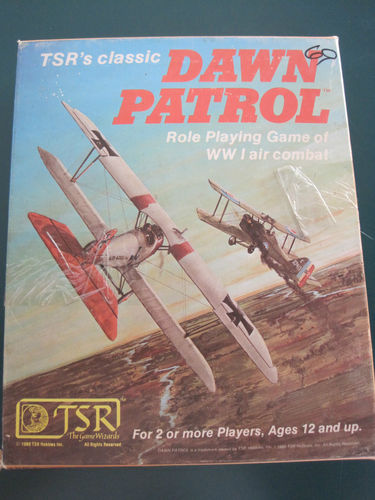
Dawn Patrol and Old School Battlestar Galactica
Wednesday, June 13, 2012
Of Yurts, and Books

Sunday, April 29, 2012
April 29th is a break day in the A-Z Challenge
Monday, December 19, 2011
OA Session Report 18 DEC 2011
Two noteworthy things to mention here. First, it's hard to pretty much start over in the same adventure with an (almost) entirely new party. Second, it's hard to tone down what had been a pretty PG-13* rated adventure, where the youngest player was my fourteen year old daughter, so I got to make the judgment calls, to a G rated adventure for the inclusion of a six year old and an eight year old. Remember the eerie horror elements I have been slowly adding and alluding to? I don't think that's going to work with a first grader and a third grader in the room. Ultimately the Temple of Elemental Evil focuses on a fight against Demons and their worshipers, having small children in the party will throw me off my proposed game.
Anyway, I am now in a position of having to either completely alter my game so I can accommodate Lee and her kids, and I am not sure if not accommodating her is a deal breaker or not as to whether or not she'll be able to make it at all; or telling her to not bring the kids again and maybe losing one of my players, and we all really like Lee. So that sucks.
Other than that we mostly just explored a little more of the top level of the Moathouse, I really wish my OA conversion notes hadn't disappeared, I just worked from my memory on that, but I am sure it would have been better with my actual Japanification of the Moathouse. They pretty much cleared the north side.
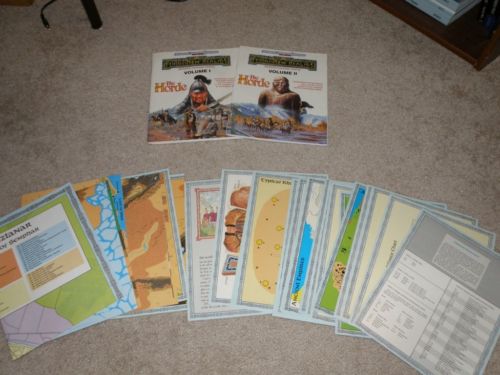
Here's what came in the mail today.
I bought this right after Lee Ann rolled up a Steppe Barbarian character, because I forgot that not everyone is a setting nazi like me and wants to know everything about the imaginary culture from which their D&D character has come. This is billed as an AD&D 2nd edition product, it was published in 1990, but it makes heavy use of 1st edition Oriental Adventures materials. I remember buying the Hordelands trilogy of novels when they came out, I was interested in the Mongols and how they would fit into a fantasy world then and I still am. My online persona as Jagatai, Khakhan of the Steppe Warriors comes directly from the continuity of the Forgotten Realms and AOL's Neverwinter Nights- we used the idea that Yamun Khahan's defeat by Azoun's crusade at the Battle of the Golden Way** was our origin story as a guild***. I probably should have owned this product before now, I had read it before and was unimpressed at the time, probably because I was expecting something meatier, like say, the Oriental Adventures book (also written by David "Zeb" Cook), but as a campaign boxed set goes it really isn't bad. Some better ideas on how to run a campaign set in the area would have been nice, or any at all really, and it makes the assumption that you really aren't going to play a character from the "Endless Waste", you're probably going to be a "regular" AD&D character passing through, which is too bad. It comes with a lot of cool bits, some pretty lame stuff thrown in to make it a whole boxed set, and a few ideas that a clever, enterprising DM might be able to mine out of there for running an actual campaign in this campaign setting, but really it's just an add-on for the Forgotten Realms, and it arbitrarily changes the scale of all of the Kara-Tur maps by 1/3 "to improve play" which kind of irritates me. It does make me kind of want to get Al-Qadim though and see how they did that, to see if they got around to doing exotic settings right, plus, as I understand it, doesn't Al-Qadim fit in there too somewhere?
*Hollywood would probably give me an R for violence, and maybe I deserve it for some of the creepy/disturbing stuff I throw in, but I try to keep my descriptions and plotlines from getting too graphic. I played in a Living Greyhawk game once where small humanoids were kidnapping human children to be sex slaves, that's pretty messed up; I wouldn't go there. It did make sure we killed every last one of them though.
**Yamun was robbed by Azoun's plot immunity. His failure to conquer Shou Lung and all of Faerun is total BS from any military standpoint, seriously, play it out using Battlesystem or Warmachine rules or pick a wargame. Yamun's forces should have won that battle, fighting it out using the tactics described in the Horde Campaign (FR 12) requires that Yamun and all of his generals receive frontal lobotomies prior to engaging the crusaders; they have literally never acted in a like manner in any previous battle in the book. Nor did they behave in such a manner in any book of the Hordelands trilogy, until it was required to keep the Realms at status quo ante bellum.
***I am the second Khakhan since Yamun, Ogotai (AKA Darryl C.) having been before me, reigning from our inception as a guild until 1997.
Friday, December 2, 2011
Garnia Reboot.

Rebooting movie franchises and beloved television franchises seems to be all the rage these days, from J.J. Abrams' "Star Trek" to Ron Moore's "Battlestar Galactica", that caused waves of nerd rage and/or nerdgasms, to a bunch of stuff like the "Dukes of Hazzard" or "Miami Vice" that most of us nerds could not care less about. Hollywood has been doing it for decades now and I figure maybe it's time I give my old workhorse world of Garnia a reboot to see how a fresh perspective and some new ideas in design might make my Celtic fantasy world work a little better now that I am older and less of a slave to the AD&D rule books.
Back when I was a kid; I mean literally a child, Garnia started as a project when I was in 7th grade, so I would have been twelve years old; I felt like I needed to jam into it everything "officially" available to me. Thankfully, at the time, the only published AD&D books were the MM, PH & DMG, although I did go on to make extensive use of other AD&D books as they were published, I felt less pressure to always find room for,say, the Nilbog or the Flumph. I will now apologize to my British readers for slighting their countrymen's contributions to the AD&D monster canon.
What got me thinking about this, aside from my work on putting together the campaign pages for my OA game "Against the Black Temple" on Obsidian Portal and seeing my still unfinished "Garnia" campaign pages, was the fact that I have been talking to Darryl again lately, and sure as winter is coming, we will eventually talk about Garnia. Why? Because, while Garnia may have been my brain child, he and I have been collaborating on it for so long now that it is at least partially his. He drew the original maps. He spent countless hours of his youth writing histories for the world. None of it is in use anymore, but he still was always right there in the planning stages. I know for a fact he's run entire campaigns there without any of my input at all when we lived thousands of miles apart.
We even have our favorite nations in the world, I favor Garnia, it was originally named after an old D&D character of mine "Garn the Great", I later retconned that to be an altered form of Gwarynica Riga- in the pseudo-Celtic language I kind of created using bits of Gaulish and Welsh and Gaelic and Breton it means pretty much "Kingdom of the people of Gwaryn", which was later shortened to simply "Garnia"; allowing me to keep the same name I'd always used for the campaign and the kingdom, but giving it a more historico-linguistic rationalization. Historically, in the campaign world, they are founded when the Humans sweep in off the northern steppes and destroy the (already besieged) ancient Elven empire in a decades long war of extermination. I picture their material culture starting off like the ancient Celts and building pretty much like western Europe over time, only with the Celtic artistic flavor throughout. Their kingdom has been conquered several times by their steppe dwelling cousins over the centuries, which generally results in nothing more than a change of dynasty as the new lords settle in to the comforts of civilization. I modeled their history on that of China.
Darryl favors Frodia. Frodia was a nation of sorcerers that I always likened to Howard's Stygia with it's Sorcerous Priests and I wanted to have a nation that would be a clear foil to the noble warriors of Garnia when I set up the world initially, as a kid. Plus, Magocracy was a government type in the DMG and it sounded cool. According to the earliest histories that I wrote (and still have!), Frodia is a child kingdom of Garnia dating to the earliest times after the Humans conquered the old Elven kingdom. A cult sprung up worshiping Frodal*, a name that is going to have to go in any reboot, who was a god of magic; and they were outlawed and driven from the kingdom of Garnia into the wilderness; or, alternately, these priest-kings discovered secrets of ancient elven magic and rebelled against the weak central authority of the Garnian high-king, taking the south-western third of the kingdom with them, which is actually more likely. Frodia also is more urban, the major elven cities having been less destroyed by the decades long conquest by the time it reached there. They have a major river as a natural defensive border between them, think of it like the Rhine.
That actually is where he and I had one of our greatest creative differences. He saw Frodia as this Magic-User ruled utopia with magic taking the place of technology, kind of a magi-tech, almost steam punk before that was a thing, thing going on there. He also saw them as clearly the greatest superpower in the world. I was going for a more "pulp-fantasy" Conan the Barbarian, so when magic does happen it will be awesome kind of a vibe, even back then, and I still kind of do that now. I like magic to be either of the rare and wonderful or scary and possibly sanity destroying varieties. Perhaps D&D/AD&D wasn't the best vehicle to convey my vision of a "perfect" RPG world, but it's what I had, and what I have.
Anyway, enough about two countries in a fantasy world most of you don't care about, although, if I ever do actually publish anything through the Hydra collective, my Garnia campaign will probably be it. My wife Mona and my daughter Ashli were sitting in the living room sick the other day, so I had a captive audience, which they hate, and I said to them "I think for my next (D&D) game I am going to get rid of all the half breeds, they really don't make much sense when you think about it. No Half-Orcs, Half-Elves, Half-Ogres, or Halflings!", I threw that last one in there just to see if they were paying attention, and if they weren't before, that sure got it. You'd think I'd kicked a hornet's nest from the reaction it got, are Halflings really such sacred cows in the D&D/RPG universe? My adult take on them is that EGG either added them to OD&D because he snagged everything he could for content from every source he could find, fantasy, science fiction, mythology, even the Bible(!); or, more cynically, he deliberately contrived to add Hobbits to OD&D to broaden it's appeal because Tolkien's work was so popular in the US at the time; either way, I don't think the loss of one PC race is going to ruin the game world and I have always had trouble rationalizing a reason for their existence in my Garnia campaign world. Plus, I didn't see anyone coming to the defense of the poor bloody Gnomes when they got the axe back in the 90's. I know they are technically not half breeds, like the other races I am considering taking out, but is it really so bad to be limited to playing Humans, Elves & Dwarves?
Elves and Dwarves are getting a racial make-over too, partially due to an offhand comment by my wife, who said "Why let people play Elves at all?", in regard to the setting being the ruins of an ancient Elven empire; that gave me a kick-ass idea, all player character Elves are what I am calling "Fallen Elves" the degenerate survivors of their long ago fallen race, no longer immortal, merely long-lived; they have lost the culture, technological secrets and magic of their forebears. They are the ones that fled to the wilderness, turned coat or submitted to slavery, the descendants of the few survivors of a near total genocide of their species. This allows for the seriously strong mystical, hidden Elven island kingdom to still exist and have really powerful Elves that aren't like the PCs, that shun the PC Elves as a lesser version of themselves.
Dwarven PCs get a similar treatment, but to a much lesser extent, all Dwarven PCs start as "Broken Dwarves", Dwarves from clans or kingdoms that have lost their territory to humanoid encroachment and moved into Human lands as refugees. The Garnian high-kings have always had a history of keeping a Dwarven warband, as do some other ranking nobles. Dwarves are essentially mountain dwelling craftsmen, traders and warriors; to my mind that makes them pretty much like short Vikings culturally, and in AD&D they can't be anything but Fighters and Thieves (or Assassins, but that's another story). So, my point here is, essentially, that if you play a Dwarf in my Garnia campaign, then your character is pretty much a refugee. Maybe a refugee of generations long status, but a refugee all the same.
Humans are supposed to be the backbone of any party in AD&D, and the culture of my campaign is set up for it to be a very humanocentric world, the reboot is going to make it even moreso, only more like ancient/medieval Europe too, where the territory between settled areas is dangerous howling wilderness and ancient evils lurk waiting to trap and devour the unwary. The cool thing about a reboot is I don't have to toss out thirty years of development entirely and start again from scratch, that's probably why Hollywood likes them, I can take the good bits and tweak them better, I can keep the best bits the same and I can toss the crap bits entirely.
The hard part is deciding what constitutes crap. Over the last 30 years Garnia has accreted to it pretty much every smaller, lesser campaign idea I have ever had and some of them I still love. Old fantasy Roman empire campaign where the Romans conquered an Egypt that was run by Goblins? It's on the other side of the huge and largely impassable mountain chain where the Dwarven kingdoms are, on the old Roman campaign map, they were called "Regni Homoi Cortii" or something like that, I don't actually speak Latin, so I had to look it up at the time, I really just read Latin, and then only some. Damned American educational system. But it was like I'd planned for those two maps to fit together all along.
How about those independent "Mistlander" Clans? Essentially Scottish Highlanders living in a mountainous area north east of the kingdom of Garnia, the area is always foggy and the sulfurous fog eats ferrous metals over the course of days. Between the mists and the hostile terrain, no one has ever been able to conquer them. Do we like the idea of a Chinese empire on the same map as a Celtic one? How about the Japanese islands (Tenchuko, I forget what it means) just off map? Most of the lands are Celtic, the first non-Celts were the Wotanic Knights, who were actually one of the few (relatively) unchanged names from the original Garnia map, back in the day when all of the names were vaguely Germanic, rather than Celtic. Now the county's called Wodanslund, and the people bear a striking resemblance to the Rohirrim that I never noticed until I actually set a campaign there a couple of years ago. I have an origin myth for them even. What about the Viking island kingdoms? The Byzantines? The Aztecs? The Mongols (actually a mixed Turko-Mongolian horde) that I placed in an unused spot on the map and used as a tribute to the Steppe Warriors? The Necromancer's lands are Arabic in name and culture, just south of the civil war torn Celtic kingdom of Tir nan Kaur, and the Necromancer once, almost, conquered the entire world. I have an Orc kingdom on land torn from Garnia itself, should I keep it or kill it? Do I have too many races and cultures?
The key thing to remember is that the world where Garnia is was the Elven home world and is at the heart of a multi-planar war between the forces of good and the forces of evil. Humankind was the wild card introduced by the forces of evil to unbalance things, Humans are inherently neither good nor evil, other races are. Since this is a good plane, the goodness emanating influences the naturally unaligned Humans towards good, but it isn't a given. Anyway, Humans are an import, brought through planar gates, Stargate style, although long before that movie/TV series, and I picked the Ancient Celts as the people to go, the had a lot going for them. War chariots, head-hunting, woad, iron weapons, warlike disposition and a tendency to migrate entire tribes all at once seemingly on a whim. Oh, and Druids and Bards. Plus a largely mutually antagonistic relationship with the Roman empire over time. Those things combined to make them ideal choices for my peoples of choice for the journey to another world, plus my own feeling that they peaked too soon here on Earth, so maybe I could give them another chance elsewhere, and almost all of my own ancestors are western Europeans, some of them are Scottish Highlanders, so there is a little narcissism there too.
There's a little more to the whole story than just that, and originally I had it being the Germanic hordes that took down the Roman empire instead of the Celtic hordes that were taken down by the Romans, but I wanted to move it back into the mists of time some and give me a little wiggle room, plus it seemed like everyone and their brother was doing everything in a Germanic barbarian or Viking theme back then, so I wanted to be different, even if it meant I couldn't pronounce half of the names I was using properly. Incidentally, also a problem for people using Viking or Germanic barbarian stuff, just saying; it remains so to this day for the vast majority.
*Frodal- God of Magic is one of the pantheon of deities I designed using EGG's Greyhawk and the DDG as a guide, they are horrible. Garn was another, but he was just a deified player character of mine, that I created the entire world as a vanity project for, one of the other gods was "Ignas the Bright" Who, I believe was a God of Law. His people got the far away "Bright Empire", a Lawful Neutral aligned empire, that was sometimes at war on the sea and over some rough terrain and at long distance, on land, with Garnia, they are now known as "The Empire of Ming Liang**". The rest of my original pantheon? I have them in a binder here somewhere, but they are painful to see. They were replaced, largely, by the Celtic pantheon by the 1990's, although some parts of the world have other gods and the Demi-Humans and Humanoids have always had their own too. I have never been able to come up with a good rational Celticization of Frodia, I have been able to do that for other countries on the map, the old Torakor, invented when I was 12, got to be renamed "Tir nan Kaur", I forget what it means, and it's probably in a mixture of languages, "Tir Nan" means "Land of" in Gaelic I know.
**Yes, it's poor form to footnote a footnote, but I felt it best to mention that I redesigned that area of the world specifically so I could play some Oriental Adventures without ever having to leave my Garnia campaign world, and then never did. Every single time I play OA, I end up playing in Kara-Tur.
Sunday, November 27, 2011
Happy Belated Thanksgiving and Happy Anniversary Mona

I hate when I take a break from blogging, it always seems harder to get back to it than if I'd just kept going. Here in the US, of course, we had Thanksgiving on Thursday. We've also had a house guest for Thanksgiving, our family friend Michael, who comes up several times a year from New Jersey, apparently for the peace, quiet and fresh air. Sickness, in the form of some virulent plague, also paid us a visit. John brought it home with him from wrestling practice on Tuesday evening after school and it has since passed through the rest of us, Mona is sick now, and probably has it worse than anyone else but John had it. I had it and my iron constitution shook it off pretty easily. Sadly for Mona, today is our wedding anniversary; we've been legally married for seven years now. Here's a fun trivia fact- our wedding anniversary is on the same date as the anniversary of the day that we had our first date, way back in 1993; purely by coincidence.
Gaming-wise it's been an unusual time for me too. I created a Steppe Warriors tribute page on Facebook, for those of you that don't remember, or haven't been following the blog long enough to have seen the stories; the Steppe Warriors are a Mongol warrior roleplaying guild created in 1996 for the original Neverwinter Nights on AOL. This led me to talk to Darryl today, first via email, then over the phone, for the first time in a few years. I guess we'll see where this takes us. Darryl and I have a relationship that goes back decades and has been filled with great partnerships and great clashes of vision. In some ways I think we are like central NY RPG gaming's version of Lennon and McCartney, take your pick on which of us is which. We talked for like 2 hours, he told me he read my blog. Turns out he recognized one of my blog followers as a guy from one of his gaming groups, small world.
Today he tried to convince me that Fudge is a better system than AD&D or D&D, again; which I find amusing because that makes him the anti-version of his dad, who was always looking to make a more simulationist wargame-ey RPG. I think Big Darryl would still hate 3rd and 4th edition D&D, despite their more tactical and rules heavy nature, because they aren't simulationist enough, but he might consider them a step in the right direction; or he might just think they were piling on even more errors onto a bad chassis, it's hard to tell. Darryl, on the other hand, wants more rules light than I do. I am comfortable playing the same game I grew up playing, that everyone I play with already knows the rules for and I can DM with little to no preparation, I might consider other rules systems to break myself out of a rut, but I am unlikely to give up on D&D as my workhorse of choice. It may not be simple, elegant or new, but it is tried, proven and everyone understands it.
I also saw Lance yesterday and played a game of Munchkin with him and his new girlfriend here at my house, that was nice. He came bearing gifts too, although not really out of the kindness of his heart (or so he said), but because he didn't have anyplace to store them and wanted them to go somewhere they'd see some use. The gifts were a huge box of paints and washes for miniatures, old issues of The Dragon and Polyhedron and some old Miniatures, mostly older citadel Dwarves and some other stuff. I recognized some Grenadier Kobolds in there too, for instance. I haven't inventoried the whole box yet. The oldest Dragon I spotted on a quick check was #87. Does every old gamer have a huge box of old issues of The Dragon? I do, mine goes back to #49.
Friday, April 22, 2011
S is for-
Shunting at least half of the S words I wanted to use to Sunday, seriously, a whole lot of good words start with the letter S. Look forward to another Sunday special that'll cover a bunch of stuff I didn't have time for during my busy, busy week; but heavy on the S's.
S is for Satisfaction. Mick Jagger can't get none. I once convinced a guy that it was a federal law that you had to play that song in every movie about the Viet Nam war. Sometimes I use my Jedi BSing powers for my own amusement instead of for the good of all mankind.
S is for Soviet. The Soviet Union was THE enemy when I was a kid. Every American kid in my generation (and for the previous generation) just knew those bastards wanted to invade us to take over and destroy our way of life, or, failing that, simply blast us off the map with a metric ass-load of nuclear weapons. Plus they were the puppet masters for a whole bunch of other commie countries, like the entire Warsaw Pact and the Red Chinese, Cubans and Viet Nam. As it turns out the Soviet threat was greatly overstated, but it made for some good gaming. So many world war 3 wargames I played. Twilight 2000 remains a sentimental favorite RPG of mine to this day.
S is for Star Wars. I have heard it said that Star Wars is the Viet Nam of my generation; I disagree because I feel that Viet Nam still looms too large in the minds of even those of us who were too young to be there or even were born shortly after the end of the war. But Star Wars certainly is HUGE in terms of it's cultural impact. It introduced the concept of good versus evil to a generation of people that had been raised on jaded anti-heroes. Star Wars also made Science Fiction movies cool and mainstream. My dad liked Star Wars, I even took him to see every prequel and the stupid animated Clone Wars movie; if you can make my John Wayne loving dad into a fan you have changed the culture.
S is for Star Trek, and Ashli will say that I shouldn't put it next to Star Wars on the blog page because it will cause nerd-rage; but Star Trek is another huge influence on me. I discovered Star Trek when I was in kindergarten, it ran on a Canadian TV channel that we got because we moved to a house* near the lake (Lake Ontario). I think that it was a combination of Sesame Street and Star Trek that made me non-racist; as a kid racism just kind of confused me; when I got older it really just kind of pissed me off. I don't even like racist dickery in my D&D games, why would I even consider tolerating it in real life? Anyway, all of those lessons taught by the original series kind of stuck with me because I was watching them pretty much every day for years on end. That same Canadian TV station was still running Star Trek at 4:00PM on weekdays when I graduated from high school. I didn't always watch it by that point in time, but I always knew if I needed a fix it was there. This was the late 1980's and cable didn't make it to my home town until the early or mid 1990's; and my parent's didn't get a VCR until I bought them one for Christmas in 1988 so that's another thing to consider. New Haven, New York might just have well been trapped in the late 1970's in the late 1980's.
S is for Sengum, AKA Matt S., one of the ranking old school Steppe Warriors of the AOL NWN era. In real life he started out as a friend of my younger brother John and I "inherited"** him and a couple of other guys that my wife and I (and our other older gaming buddies) referred to as "the lads". I was the minister at his wedding a couple of years ago and this past fall he became a father; his son, thankfully, favors his mother in looks ;)
S is for Skills. I have a love-hate relationship with skill systems in RPGs. I love the secondary skill system in the DMG because it has one huge advantage, but it has a couple of flaws. It's advantage is that it is vague. It's flaws are that it assumes a couple of things that need fixing; first that the players are in a certain technology level and governmental type and second that they are human. I am told that the Harn game did this much better, but never really had a chance to examine the Harn products.
S is for Sumo. Dragon #64 had a Sumo game that was probably the first time I had ever heard of Sumo wrestling. Darryl C. and I played the hell out of that game. I have always wanted to somehow graft it in as a sub-game for an Oriental Adventures campaign, but for some reason most people fail to get Sumo fever the way Darryl and I did. We even learned some of the techniques and tried Sumo wrestling against each other and with some other crazy friends, it's harder than it looks.
S is for Swamps. I guess I am just a sadistic dick of a DM, I love to place adventures in crappy, hard to reach places; it makes sense to me because otherwise all this cool stuff would have been discovered; but I really like swamps. They make partys miserable, regardless of the weather, hot or cold, rain or shine, it's always wet and miserable. They have to worry about leeches. There are clouds of mosquitoes and gnats. Their equipment is getting wet and that'll make it rust or rot or at least be uncomfortable to wear. I like to set tone and mood with stuff like this, I find it makes it easy to drag the players into game when you can invoke these feelings. Good feelings work too, but I am talking about swamps here.
S is for Sewers which are absolutely indispensable for a city based campaign. I once ran a pretty long section of a campaign based on the party's hunt for a pair of Vampires that lived in the permanent darkness of a large city's sewers. Sure they had some minions and allies, including a Beholder, but it was a pretty awesome time for everyone involved.
S is for Subotai, which can refer to Conan the Barbarian's buddy in the Milius movie, Subotai the Hyrkanian Archer and Thief, who is cool as hell and deserves a shout out just because; or it can refer to Subotai Bahadur the Mongol general. Genghis Khan referred to Subotai Bahadur as one of his "Dogs of War". Technically Subotai wasn't a Mongol, but was an Urianqai forest tribesman and the son of a blacksmith. Anyway, he pretty much never lost a battle, and conquered Russia and defeated the combined armies of eastern (and some of central) Europe while on a reconnaissance mission.
*My dad and my grandfather built it, my parents still live there; it's quite nice.
**My brother John didn't die or anything bad like that, he just moved out of state and pretty much never came back. Matt S. and John DeG. and Carl D. and Ted D. stayed local enough that they could still game together and with us, at least intermittently. They are scattered to the winds now, but mostly they stuck close during their college and grad school years, or at least kept in touch during breaks.
Monday, April 18, 2011
O is for-
Oil, why can't Monks use it? Beating a man to death with your bare hands is perfectly acceptable, but setting his ass on fire is somehow wrong? I never really got that, particularly in light of the fact that it is perfectly acceptable for Paladins to do so. So it can't be a "Lawful" thing. Whatever.
Oil is also one of those commodities I really need to track better in a dungeon setting. So far the players have been doing a pretty good job and I have been kind of faking it when they haven't, but it's a habit I really need to get back into.
Flaming oil grenades have also been a favorite tool in my daughter Ashli's arsenal, regardless of what character she has been playing, ever since she took an Ogre out by one-shotting him with a nearly impossible shot with a Molotov Cocktail into the darkness when she heard him coming. Thrown grenade-like missile, outside the visual radius of their campfire; her fighter had all kinds of negative modifiers to hit. Her plan actually had been to hope to start a fire somewhere near enough to it to illuminate it for the rest of the party to see and shoot at, but a natural 20; which in my campaign house rule always doubles the number of dice you roll for damage if you need less than a 20 to hit; combined with maximum damage absolutely incinerated his ass instantly.
O is for Ogotai, the Steppe Warrior name of my old buddy Darryl C. Ogotai was the first Khakhan of the Steppe Warriors and he had a pretty good, if relatively brief, run. He took my notes and wrote them into a pretty damned good guild charter; we tinkered with it a lot over the years, but the basic structure remains the same to this day. He made a better general than he did a politician and a better advisor than he did a leader.
O is for Oriental Adventures, hands down the most awesome expansion to the core AD&D rules. How awesome? The OA book sits on my desk next to my DMG, PH and MM. D&DG, FF, UA, MM2, WSG, and now DSG got to sit out on the bookshelf with the other RPG books*. Sure, you needed the other core books to play Oriental Adventures, that's not the point, it was never intended to be a "stand alone" version of AD&D; but it was the best setting book ever published by TSR. I loved the Original 1st edition Oriental Adventures from TSR. I kind of tried to make due with the disappointing 3e version from WotC; I house-ruled it back to a D20 version of the TSR version, but that was a lot of work and some people really didn't like my changes and modifications to core concepts, for the classes and races especially. I ditched Rokugan and ran with Kara-Tur because I was familiar with it and I had a lot of good times there. The 3e Oriental Adventures book with it's wholesale adoption of the Rokugan setting and consequent abandonment of Kara-Tur gave me such a hateful grudge against Legend of the Five Rings that it has taken me until now to get over it; and I was all about it previous to that because I thought that Clan War looked cool as all get out. I was never going to play the CCG, but that pretty much goes without saying about any CCG. I was largely unaware of the RPG until it's setting and rules trumped D&D's in a D&D product. I never really got the point of dumping Kara-Tur either, it's officially part of the Forgotten Realms, which is a giant cash cow for whoever owns the D&D product line. Kara-Tur may not be the most popular part of the Realms, but I am sure a lot of people would have paid for an update.
*OK, there is also an extra DMG, OA and a couple of extra PHs out there too; the point stands though, I keep them handy at my desk as a ready reference.
Saturday, April 16, 2011
N is for-
Nudity in battle! Among the ancient Gauls there were an entire society of warriors called Gaesatae that fought in the nude. Their opponents, Greek and Roman, that wrote about them could only speculate as to why they did this, but they did observe that they were the most seriously hard-core bad-asses on the Gaulish side of the battle. Polybius said that the name Gaesatae meant "mercenary", but it is a much closer cognate to the Old Irish word gaiscedach or "Champion".
N is for Norsemen. I can't say enough good about the Norsemen. I love their culture, their religion and their women. The Norse had a more direct effect on how English and American democracy came into being than the Athenians did because of their democratic councils or Things. The Norsemen and their culture touched and had a lasting effect on every other non-Mediterranean European culture starting from their Scandinavian homeland and heading west to France, Britain and Ireland; across the Baltic to Germany and all of the Baltic and Slavic states there. They pretty much created Russia and it was named for them*. Aside from all the raiding, raping and pillaging, they also colonized pretty aggressively. Normandy**, The Danelaw in England***, Orkney, Shetland, Sutherland, Caithness and the Hebrides in Scotland, the entire Isle of Mann and pretty much everywhere there is a city in Ireland (Dublin, Limerick, Waterford, Wexford, Cork). As explorers they found and colonized The Faeroes, Iceland, Greenland and, briefly, Vinland****. They also were pretty hard-core capitalist-consumers. They loved trade.
N is for Normans which are what you get when you take Norsemen and "civilize" them. Teach them all about Christianity, Feudalism and French culture, then give them horses. You got a culture that retained the dynamic expansionism and warrior ethos of their Norse forefathers and gave them the sense of history, responsibility and entitlement or the Frankish aristocracy, then added the imperative to serve the church of Rome to save their souls. Oh, and they learned politics and public relations along they way too. The transitional period from the early middle ages, or so called "Dark Ages" to the High middle ages might as well be called the Norman middle ages. The Normans had two major conquests in that period, both with Papal blessing; their Duke William the Bastard got to become known as William the Conqueror in the more famous of the two, the Norman conquest of England; but they also conquered Sicily and southern Italy under the leadership of the Norman de Hauteville family after a decades long campaign.
Normans from Normandy would continue to migrate to both areas of conquest, and both of the conquered areas would become launching points for further military adventures by Normans. Over the course of the 11th and 12th centuries the Normans would come to dominate Scotland and Ireland and Wales. They would secure all of southern Italy from the Moors and Byzantines. They would wage war against Papal armies to secure their own rights by conquest. They would be among the key players in the first Crusade*****, founding Christian kingdoms and principalities in territories that had long been in Muslim hands.
The Normans weren't completely about conquest and war either, they were patrons of the arts and of the church too. The Bayeux Tapestry was a Norman commission and most of the medieval cathedrals in England are Norman built. They were big on poetry and feasting and hunting and stuff that most nobles of the middle ages liked too.
N is for Nobunaga. Technically it's Oda Nobunaga, but he's famous enough that people will recognize him just from his first name. The Japanese video game company Koei has put out an entire series of Nobunaga's Ambition games; including an MMORPG set in feudal Japan. Sadly not all of the series have had English translations. The first two were available for the NES though and were part of what got me interested in Japanese history, particularly the Sengoku Jidai period. Oda Nobunaga himself is the first of the three great unifiers of Japan. Before he completed his work and unified the nation, ending the age of battles; he was betrayed by his retainer Akechi Mitsuhide and forced to commit seppuku. His unification of Japan was ultimately completed by two of his vassals Hideyoshi Toyotomi and Tokugawa Ieyasu.
N is for Neverwinter Nights, specifically AOL's Neverwinter Nights. AOL NWN was an SSI Gold Box AD&D 1st edition computer game adapted by Stormfront studios for multiplayer online play. I know that I spent literally thousands of dollars for my wife and I to play this game, making it one of the most expensive entertainment expenses I have ever incurred, and I do not regret it. The community of players made it worth every penny. My wife and I once traveled, with Darryl C and his wife Muriel, to a wedding in another state for a guy we had only ever met online, and he was from a rival guild! In July it'll be 14 years since that game stopped being and I still miss it and I know I am not alone. I am pretty sure that if someone were to get the game up and running again most of the old players would come back, crappy graphics and all. I mean, the graphics were already 10 years out of date when we were playing the game in the late 90's.
N is for Ninja. Mystical bad-ass assassins and spies of feudal Japan. I have found that in every Oriental Adventures campaign there is always that one guy that wants to be the Ninja. I have tried to work with that guy on numerous occasions with varying degrees of success. My advice is that Oriental Adventures campaigns come in two types- Samurai campaigns and Ninja campaigns, keep them separate. Other then that the only real thing I know about Ninjas is that there weren't any at my wedding******.
N is for Naginata, essentially a Japanese Glaive. Traditionally considered a good weapon for women because it increased their reach, this did not discourage their use among men. The Japanese don't really have a lot of pole-arms, the only other one I can think of off the top of my head is the Yari which is just a spear.
N is for Nomads. I have to give Nomads a shout out because not only are the Mongols nomadic pastoralists, but I lived a pretty nomadic life for much of my young adulthood anyway. I used to limit the amount of stuff I owned to what I could easily move, with a couple of friends helping, in one day. Getting married and having kids kind of put the kibosh on that, but I still like the concept of a semi-nomadic lifestyle. Of course now it's just because I am getting older and don't want to deal with the Oswego county winters anymore. I keep telling Mona that when Em graduates from high school we're moving someplace with less snow, like Alaska or Canada.
*Actually what the Greeks called them, Rhos or Rus.
**Funny story that's largely forgotten by history; apparently there were very briefly two different Normandys in France. The records of the era are spotty and there isn't much information available on the "other" Normandy in English. Maybe not in French either, I don't know.
***Or, as people with maps call it half of England.
****How long the Vinland colony lasted is disputed by scholars, which should come as no surprise since scholars didn't believe in it's existence half a century ago. Scholars also argue about how long the Norse maintained contact with North America after the failure of their colony. Archaeological evidence from Greenland and Iceland suggest that the sagas weren't bullshitting us on this one either, they probably continued making trips to North America for wood into the 14th century; when global climate change made the trek across the north Atlantic near the Arctic circle in a small open topped boat dangerous. Also, Eskimos probably killed the last of the Greenlanders off.
*****The First Crusade is arguably the only really successful one, and it came in two waves. The first wave was a bunch of poorly trained and led religious fanatics, many of them peasants and clergymen; they were pretty soundly beaten, which may have been what caused the Muslims, who were also busy at the time fighting among themselves, to not take terribly seriously the second wave of professional soldiers that pretty much handed them their collective asses wherever they stood to fight. Professional Norman-Style Christian knights were inarguably better trained and better equipped and better led than any of their Muslim opponents during the First Crusade. For later Crusades the Muslims got their shit together and started taking Europeans seriously, then it was the Christian Europeans that didn't take their Muslim opponents seriously, which was a big mistake when you are trying to maintain a series of colonies hundreds of miles from home in an alien environment surrounded by hostile natives with a tech level roughly the same as your own.
******Or were there?
Friday, April 15, 2011
M is for-

Mongols. It would be remiss on my part to not mention the Mongols when we got to the letter M. The Mongols had the world's largest land empire. The Mongols invented the concept of diplomatic immunity. The Mongols practiced religious freedom and tolerance*. The Mongols had the world's largest free trade zone. The Mongols were great patrons of both the arts and science. Mongol women had rights and privileges that their settled sisters could not have even dreamed of. Not bad for a bunch of smelly horse-riding tent-dwelling nomads, eh? Seriously, Jack Weatherford wrote a couple of books on the subject that are pretty easily accessible for non-historians, find them on Amazon here and here.
M is for Morgana Le Fey, particularly the deliciously evil Morgana played by Helen Mirren in Excalibur. Smart, sexy and evil with an agenda all her own. She plays Merlin and steals all his secrets. Seriously, the women in that film totally set my taste in women going onward into adulthood.
M is for Manorialism the economic system associated with feudalism. A manor is held by a lord, of some rank or another, and it is his means of support. The, very much simplified, main idea is that a manor be essentially self sufficient in the production of food and necessary goods, or as close to it as possible. What they can't produce for themselves they can trade their surplus for. The system assumes that there will be a labor force tied to the land. In the end two things destroyed the manorial system. The first was the black death, which made labor scarce and valuable. The second was the rise of the money based economy, which caused often wide fluctuations in the value of tradable commodities and the general rise in the price of labor, which led subsequently to the raising of rents. Obviously, a system that reigned over western and central Europe from the Carolingian period until, in some places, the early modern period had a lot of variation over time and geographic area; but this is a pretty simple definition.
M is for Monelun, which is the online gaming persona of my lovely wife Mona. She is also a founding member of the Steppe Warriors gaming guild in AOL's Neverwinter Nights. Probably because the internet became omnipresent at the same time that we were using these names online a lot, she too has managed to keep using her old gaming persona name as her nom-de-net. She is a talented fantasy artist and has been moderately successful. She has an art blog here, that she rarely updates and a deviant art site here that receives only slightly more attention. There is a great corpus of work just waiting to be scanned and uploaded and I am sure that if there were enough of a clamor...
M is for Mind Flayers. Creepy, alien looking, brain-eating things. Psionic on top of that. Bastards. I hate them.
M is for Medieval, presumably the default setting for D&D and the SCA, but both of them have serious issues there. In D&D the problem is that they can't really decide where in the middle ages they want to be and seems that this ranges from late antiquity to the renaissance with fantasy added, usually all thrown in a blender. With the SCA it's pretty much the same minus the fantasy**.
M is for Magic. A long, long time ago I made a decision to keep magic rare and wonderful. Lately, I have been making more of an effort to randomize treasure items, including magic, and just let the dice fall where they may. I may have to alter this via DM fiat if it drops the Wand of Orcus into the hands of a lone gimpy kobold, but it seems to be working out OK so far.
M is for Magic-Users, but I covered them here not too long ago.
M is for Maps and Mapping, which fell into the same category of laxity on my part that lighting and food/water and encumbrance did. We're doing a megadungeon now and I am working harder on forcing them to map better, but a lot of the time the battle mat comes out and makes it easier on them and sometimes I feel the need to correct their map when they ask me if something is right. I know I need to start being a more of a hard-ass about this and I am working on it, but it is my wife and kids...
M is for Miniatures and boy do I have a complicated relationship with them. When I was a kid we played with them as often as not, just because they were cool, not because we thought we needed them. Then I got older and we used them less and less. My collection dwindled due to sales and never really replacing them thoroughly and most of the people I played with wanted to invest, at most, in a single mini for their own character. DM's burden then, eh? Some of my players had collections and some didn't over the years, but most of us didn't want to haul them around to wherever we were playing; so we mostly quit using them. Then I started playing in a 2nd edition game where the DM had a huge collection of his own, so we started just bringing our own to the game***. After several years of play that campaign ground to a halt due to personality clashes, and I went back to mostly not using miniatures for the rest of the 2nd edition era; then 3e came along. 3e made the damned things practically mandatory. I had a number of frustrating years as an old school style DM running 3.x D&D and ultimately gave it up for HackMaster. I bought the HackMaster PH and DMG and was quickly convinced you could play it as a straight game rather than a parody. I convinced some of my older gaming buddies to give it a try and we had a great time with it. Probably the greatest moment though was when we realized that we had played through a combat encounter with out the use of miniatures. The next combat was larger, so I offered to "battle-board" it up and everyone emphatically said NO! We felt freed from the shackles of 3.x D&D's bondage and we saw the miniatures as the manifestation of everything we had felt was wrong, what had gone wrong with D&D. I have miniatures today and I use them for combats more often than not. My kids have a hard time visualizing combat without the battle-board; I blame video games.
M is for Monks, seriously my least favorite class for standard D&D play. Clearly these guys are Shaolin Monks, not Benedictines. The best thing 2nd edition did was remove them from the game. Bards make more damned sense in an occidental setting, they're still useless wusses, but at least they make sense there. Monks on the other hand are pretty cool on Oriental Adventures, so I don't hate them completely.
M is for Monasteries, you know the places where all these Monks come from? Except in almost every case D&D monasteries are A: ruined and B:the kind where Benedictines would have lived. Maybe it's because the D&D setting logic gods have ruled that all player character Monks are travelers from distant lands AND that all of the occidental Monks are dead so there wont be any confusion.
M is for Morale. Here is my question why does B/X D&D have easy morale rules and AD&D have a quagmire of judgment calls and unrelated systems? In all my years of DMing I have always used simple morale rules and never really remembered where I got them. They certainly weren't from any AD&D book, but I always liked morale rules; probably the wargamer in me. Since I started playing AD&D and DMing I have apparently been using a modified version of the B/X morale rules for AD&D and I have to say I think it makes the game better. Morale isn't the only non-AD&D rule to filter into my AD&D game either. Holmes and B/X really have molded my AD&D quite significantly.
*Unless you were an Assassin, them they hunted down and destroyed. I wont argue that the world is a worse place because of the loss of the Assassin cult.
**The SCA of course has the suspension of disbelief required to have events where people from across over a millennium of time and all over the world, usually not including the Americas, can somehow get together and peacefully co-exist. Hell, my wife and I are neither from the same country nor the same century; and our oldest daughter has a persona that predates both of ours by centuries.
***Except Lance W., always a trooper willing to go the extra mile for a D&D game he hauled around those hard plastic army cases full of D&D miniatures to those games too, just in case Marty Van B., the DM, needed something he didn't have a miniature for.