OK, I've had some time to look at WotC's latest iteration of D&D now, and I have to say that my reaction is mixed. Not just on the aesthetics either.
The Player's Handbook- I think I have made my opinion on the art in the Player's Handbook pretty clear, not a fan. However, the rest of the book, and I am willing to let the art slide if I like the content, still left me with an over all negative opinion. I mean, I realize this is the Player's Handbook, but 170 pages on character generation? Really? OK, that covers advancement too, but in the 1st edition AD&D Players Handbook it's a mere 38 pages, which is far in excess of B/X's 14 pages in the Basic book. I found myself skimming in a lot of places and had to force myself to slow down, go back and reread sections. That was tedious. Sure, I could just pick a "standard" Dwarven Fighter instead of reading through all the class/race choices (which would save me roughly 110 pages of reading), but then there's a bunch of fiddly stuff (that I will likely forget about as a player, not to mention trying to remember all of it as a DM) before I even get to buying my starting equipment. Now, my caveat here is that I have not played yet, so maybe it will all go easier than I think. My personal bias is also irked by the fact that the tallest Humans are now only 6'4", according to the random table. I am 6'6" and I am not the tallest Human I have ever met. Overall grade D.
The Monster Manual- Not a huge fan of the art there either, but it is an improvement over the Player's Handbook. There is a design aesthetic at work here that seems too homogeneously stylized, but this isn't really new to this edition; just, disappointingly, continued. The stat blocks, ranging from roughly 1/4 to 1/2 page are too much, in my opinion. B/X D&D gave us about 6 monsters to the page, here we might get 2. It's pretty hard to screw up a Monster Manual too bad though, so overall grade C.
The Dungeon Master's Guide- Probably the saving grace of the core books of this edition, the art still didn't appeal to me, but damn, it's a meaty tome. Chock full of real advice that is practically system neutral, I'd have to say it's the best effort on a DMG since 1st edition AD&D- and I loved that one. The overall greatness is diminished by a couple of the things that I find to be anathema to DMing- Tailoring your encounters to your party, and it's ugly cousin; tailoring treasure yields to the party. They are small parts of the book, but they remind me too much of 3e and the reason I quit D&D. They mar an otherwise awesome book, but they are core to the build of the system, as they were in 3e (and, presumably, 4e). Anyway, it's a pretty darned solid book for any GM, but it's weak art and a few later editionisms that were kept drag it's grade down, a solid B.
Other random thoughts-
Backgrounds: I actually thought I would like them, I like the concept, but they left me cold when I read through them. Power Level: Easily as amped up as 3e.
Races: Their proliferation irritates me, but at least it's the DM's explicit say as to whether or not any given race is allowed.
Art: yep, I know, I keep harping on the art. I think they would have done better with LESS art direction. Give an artist a general description of what you are looking for, and let them do it, maybe you take it maybe you don't, but I think that this edition could really have benefited from having different art styles represented. I think too that this edition has taken itself too seriously and has produced a lot of self conscious mediocre art as a result. My wife is an artist, so I have grown, over the years, to appreciate how much of an impact the art has on the product. Early editions mixed it up
with a bunch of different artists, with wildly different styles and levels of talent. Sutherland, Roslof, Dee, Willingham, Otus, Darlene and Trampier (just off the top of my head, and I apologize to the artists I missed and their fans) put their stamp on Gary and Dave's game. Just looking at the illustrations in the Holmes Basic, B/X and AD&D books made me begin to imagine, and still does today. This edition just doesn't. I think it was the love for the game, and the use of their own imaginations that made the early D&D artists so good, they pored their souls into the work. Art is subjective, but I think that these-
are more evocative than this-
So I guess that gives 5th edition D&D a solid C average. My opinion of it may change with play, and again with DMing.
This is a blog about "Old School" RPGs and the OSR movement in gaming. I also write about other stuff, like miniatures for wargames and RPGs, wargaming, my family, etc.
Mongol Home
Showing posts with label 3e. Show all posts
Wednesday, January 7, 2015
Tuesday, August 26, 2014
What I have been doing lately...
Since last year, I've picked up a ton of OSR stuff in print- ranging from Expeditious Retreat Press' "Malevolent and Benign" to Lamentations of the Flame Princess' "Player Core Book: Rules and Magic", I also bought a whole lot of miniatures, mostly WWII and Ancient Romans and Gauls/Britons, for use with my B/X WWII game (still in early development) and 43 AD respectively. I also did something I expressly stated I wouldn't do, I bought the new Players Handbook (and the starter set, but even at 1/2 price I think it was a waste of money). Oh, and I completed my 3rd edition Legend of the Five Rings RPG collection, and started on the 4th edition with the core rulebook.
Now, the new D&D surprised me, after Gen Con everyone was all raving about it, so curiosity got the better of me and I order it on Amazon, I haven't had a chance to look at really yet, because my lovely wife Mona has been reading through it. Oh, and I also bought a ton of Pendragon stuff, from 1st edition through 5.1, I kind of felt like I had to when I found "The Great Pendragon Campaign" for a mere $60.00US in a game store in Germany, 1st (only?) printing, mint condition. I actually want to run some Pendragon now, but I haven't figured out how to go about it. I am considering PBEM because my gaming group has grown up and gone to college and moved out of the house. I only have my youngest, Ember, left here now and she'll be gone in a couple of years.
I suppose I should have seen it coming, this isn't the first time I've lost pretty much my whole gaming group because they grew up and moved away. The last time it was my brother Jon's friends, he's nine and a half years younger than me, so I was in my mid-to-late twenties when I ran AD&D (2nd edition, they were oddly reticent to play 1st edition) for those lads. Eventually I switched to 3rd edition, but they were mostly gone by then. I ran Hackmaster (4th edition) for a while after I gave up on D&D, really it's the first retroclone though, right? Anyway, my oldest two children have moved on, although John is forced out of the dorm for holidays and between semesters, so I see him then. Ashli calls a couple of times a week usually.
In theory I am still working on a super-hero genre RPG based on Joshua Guess' book Next (and it's impending sequels), but I haven't really been doing much of anything but playing "Civilization 5", "Mount and Blade" and the "Panzer General" clone "Panzer Corps", and by playing Civ5, I really mean working on a mod. "Mount and Blade" is great, because it's a sandbox RPG, but I became mightily peeved with it on Sunday when my saved game corrupted, why didn't I think to do alternating save slots? I tried starting over, but that kind of blows. I am accustomed now to being the most powerful lord in my Kingdom, who single-handedly brought the other four Kingdoms (OK, one is a Khanate) of Calradia to their knees, commanding armies of 4-500 elite troops. I was an axe-wielding god of death, now bandits can beat my ass and take me prisoner.
"Panzer Corps" continues to please though, it has all of the good turn based strategy of "Panzer General"- even the maps look the same and the controls are identical, but the scenarios in the Grand Campaign are different enough from PG to be fresh and challenging.
Anyway, it's late here and I am rambling, so I'll just mention that I also got a couple of different flavors of "Swords and Wizardry" and bought everything available for the "Basic Fantasy" RPG. I am going to sign off for tonight and I'll try to start posting more again. Before I was blogging about gaming almost every day, but when you take year off the habit gets broken, now I have to reinstate it.
Now, the new D&D surprised me, after Gen Con everyone was all raving about it, so curiosity got the better of me and I order it on Amazon, I haven't had a chance to look at really yet, because my lovely wife Mona has been reading through it. Oh, and I also bought a ton of Pendragon stuff, from 1st edition through 5.1, I kind of felt like I had to when I found "The Great Pendragon Campaign" for a mere $60.00US in a game store in Germany, 1st (only?) printing, mint condition. I actually want to run some Pendragon now, but I haven't figured out how to go about it. I am considering PBEM because my gaming group has grown up and gone to college and moved out of the house. I only have my youngest, Ember, left here now and she'll be gone in a couple of years.
I suppose I should have seen it coming, this isn't the first time I've lost pretty much my whole gaming group because they grew up and moved away. The last time it was my brother Jon's friends, he's nine and a half years younger than me, so I was in my mid-to-late twenties when I ran AD&D (2nd edition, they were oddly reticent to play 1st edition) for those lads. Eventually I switched to 3rd edition, but they were mostly gone by then. I ran Hackmaster (4th edition) for a while after I gave up on D&D, really it's the first retroclone though, right? Anyway, my oldest two children have moved on, although John is forced out of the dorm for holidays and between semesters, so I see him then. Ashli calls a couple of times a week usually.
In theory I am still working on a super-hero genre RPG based on Joshua Guess' book Next (and it's impending sequels), but I haven't really been doing much of anything but playing "Civilization 5", "Mount and Blade" and the "Panzer General" clone "Panzer Corps", and by playing Civ5, I really mean working on a mod. "Mount and Blade" is great, because it's a sandbox RPG, but I became mightily peeved with it on Sunday when my saved game corrupted, why didn't I think to do alternating save slots? I tried starting over, but that kind of blows. I am accustomed now to being the most powerful lord in my Kingdom, who single-handedly brought the other four Kingdoms (OK, one is a Khanate) of Calradia to their knees, commanding armies of 4-500 elite troops. I was an axe-wielding god of death, now bandits can beat my ass and take me prisoner.
"Panzer Corps" continues to please though, it has all of the good turn based strategy of "Panzer General"- even the maps look the same and the controls are identical, but the scenarios in the Grand Campaign are different enough from PG to be fresh and challenging.
Anyway, it's late here and I am rambling, so I'll just mention that I also got a couple of different flavors of "Swords and Wizardry" and bought everything available for the "Basic Fantasy" RPG. I am going to sign off for tonight and I'll try to start posting more again. Before I was blogging about gaming almost every day, but when you take year off the habit gets broken, now I have to reinstate it.
Labels:
2nd edition,
3e,
43 AD,
5th edition,
adnd,
Advanced Dungeons and Dragons,
Ash,
B/X,
Celt,
Ember,
Hackmaster,
John,
L5R,
Lamentations of the Flame Princess,
Mona,
Pendragon,
Romans
Sunday, July 29, 2012
As Requested, My Curriculum Vitae-
Pictured - Mona and I at our big SCA wedding with the kids, Ash was had turned 12 then and Em had just turned 7 earlier in the month, John was still 9.
My name is William Dowie. I am a 43
year old white man from the rural northern edge of central New York
state, on Lake Ontario. I am a giant history nerd, in college I
majored in history with a focus on Classical Antiquity and the
European Middle Ages, I minored in Medieval and Renaissance Studies.
I also took a bunch of Anthropology courses, but not enough to count
as a second major. I am 6'6" tall and I have worked as a
substitute teacher, short order cook, bouncer, machinist and
convenience store clerk, just to name a few. I speak French passably
well, Spanish slightly less so, and can usually guess my way through
written Italian or Latin. I have tried to teach myself Scots Gaelic,
much less successfully, but can pick out a number of written words on
sight and sometimes recognize words when I hear them. Oddly enough I
can pick out Welsh words now just as easily when they are cognates to
the Scots Gaelic words I know, I see patterns in language easily.
I am married to a wonderful woman named
Mona and we have three children; Ashli (19), John (17) and Ember
(14), who were literally left on our doorstep when they were 11, 9
and 6 respectively. We live on a small, mostly forested plot of land
in New Haven, New York - which is north of Syracuse and east of
Rochester, nearest to the smaller city of Oswego, NY - where I
continue to scheme ways to homestead and get off the grid, mostly
because I hate the high cost of electricity in a county with three
nuclear power plants, and I want healthier food than I can buy from
the store, with the bonus that it'll be cheaper too. I have been
frustrated in my attempts to clear my land because it's a lot harder
to do than you would think, I have a lot more respect for pioneers
now, especially since they did it with no power tools at all. I also
have some valuable lumber that I can't seem to get anyone to harvest
because my lot is too small and the presence of my house and the
power lines along the edge of the road make it too difficult to be
worth it, so apparently I need the price of Cherry to rise back to
the level it was before our economic collapse to attract loggers.
I have been playing board wargames and
D&D since 1980, when my friend Chris introduced me to both the
week that we went to see Excalibur together with my dad. We played
SPI's Sorcerer that weekend, because he had brought it over to my
house and played D&D with him DMing before the week was out using
the Holmes Basic rules. I went out and bought a set as soon as I
could save up the money, maybe a month later. For a long time after
that pretty much all of my money went into my D&D habit in some
way or another, books, modules, Dragon Magazine, "official"
Grenadier miniatures.
I found the SCA while the local group
was doing a demo at the Sterling Renaissance Festival in Sterling, NY
back in 1983 when I was 14, I have drifted in and out of the SCA ever
since. I am currently missing Pennsic for my 41st time in a row.
Something always comes up. Not that it matters anymore, I have passed
my fighting prime and I don't think it's coming back no matter how
hard I try. I keep resolving to make it to fighter practice more
often and get back into my "Crown Tourney" rhythm, but that
just isn't going to happen at my age anymore. I don't heal quick
enough to fight six days a week anymore. That and I can't afford the
gas money for the hundreds of extra miles per week I'd be putting on
my minivan to go to all of the extra fighter practices and events.
Still, I have made a lot of good friends in the SCA over the years
and some great memories, I am happy to have been there for what I did
and I wish I could do more still.
1985 was the year of the release of the
1st edition AD&D Oriental Adventures book, it's one of those
books that you either love despite it's warts or you hate because of
them. I love that book and it's probably because it's the only AD&D
book I ever pre-ordered at Twilight Book & Game Emporium in
Syracuse, NY - a sadly long gone FLGS. Despite the fact that the glue
cracked on the binding causing several pages to become loose
literally the first time I opened it, I was determined to get my
money's worth out of it. Before my friend Tim left for Basic
training in the US army the next year I took over DMing duties from
him, which I had only rarely done before, and we played an epic OA
campaign. I have played in one pretty epic OA campaign, as a Steppe
Barbarian named Chanar Ilkhan, and DMed a few more since. One of my
current projects is rewriting the OA book as I think it should have
been.
As a side note, I was really
anti-Rokugan because they changed the default setting in the 3e
version of the Oriental Adventures book to Rokugan from Kara-Tur, and
that made me, by default, anti-Legend of the Five Rings. I had been
strongly attracted to the setting through AEG's Clan War miniature
battle game prior to that, but hadn't bought into it at the time
because I could not find at least one other person that was willing
to also jump on board with me and had been burned by miniature games
that way in the past. Now I am happy to say I have come full circle
because I started buying old Clan War miniatures on EBay for my OA
campaign and ended up getting the rules, which made me interested in
the setting, which made me interested in the RPG, which got me to buy
the new board game, which led me to buy some CCG cards too. I have
even read through some of the published fiction, and, until it was
shut down recently, was playing in a Facebook app version of the RPG
called Emerald Empire. I really hated the 3e version of Oriental
Adventures.
I played (A)D&D, tried out some
other RPGs and wargamed a lot through the 1980s and into the 1990s.
Wargaming kind of died in the 1990s (except on the PC, it boomed
there), and I concentrated on just RPGs, then just D&D. Sometime
after 3rd edition D&D came out, after the novelty wore off for
me, I realized I disliked DMing it rather intensely. I was a little
late coming to the 3rd edition party, because my D&D group was
happy with 2nd edition and we didn't switch over until that campaign
died. At the time, I had grown bored with 2nd edition AD&D and
welcomed the change, although several things bothered me from the
beginning; the faster rate of rising in level was a big one and I
missed real multi-classing. I took me a while though, and DMing for
several different groups, to realize the worst part was that it
neutered the DM. My original AD&D groups, who were familiar with
my fast and loose, shoot from the hip DMing style were OK with me
making rules calls on the fly when none of us had any idea how
something was supposed to work in the new system; we'd keep the game
moving and I could look it up later. We might even like my way
better. The other groups had people who STUDIED the rules though; at
first, every time I made a ruling I'd see disapproving looks,
eventually they got brave enough to start offering suggestions as to
the right way to handle the situation.
So I quit DMing and let one of them DM
in each group. Neither group lasted much longer. One started a new
campaign and it was just too railroad-ey, I actually started stress
testing that campaign to see what would happen if my character
deliberately did things that were contrary to the predestined
storyline. My character got punished, he made minor alterations to
his storyline, but nothing seriously bad could ever happen to us, so,
eventually, as a group we got bored and quit. The other guy just took
over my game where I left off and had me make a character that would
take his place. He had been unlucky in my game and died several
times, but I assume that was because he kept making wuss characters,
Rogues and Bards. I made a Barbarian, it was fun while it lasted, we
went from 8th to 11th level with him at the helm, then he TPKed the
party.
I took a break for a while, despaired
over playing D&D again, then picked up Hackmaster. I ran a pretty
fun Hackmaster game for a while and that was what led me to realize
that I should just go back to playing 1st edition AD&D. That was
the year we got the kids though, so I wasn't done with 3rd edition -
when they decided they were interested in learning to play D&D,
they wanted to play the newest version, 3.5 at the time. I gritted my
teeth and went with it, anything to get kids into gaming. I have been
walking them back in home games for years now, and have only recently
discovered the Moldvay Basic half of B/X myself. Back in the day I
bought the Expert Boxed Set when it came out, but I never got the
Moldvay Basic Set that matched it because I already had a Basic Set,
the Holmes Basic Set. So we've been playing that a bit lately, but my
home games are pretty much at a stand-still right now, almost
everyone that doesn't live here is too busy to come over and play,
and everyone that does live here doesn't want to play with just their
mom and dad, brother and/or sister. John is still gaming this summer,
he's in a regular 4th edition D&D game with some guys he goes to
school with and I am playing Dawn Patrol semi-regularly with Darryl &
his dad, John and Dalton. We also recently tried out the Legend of
the Five Rings 1st edition RPG here at the house. I am trying to
start a game of 43 AD and it's supplement Warband, but the start has
been plagued by bad luck and poor coordination of schedules.
I have always run my D&D games in
my own "World of Garnia" fantasy setting as a default. It's
my Greyhawk, my buddy Darryl and I have been working on this on and
off for decades, we're doing a serious reboot of the entire setting
and discussing it on my other blog. The primary idea for the campaign
is that a group of Celts fled the Roman onslaught to this new world,
the world of the Sidhe (Elves) where magic works. The main campaign
area is one where their culture has flourished. I designed it
originally using the core 1st edition AD&D rules, so there are a
lot of 1st edition AD&D assumptions in the setting, but I am
trying to make the setting system neutral so that it can be played
with any FRPG system. When we have finished the maps and gazetteers
they'll be released for use. Currently we're working on the whole
world, then we plan to "drill down" and do specific
regions. I will also most likely release the adventures that I have
written for the setting over the years, it's just finding and
transcribing all of the stuff, then updating it to match the current
standard is going to be a chore.
By now you are probably wondering where
all this "Great Khan" stuff comes from, right? Well back in
1996 my buddy Darryl and I were living most of a continent apart and
wanted to play some D&D together. He had played a lot of the SSI
Gold Box D&D games starting with "Pool of Radiance"
when it came out and we were both new to the internet and on AOL at
the time where they had a game called "Neverwinter Nights"
that ran using the same engine, but was multi-player, up to 300 I
think it was. I guess that makes it the first MMORPG, it was great
fun anyway. Darryl was more savvy than me and figured out the best
way to advance in the game was through guild membership, so we duly
joined a guild together. ERS, the Explorers of the Rising Sun, who
made us create new Screen Names, because that was your character's
name in the game, and everyone in the guild was named ERS something.
I was ERS Garn, Darryl was ERS Frodal, we were named after deities I
had created for my Garnia campaign world.
But then we realized, being ambitious
adventurers, that ERS was there to help newbies find their bearings
and, in general, be nice; and we wanted to move up the food chain in
NWN. So we decided to create our own guild, which would, even though
it was a gamble, make us guild leaders and let us take charge of our
destinies and how we wanted to play the game. We needed a hook
though, and that's where our collective history nerdity took over, we
decided to play as Mongols, because we wanted to send out a strong
challenge to the status quo in all of the guilds and it was unique in
NWN to play a culturally oriented guild, unless that culture was a
fantasy one. Mostly I think we chose the Mongols though because I was
playing them at the time in Civilization. Partly I think we picked
them because we both loved the NES game Genghis Khan*, Darryl and I
used to spend weekends playing that game together. We also both
liked the Mongol reputation for ass-kickery and conquest. Then we
studied and studied some more, at this point I think that our kids
could hold their own at a conference of Mongol Medieval History
scholars.
Anyway, the Steppe Warriors were born.
Technically, since NWN is in the Forgotten Realms, we were members of
the, at the time, recently defeated Tuigan Horde that decided to
march west rather than return east. Darryl was our first Khakhan with
his character SW Ogotai, named after one of the sons of Genghis Khan,
the reasoning was that he could afford to be online more often
(remember this was when you paid/minute of use) because I was in
school at the time, and he was a better recruiter. My character was
named SW Jagatai, also after a son of Genghis Khan. Ultimately Darryl
resigned the position of Khakhan and I was elected to fill it. We've
had our highs and lows as a group, and we're pretty dormant now, but
I have been Jagatai, Khakhan of the Steppe Warriors since 1997 on the
internet, so when I named the blog and when I created my initial
Blogger account, I just naturally went with the same motif. My Yahoo
email address is still SWJagatai at yahoo dot com, created in the
same era. Back when I was sure we were going to leap from AOL's NWN
into the expanding universe of MMOs I registered three domain names,
steppewarriors.com, steppewarriors.org and steppewarriors.net; I used
to joke that they would soon be followed by steppewarriors.edu and
steppewarriors.gov. Clearly things didn't turn out as well for the
Steppe Warriors as I had anticipated in the late 1990s.
Ultimately, I am pretty pleased with my
alternate persona. In doing the research to properly play a Mongol
character I have learned a great many things about the Mongols and
other steppe peoples. I have eaten a bunch of Mongol food, drank
Kumiss, shot arrows from a composite bow (not while mounted though),
been in a yurt and made friends with a bunch of people that I
otherwise probably never would have met. When I think about how it
could have gone another way, if I'd been playing a different
Civilization that day when Darryl and I were talking on the phone, or
if he and I hadn't played so much of Koei's Genghis Khan together and
he hadn't been as receptive to the idea, or maybe it was the fact
that he had played in one of my epic Oriental Adventures campaigns
that made him cool with the idea. If Darryl hadn't signed on for
Mongols, we might have been a Samurai guild or a Viking guild or a
Celt guild, they were all infinitely more familiar to both of us at
the time; or maybe we'd have gone with something lame like a Dark Elf
Ranger guild, who knows?
At any given time I usually have more
irons in the fire than is wise, so many of my projects get
back-burnered until I get back around to them. Currently I have on
hold an Oriental Adventures campaign that just kind of fizzled when
it was starting to get good, I had converted the Temple of Elemental
Evil for OA and made it the Black Temple from OA1. I have a B/X
Viking campaign that stopped when two of my regular adult players got
new jobs. I have a B/X conversion for WW II that I spent a lot of
time working on last summer, but my regular group, which is mostly my
wife and kids and family friends, was lukewarm about play-testing it.
I'd say it's an early alpha level right now. I am working on a total
rewrite of the 1st edition OA book, kind of recasting it in a form I
find more desirable. I just started learning the L5R RPG, I am GMing
and the party is about 1/2 way through the adventure in the back of
the book, I still haven't found the fumble rule. I have announced
several times, prematurely, the start of my 43 AD campaign, so while
that should be starting soon, I am going to not say when just in case
something happens again. Mostly though, right now, getting a lot of
my time behind the scenes, is the reworking of my old Garnia campaign
world. We've made some interesting progress on it. I also have a
bunch of OSR stuff piling up on my to read list, making me wish I had
bought hard copies rather than pdfs because I mostly hate reading off
my monitor, but that's where my copies of "Lamentations of the
Flame Princess", "Carcosa", "Vornheim",
"Adventurer, Conqueror, King", and several other major
releases are sitting waiting to be read.
*Out of all of Koei's strategy games
for the NES, Genghis Khan had the best multi-player play, Nobunaga's
Ambition and Romance of the Three Kingdoms were too slow, and
Nobunaga's Ambition II had the annoying "siege mode" in
battle.
Labels:
2nd edition,
3e,
43 AD,
4e,
Advanced Dungeons and Dragons,
B/X,
CCG,
Celt,
Clan War,
CRPG,
Forgotten Realms,
Garnia,
Holmes,
L5R,
Lamentations of the Flame Princess,
Mongol,
NWN,
OA,
OSR,
Steppe Warriors
Thursday, July 12, 2012
Keeping you all up to date
I have not posted to my blog in a couple of days now because one of my players, Dalton, had his dad pass away. He's 19 years old and now both of his parents are dead. I turn 43 later this month and both of mine are still alive, in fact today is my mother's 68th birthday. I can not imagine being in Dalton's place. His loss has kind of made me think about a lot of different things, mortality being one, my mark on the world being another.
I am not saying that I am going to quit gaming or anything radical, it's just that this blog is, apparently, a part of the legacy I am going to leave behind, so too are the games I have DMed or played in; almost everything I have done in my adult life has been in some way a form of entertainment for, usually, a small group of people. I doubt more than a few hundred people have ever seen the low budget horror film I was in, and I haven't been in a play since middle school. But I have DMed, conservatively, over the last 30+ years, more than 1000 games of D&D of various editions up through 3.5 and Hackmaster 4th edition.
I have also run games in other systems, WEG D6 Star Wars and WotC D20, Twilight 2000 1st, 2nd and 2.2 editions, Boot Hill, Star Frontiers, Marvel Super Heroes, and who knows what else I can't remember off the top of my head. My wife tells me I should be a novelist, because I am a good GM. I think she's wrong, I set up good scenarios for people to react to, and I am quick on enough on my feet to counter-react in realistic ways. I've never carried anything very good, except academic papers, past about 20 pages. I can write decent short stories, not novels.
I don't know where I am really going with this, it's turning into one of my more rambling rambles, so I guess I will just wrap it up here and show you the picture of the book I got in the mail today.
I am not saying that I am going to quit gaming or anything radical, it's just that this blog is, apparently, a part of the legacy I am going to leave behind, so too are the games I have DMed or played in; almost everything I have done in my adult life has been in some way a form of entertainment for, usually, a small group of people. I doubt more than a few hundred people have ever seen the low budget horror film I was in, and I haven't been in a play since middle school. But I have DMed, conservatively, over the last 30+ years, more than 1000 games of D&D of various editions up through 3.5 and Hackmaster 4th edition.
I have also run games in other systems, WEG D6 Star Wars and WotC D20, Twilight 2000 1st, 2nd and 2.2 editions, Boot Hill, Star Frontiers, Marvel Super Heroes, and who knows what else I can't remember off the top of my head. My wife tells me I should be a novelist, because I am a good GM. I think she's wrong, I set up good scenarios for people to react to, and I am quick on enough on my feet to counter-react in realistic ways. I've never carried anything very good, except academic papers, past about 20 pages. I can write decent short stories, not novels.
I don't know where I am really going with this, it's turning into one of my more rambling rambles, so I guess I will just wrap it up here and show you the picture of the book I got in the mail today.
I bought it so I'd have even more background material for my 43 AD game, but that doesn't seem likely to start soon now with Dalton's recent loss, he's a key player for me and I consider him a protege of sorts. I won't start anything until he's good to go.
Monday, July 9, 2012
Romans & Britons
For days, Romans and their invasion of
Britannia have been foremost on my mind. I had, more or less, skimmed
through the 43 AD rulebook when I bought it, as well as it's Warband
supplement; but for the last few days I've been giving them a
thorough read through; and, because of my somewhat
perfectionist/obsessive personality, I've also been watching
documentaries about the Romans in Britain, the Celts and some movies
about the Romans and the Britons fighting it out. I have been
prepping for this new campaign like a champ. I've even ordered new
books from Amazon, some of which have begun to arrive, just to
immerse myself in both the Roman and Celtic worlds. Here are a few
that have already made it here, I've only just begun to read them.
"Art of the Celts" actually
just arrived today. I may just be using this as an excuse to buy more
books though, because it's not as though I don't already have
significant library sections on both peoples; as in, they each have
their own shelves. I took a course on ancient Rome in college,
ancient Greece too, but I liked Rome better. I kept all the text
books and bought all the recommended books for that course. The Celts
I started studying on my own, just because of their connection to my
own Scottish Highland heritage, but I am pretty sure I am at least as
knowledgeable about the Celts as I am about the Romans. The Scottish
Highlanders descended from the Gaelic branch of the Celtic tree too,
but that's beside the point.
So today's mail was almost a system
shock, it yanked me away from 43 AD and back to both the OSR and my
Oriental Adventures project. Aside from the aforementioned "Art
of the Celts", I got Tim Shorts' "The Manor" Issue #2,
I read the 'Introduction' and 'Hugo's Healing Potions' all the way
through, so far so good; but what really impressed me was the had
written note on the envelope it came in. That's the sort of touch
that makes you feel like you are really a member of a community
instead of just someone typing words out into nothingness. Thanks for
that.
I also got these miniatures from EBay.
They are old Clan War miniatures, which I started collecting for my
Oriental Adventures games, now I also hope one day to actually play
some Clan War and some 1st or 2nd edition Legend of the Five Rings
RPG, for which, of course, the miniatures are also eminently suited.
I got them at such a bargain, I thought
there must be something I was missing in the sale, but, aside from
the blister pack plastic being a little smushed in on the Crimson
Legion, the miniatures are in fine shape. The Oni no Hida Yakamo was
still shrink-wrapped and looks as fresh as the day it was
manufactured. Then there was this 3e era module that I had never
heard of-
Interestingly, it says it requires the
use of the 3e D&D Player's Handbook, but makes no mention of the
3e Oriental Adventures book. It was printed in 2002 and 3e OA came
out in 2001, so I don't really get what's going on there, given the
obviously pseudo-Chinese setting of this module.
Labels:
3e,
43 AD,
Celt,
Clan War,
Highlanders,
L5R,
Mail Call,
Miniatures,
OA,
OSR,
Romans,
Warband
Saturday, July 7, 2012
And now for a change of pace and game.
Instead of my planned OSR games or the
L5R RPG that I keep hoping will break out here, or even the D20 Star
Wars game that I had my players actually make characters for; we're
going to admit that my home gaming group is a broken thing and take
it on the road with a new game- 43 AD.
There are a lot of reasons why my home
group is broken, two of my adult players are in new jobs and don't
have time to play. One of the other adult players is the girlfriend
of one that just started a new job, and was only coming to spend time
with him. My oldest daughter is on medication that makes it too
difficult for her to concentrate for any real length of time. My son
has decided he really prefers playing 4th edition D&D with his
buddies to playing old school D&D at home with his family and his
parent's friends. My youngest daughter, oddly enough, only wants to
play when one of the family friends is playing. Lastly, my long
suffering wife is sick of playing dungeon mom, keeping the party
coordinated and moving along, all that sort of stuff. She never
really likes the role of party leader anyway, but when it's just her
and the kids playing, it kind of naturally falls to her. My son also
chafes at that, because he thinks he'd be a more suitable party
leader, but when that was tried, he was ineffective and kind of self
serving.
So, I've been reading through 43 AD,
from Zozer games, I bought it last month. I am pretty sure that's
when it came out. See, I have the people I play Dawn Patrol with Big
Darryl and Little Darryl, Dalton and maybe my son John would be
interested in this; and I think I could get some more people to show
up for an RPG; but both Darryls HATE D&D for opposite reasons.
For Big Darryl, who gets first mention
out of respect for his age, he hates D&D because it was too
abstract, not rules crunchy enough and not realistic enough. He likes
games where you might get crippling wounds that last forever, where
you only get better at skills you actually use, stuff like that. He
was really into DragonQuest back in the day, probably just because it
was an RPG written by SPI, a wargame company known for it's strict
simulationist approach.
For Little Darryl, he hates D&D
because he can't divorce it in his mind from 3e. He actually was none
too fond of 2nd edition either, but 3e was the straw that broke the
camel's back for him too. I went back to 1st edition AD&D and
B/X, he went to FUDGE and other extremely rules-lite games.
FUDGE-on-the-fly is his favorite way to play his favorite game,
that's how rules-lite he went; although he has expressed a fondness
for Savage Worlds too. He also has another gaming group he plays with
that have played a whole bunch of different indie RPGs, some of which
I've heard of, others not. They are almost universally story oriented
rules-lite systems though.
For my part, I think I could use a
little experience away from D&D and it's derivatives for a while,
despite having a fairly vast collection of games, I really haven't
played anything that wasn't D&D, with the exception of Ashli's
brief Hackmaster Basic campaign she ran for the family when she was a
junior in high school, so 3 years ago or so, I played a different
system. I haven't GMed anything non-D&D, unless you really count
4th edition Hackmaster as NOT D&D or 3e as NOT D&D, since I
am going to guess the late 1980s or early 1990s.
Dalton is young and has most of his
gaming experience at my table, so his horizons could stand to be
expanded too I guess. I have given him a lot of books to read, but I
don't think he's played any of them, much less GMed them. He does
have a core group in Oswego, NY, that he DMs for, but apparently it's
as dysfunctional currently as my home group.
Now, 43 AD is a pretty rules-lite
system, so little Darryl will be pleased, but it has the realism
requirements that Big Darryl likes too, armor reduces damage for
instance instead of making you harder to hit, that always got him
going about D&D. It also has the advantage of being able to be
used as a gateway backstory role playing experience for my Garnia
campaign world if things work out as I hope they will. Additionally,
we, and by we I mean Little Darryl and I, plan to run simultaneous 43
AD and Warband (the Celtic character's supplement for 43 AD)
campaigns, alternating adventures and having an impact on each
other's storylines. I suggested that and he agreed that it would be
pretty cool. We haven't set it in stone yet, but it is most likely
I'll be up to bat first for GM duties with the Roman half of the
campaign, which means I get to play a Briton!
Ordinarily, I'd want to do this with
two completely different groups of players, but apparently I can't
scrape together enough role playing gamers in central New York to
make that sort of thing happen. Anyone getting this signal within
driving distance of, roughly, just north of Cicero, NY that wants to
play in an RPG that will be kind of irregularly scheduled during the
summer, and if it lasts, most Saturdays after school starts, is
welcomed to leave a comment.
So, here's hoping this new venture
works out. It's currently dependent on the old man wanting to try
some role playing again rather than sticking strictly to a schedule
of wargaming. I hope that won't be a problem, because at 70, his
wargaming skills have lost their sharpness. Either that or Little
Darryl and I are just that much better than he is now, which I find
unlikely. In either case it's sad for me, the man was like a father
to me growing up and I hate having to take it easy on him in a
wargame.
Labels:
2nd edition,
3e,
43 AD,
Advanced Dungeons and Dragons,
B/X,
D20,
DnD,
L5R,
Star Wars,
Warband
Sunday, July 1, 2012
Character Questionnaires
This blog post over at Adventuring
Archives got me to thinking about the whole idea of character back
stories and how they fit in with the game world and all.
You see, I am of two minds about the
subject, especially now that I am hardcore Old School; on the one
hand I like the immersion that it brings a new character into the
game world, on the other a single dagger blow might wipe that same
character out wasting all the time and energy put into a decent,
campaign immersive back story.
There were periods in my DMing over the
years where I would give bonuses to people for coming up with a good
back story for their character, anything from 100-250 XP to start out
with, or an "Heirloom" of some sort that would be helpful,
but not campaign breaking for a low level character to have that
their class could use. Now, there were downsides to this too, I had
to give DM approval to any back story. Some were so poorly written
that they were just dreadful to read, others were written with
power-gaming in mind, a lot of them seemed to skip over the part
where I gave them extensive notes about the campaign world and were
entirely inappropriate from that angle, and then some players just
didn't care enough to try and either turned in crap or nothing,
because the reward wasn't worth the effort.
Now, if you really want to go old
school on this, just use the "Secondary Skills" table from
the DMG and assume that's either what your father did or what he
apprenticed you to do at a young age. Unearthed Arcana adds some
tables to cover family and social status. Oriental Adventures is
where random family generation and family history really shine, but
rolling up an OA character can take a while, so you're adding time to
character creation to draw the character into the setting, and that character still may not survive the first encounter.
Taking an old school approach, but of
newer vintage, both versions of Hackmaster do the job pretty well.
The parody version 4th edition Hackmaster, can be played straight, I
have done it, but you have to rely less on randomness and more on
point buys for Quirks and Flaws, otherwise it can go south fast.
Hackmaster Basic is a lot more realistic in it's Quirk/Flaw random
assignment. Both versions also build a family for you, so you can rip
that section directly to your Old School D&D game if you want,
hack D&D with Hackmaster. Now I'll put in a good word for
Hackmaster, both 4th edition, which saved me from 3e D&D and
Hackmaster Basic, which I have a lot of things I like about it, but
it is a little too rules heavy for my current tastes. Seriously, if
it wasn't for Hackmaster, I would have quit gaming probably.
So I guess I'd like everyone to come
equipped with a basic idea of who their character is and how he or
she fits into the world, the Character Questionnaire is a nice idea,
it asks not just for a pysical description of your character, but
also about your hometown, your place there, your friends and family;
all stuff I can use as a DM to make a more immersive experience for
my players, but I guess I can see this questionnaire being abused
too. Making your acquaintances all Arch-Mages and yourself a Prince
and stuff like that.
Monday, June 25, 2012
Dungeons And Dragons: Book of Vile Darkness Trailer
I am going to go out on limb here and assume that they are basing this on 3rd or 4th edition between the straps and buckles leathery S&M look and the unfamiliar spells, but the fight choreography wasn't bad, and they sexed it up some. Maybe it won't suck and it will usher in a new wave of good fantasy films, and bad ones that we will grow to love- like "Hawk the Slayer".
Anyway, I had no games this weekend, my back is still out. I have gotten a lot of thinking, research and actual writing done on my Garnia World campaign, and done a fair bit of reading; mostly about the Chinese, whose culture and history I am weak on, and the Mongols, who I am strong on, but I have a specific area that needed more study. For fun I am still reading "The Mongoliad".
Thursday, June 7, 2012
D&D Next Playtest
I know I am a little behind the curve
on this one, it's been a busy time for me. My dad has been in the
hospital, I had a friend break her leg and she hasn't got anyone else
to take her to her appointments, Ashli has had her appointments and
even Ember had a dentist appointment stuck in there since I got the
playtest packet. I had skimmed the first few pages before and wasn't
really happy with what I saw.
Last night I finally got around to
reading the entire "How to Play" and "DM Guidelines",
as well as all the characters. Having read through most of the
packet, I am now much more ambivalent about the entire project. I
guess I am going to have to actually play the damned thing to get a
feel for it before making a final decision, but my gut tells me that
there are some things I am going to like and some things I am going
to hate, and a couple of things I am just going to wonder what on
earth they were thinking when they came up with that idea?
I suspect those are the 4th editionisms
that people in the OSR blogosphere have mentioned, but 4th edition is
a real blind spot for me, I took one skim through the 1st Player's
Handbook (I have heard they have more than one) and said "Nope,
this isn't for me". I had already abandoned WotC D&D with
3rd edition, first for Hackmaster, then I just went back to 1st
edition AD&D, but 4th edition was a disappointment for me
nonetheless because of the pre-release hype, and at least one
playtester's report I read that said he was selling all his 3rd
edition D&D stuff while it was still worth something, because 4th
edition was JUST THAT AWESOME!
D&D Next, and I hope they change
the title, doesn't seem to suck so hard as 4th edition did, and it
was nice of them to put the "modular" old school section on
the character sheet. They could still FUBAR this edition by adding in
all the stupid races from 4th edition when all is said and done, to
please their current customer base. I won't be pleased to see
Dragonborn as a player race, not in a core book anyway, or any of the
other odd races they added just so they could be different from every
previous edition of D&D.
As I predicted, Race as Class is dead
as a doornail, so we're getting a B/X meets AD&D 2nd edition vibe
with a bunch of 3rd edition mechanics and terminology thrown in for
good measure. So I guess what I'd like to see are four core classes,
Cleric, Fighter, Thief, and Wizard (I know we're not going to go back
to Magic-User), and four core races Human, Elf, Dwarf and Halfling
(despite my personal dislike for Halflings, they are traditional for
the game). Demi-Human level limits are probably gone the way of the
Dodo too, so too I imagine are Class restrictions based on Race, so I
imagine they'll end up with the 3rd edition style "Preferred
Class" or whatever it was called.
I don't have a problem with the game
evolving over time, it's evolving it into a tactical miniatures game,
that, as DM, I am expected to lose every week that I really have a
problem with. I also have a problem with having an actual rule for
every possible situation, it steals from the power of the DM and just
empowers rules lawyers. So far this seems like a step in the right
direction (except for neutering the Cleric). The next time I actually
get to game, I guess we'll see.
Labels:
2nd edition,
3e,
4e,
5th edition,
adnd,
B/X,
D20,
DnD
Thursday, May 31, 2012
A Few Random Thoughts on a Thursday Afternoon
First- it's been too hot here to spend
too much time in front of my computer blogging, one of the AC units
is installed now, so it shouldn't be too bad for a little while
longer, then we'll install the smaller, helper AC unit, but I imagine
I'll still keep my computer in suspend mode for most of the day every
day until the cool season approaches again. Partly out of energy
consciousness, I like to be as green as possible and I hate paying
too much to National Grid every month.
Second- I looked through the pictures
of the stuff I have bought on Ebay recently, and if you just judged
what I was planning for a game on that alone, I think you'd have to
assume I was planning to set a Star Wars campaign up where all the
PCs were stranded on a feudal Japanese type planet. Theoretically it
could work, they both use the D20 system, and I have always mentioned
whenever I picked up a WEG D6 module or supplement that it was for
conversion to the WotC D20 Star Wars system. Nearly every purchase I
have made, especially recently, for Legend of the Five Rings RPG has
been for the dual statted 2nd edition/D20 Oriental Adventures
edition. I think it could work.
Third- I grounded my son John from his
4th edition D&D game, indefinitely. I have several reasons for
this, and both he and I and his mom know they are all good, valid
reasons; but he's pretty pissed off about it anyway. His DM is a
teacher and rescheduled the games for a school night too because he
likes to go camping on the weekends, what was he thinking? He could
have at least waited until school was out for the summer before
making the change to Wednesday nights. To make up for it I offered to
DM a game for him and his buddies on Friday nights, but he wasn't
interested.
Fourth- Do you all think that Monte
Cook left the D&D Next project because they wouldn't just let him
do a rewrite/upgrade of 3.x D&D? That thought has been rattling
around in my brain since he abruptly left the project. I haven't been
keeping up with all the D&D Next stuff going on, although I have
the playtest packet I haven't gotten around to more than skimming the
first few pages of the "How to Play" booklet and I looked
at the Cleric of Moradin character sheet
I got this in the mail today too.
Ironically, I think John would love
playing a Ninja, but lately it's been difficult to get him to even
play a game here at the house. He claims to hate the fact that his
mom is always the de facto party leader and he never gets to show any
initiative; sadly, usually when he attempts to "show
initiative", what he's really doing is showboating and trying to
play the game by himself. One example: the entire party had been
captured by pirates, we used team work to get him out of the pit we
were stuck in. Rather than lower a rope, so the rest of us could
escape the pit while the pirates were distracted (torturing one of
our party members), he decided to explore the entire pirate camp and
then come back for us, and then without any weapons or anything
useful; he had just scouted the area.
Tuesday, May 22, 2012
Mostly Just the Mail Call 22 MAY 2012
The Dark Side Sourcebook for the WotC D20 version of the Star Wars game came in the mail.
The front of the book.
The back of the book. The pics are from the EBay auction.
I didn't play Star Wars this weekend, half my group RSVPed that they were sick, My daughter Ember got invited to a birthday party that took place right smack dab in the middle of game time and, frankly, I still feel under prepared to run any D20 based gaming. That and past experience has made me a little gun shy about running games in the Star Wars universe, I just can't shake the feeling that I am jinxed when it comes to Star Wars RPGs.
Still, I know the universe better than anyone else and this is a less rules intensive version of D20 then 3.x D&D was, so maybe it'll work out.
Wednesday, May 9, 2012
OK, I haven't blogged in a few days
First my dad was in the hospital for
the last day of the April A-Z challenge, which I guess means I won't
be getting a spiffy award for completion this year; then I got sick
with the same bug that's hit the rest of my family, I swear children
are plague-bearers, this never happened to me before I had kids.
After that I guess it's just the laziness about blogging that sets in
when you skip a few days, it just gets harder and harder to get back
in the saddle; you keep finding excuses. I didn't even have good
ones, like "There's a bunch of work to be done outside!",
because the weather has been so rainy here.
I actually figured when I got back to
blogging it'd be either about my Mongol fixation or about my Oriental
Adventures project, still working. I actually tried to entice my D&D
group to get back to OA to playtest some of my new stuff, and I have
been reading a lot of eastern philosophy, Asian RPG and Miniature
game rules sets and novels set in Feudal Japan during my recovery
from illness. Actually, the Mongol and feudal Japanese and eastern
philosophy all kind of go together for the same project anyway.
On to gaming, we decided, since Lance's
work schedule has made his attendance spotty, and since Audra is a
new gamer and his girlfriend, so she really only comes to the games
he does, and Lee Ann was in San Francisco for some reason; we'd give
Star Wars a shot since it was a Star Wars holiday weekend (May the
Fourth be with you, Revenge of the Fifth), although our game was
technically on the sixth, so I guess you could extend that out to
"Revenge of the Sixth"? Too much? Anyway, I decided to GM,
despite my desperate desire to actually PLAY in a Star Wars game*.
Like many decisions I've made in my life I put off choosing which
system to use until the absolute last possible second, the moments
leading up to character creation.
WEG D6 system lost out to WotC's D20
system for the sole reason that everyone in the group already knows
how to play D&D, and has at least a little bit of experience with
3rd edition D&D. I also have more copies of the rulebooks to pass
around for character creation. I went with the D20 revised edition,
because I had more stuff for it, and I figured that it probably
corrected some issues with the original core rules. My later research
on the web seems to indicate that I was right, but that edition
would have been a better choice still, but I don't have a lot of Saga
edition books and they are stupid expensive on both Amazon and Ebay.
Anyway, I am still going to convert a
bunch of my stuff from the D6 system to the D20 system, and a lot of
the old WEG stuff is ind of rules-lite anyway. I am setting the
campaign during the Rebellion, shortly after the destruction of
Alderaan, in fact all of the current PCs are Alderaanians that just
happened to be off world when the Death Star destroyed their home
world. Now, we know that Alderaan was a peaceful planet with no
weapons, yet it was still a hotbed of rebel activity. My take on this
is that the average Alderaanian is taught to be like Gandhi or Martin
Luther King Jr., it's all about non-violent resistance, right? I
figure that this diverse group of survivors, many of whom may have
had pro-rebellion sympathies before their home world was destroyed by
the Empire, decided to be a little less like Dr. King and a little
more like Malcolm X. Passive resistance was no longer an option, it
was time for a more active role in their resistance to the Empire.
All of the current PCs are Human, one
is a Noble, one is a Soldier (just completed Imperial Flight
School!), one is a Force Adept, I assume from some sect of non-Jedi
sometimes Force-Sensitive religious cult on Alderaan, and the last is
a Scout who had the wanderlust.
Next I got some stuff in the mail-
The Manor was a great little zine and I
thoroughly enjoyed every page of it, which is something I can't say
about any professionally produced magazine I have bought in a long
time. I bought it the day it became available, and I have had it for
a few days now, but didn't really get a chance to sit down and read
it cover to cover until today. Well worth the money.
Secrets of the Scorpion. I know I swore
off buying Legend of the Five Rings stuff as a New Years resolution,
but it was such a bargain and I still hold out hope that I may
eventually play that game. Plus I fell off the Ebay wagon pretty hard
this month, indulging in all of my hobby whims pretty
indiscriminately; perhaps not the best idea since my wife's birthday
is Friday, followed by Mother's Day on Sunday.
Fortunes and Winds. Another Legends of
the Five Rings Score, I don't even know what this book is about,
except that I can ALMOST convince myself that it will be useful for
my OA project because it is one of the Dual-Statted L5R 2nd edition
RPG/3e D&D OA books.
Plus I have probably been thinking about Rokugan lately because my Lion clan just lost a major battle to the Dragon clan in the Emerald Empire game I play on Facebook.
*or a Star Trek game, or a D&D
game, I am not picky.
Saturday, May 5, 2012
My son played in a 4th edition D&D game today.
I was going to write about how today
was Star Wars day- May the Fourth be with you! and all that, I
actually have had Star Wars on my mind as a result of the Star Wars
blitz that's just everywhere today. So I guess I'll talk about that a
bit first. My first experience with any Star Wars RPG was the D6 West
End Games version, and I have a bunch of stuff for the game, and I
have run a couple of different campaigns set in the WEG Star Wars
system. Sadly, they were failures. Not that fun wasn't had, but
something went wrong.
I think part of the reason they were
failures was that WEG D6 Star Wars was one of the 1st non-D&D
games I ever tried to teach myself and others how to play. I think
the other, and perhaps bigger, part of the failure of my WEG Star
Wars experience was that my players were all D&D players; sure
they were Star Wars fans too, hell they'd been Star Wars fans since
before they were D&D players, but the fact that they'd been D&D
players for years before WEG came out with their Star Wars RPG meant
that they went into Star Wars with a D&D mind set. The D&D
mind set is distinctly not a heroic Star Wars rebellion against the
Empire type mind set. Yes, people will argue that Han Solo did it all
for the money, OK, whatever, he had Jabba the Hutt to pay off. My
real problem was that everyone wanted to be shadier than Han Solo,
they wanted to be Boba Fett, only working for the rebels, but only
because the game made them. Worse than that, after every single
firefight, they were looting corpses like in D&D, stripping off
Stormtrooper Armor because it was better than their own stuff, taking
weapons, real non-heroic, non-Star Wars type stuff; and how do you
enforce a "feel" on the universe?
Years passed, I pretty much gave up on
WEG D6 Star Wars RPG, I just assumed I'd never find the right group
to play with, then the prequels came out and pretty much screwed the
whole thing up anyway. I gave WotC D20 Star Wars a shot, I bought
every single issue of Star Wars Gamer that the released, yes, I was
the one, and eventually I found a group of people willing to give me
a shot GMing that game. I dropped the ball there too. I didn't
actually own the book at the time, my friend Mark did, I had an
introductory adventure to run, which I familiarized myself with,
but, to be honest, I am always better with my own material or
material that I alter to suit my needs. In my hubris, I assumed that
my intimate familiarity with 3rd edition D&D would be enough to
get me over the hurdle of not being actually familiar with the
specifics of the rules of D20 Star Wars, so I was unprepared I guess.
That kind of soured me on the experience, and I was getting soured on
3rd edition D&D at roughly the same time, so there may have been
some synergy there.
I had also been hearing via the
internet how WotC D20 Star Wars just wasn't as good as WEG D6 Star
Wars had been. Then I started hearing things about how a GM that
knows too much about a universe can make it suck for the players, and
I wondered if maybe that was my problem, I was projecting what I
thought Star Wars should be like onto my players, rather than letting
them play out their own stories in the Star Wars universe. Mind you,
I've heard the same argument made about canon-nazis that question a
GM's calls because they violate some obscure bit of canon, and I'd
never tolerate that nonsense at my table.
Now, over the last couple of years, my
wife has offered on several occasions to run Star Wars games for us,
mostly for the kids and me, but I guess anyone in the group would be
OK to join; I keep buying new stuff for her, hoping something will
catch her interest, I bought the Saga edition book back when it was
still available, I have a couple of other Saga edition books I have
found on bargains on EBay, I have the D20 Revised and the Original,
several copies of each and several sourcebooks for each WotC edition.
I bought tons of the Star Wars miniatures, mostly from the first few
sets, both because I like the miniatures and because I was using them
to tempt my children into playing a tactical wargame with me, it kind
of worked for a while. I have even bought more WEG D6 stuff on Ebay
over the course of the last year or so trying to tempt my lady into
running a game, I don't think it's going to happen.
Then tonight I took my son to a 4th
edition D&D game tonight. He made a Thief character, he said it
was the most powerful character he's ever played and he kind of liked
it. He was the only human in the party.
Sunday, April 8, 2012
April 7th G
With as many entries as there were for
F, it's a damned good thing there's so few G words of any note in Old
Norse. Oh wait.... And yes, I understand this is getting posted a day
late. I figured if I posted it right after the F post nobody would
have a chance to read that one and Sunday was a "break" day
anyway. I did forget it was a holiday though, so Happy Eostre,
Ostara, Easter, Passover, or whatever it is, if anything, you
celebrate this weekend.
G is for Galðr,
which is a type of magic involving words and/or runes, they may be
written, spoken or chanted, but they must be words. This is what I
think of when I think of a traditional Magic-User in an Old Norse or
Viking context. There are spells that have verbal, somatic and
material components, in Galðr you have Galðrbók
(Book of Magic, Spell Book), Galðrastafr
(Magic Staff) and Galðravél
(Magical Device). This is a type of magic used by both men and women,
as opposed to seiðr, which was
considered to be a woman's magic (despite Odin's having learned it
from Freyja).
G is for Gullinborsti, which means
"Golden-Bristle", it is the name of Frey's boar that was
made by the Svartálfar (or Dwarf) brothers Brokkr and Sindri. He
either rides it like a horse or has it pull a cart.
G is for Garð,
which is a word meaning "enclosure", but really means
something more akin to "protected-space" or "inside
the walls". The most famous Garðs are Asgarð and Midgarð, the
realms of the Aesir and of men respectively, but the term was used
for other places than just worlds. The Norsemen referred to
Constantinople as Mikligarð (the Great Enclosure, or simply, the
great city), and when gathering for a truce during war or at a temple
it was sometimes referred to as a "friðgarð" or an
"enclosure of peace", yes, I started using the eth today
instead of constantly using a th, otherwise the sound of the letter
will get mixed up with the other th sound.
G is for Garmr, the "Hound of Hel"
who is chained in a cave called Gnípahellir, which is either the
entrance to Hel's realm, sometimes called Helheim apparently just to
keep the ruler and the place clear; or it is the entrance to
Niflheim, which is a much nastier place under Hel's dominion. Either
way, he is referred to once as "The best of Hounds", then
it is revealed that he will break his bonds at Ragnarok, seek out and
kill the God Tyr. Between this and the use of his name in kennings as
a word for destructive forces, some scholars believe that Garm may
just be another name for Fenrir, which I guess means that Fenrir's
body count at Ragnarok is better than anyone else's because he takes
down to major Gods of the Aesir.
G is for Gefjon, a Goddess of the Aesir
with two contradictory background stories, in one she is said to be a
virgin Goddess and really not terribly interesting; in the other it
is said that she was a prostitute that sold herself to the King of
Sweden. As payment for her services rendered he offered her as much
land as she could plow with four oxen. She got four huge oxen, which
were actually her sons with a Jötunn, and plowed away from Sweden a
huge chunk of land into the sea, which became the island of Sjælland,
which became Denmark's main island and where the city of Copenhagen
is located. She is also associated as an ancestress of the Danish
kings of old, the Skjöldungs, who are known in Old English as the
Scyldingas.
G is for Geri, the other Wolf of Odin.
G is for Gná, a goddess of the Aesir,
who is primarily known as Frigg's go-fer. She has a magic horse that
can run over air and water. She runs a lot of errands.
G is for Gullveig, a Goddess of the
Vanir, a witch. Her attempted execution at the hands of the Aesir
caused the war between the Aesir and the Vanir. She may actually be
the Goddess Freyja.
G is for Gungnir, Odin's Spear, made by
the sons of Ívaldi. The D&D books make a lot out about the
powers of this spear, but the lore doesn't really attest to much
about it except to say that "it is so well balanced that it can
strike any target, no matter the skill of the wielder". It may
well be the spear that pierces Odin as he hangs on the tree for nine
nights as a sacrifice to gain knowledge of the runes, and it is
attested that the act of throwing a spear over the enemy army makes
them,and their goods, a sacrifice to Odin; therefore you may take no
booty and any prisoners must be sacrificed.
G is for Glíma, which is the Old Norse
word for wrestling, but is also a modern Icelandic sport that I
became aware of when I was writing up prestige classes for my 3e
Norse campaign. Glíma has a number of interesting things about it
that make it stand out from standard wrestling or really any other
type of ethnic wrestling I have ever seen. Oddly, it reminds me most
of Mongolian wrestling. Anyway, being a bad-ass wrestler is always a
good thing, and more so in a scoiety that celebrates strength and
martial manliness like the Norsemen. Slightly out of period, but
Beowulf wrestled Grendel and tore his arm off. That's a totally
Viking style thing to do.
G is for Goði, in Iceland they were a
combination of chieftain and priest, a secular and religious leader.
The plural is Goðar, their domain is called a Goðorð. The feminine
version of the title is Gyðja. It is probable that in continental
Scandinavia there were temple based Goðar and that in Iceland the
traditional duty of Jarls devolved into the duties of Goðar. In
modern Germanic Heathenry, particularly Asatru, this is often a term
used for the priesthood.
Saturday, January 28, 2012
Moldvay Basic Observations Part 3-
Sorry I missed a couple of days, I had some real life get in the way of blogging, not all bad, some gaming was involved. I figure I should probably provide a link back to parts one and two in case you missed them before.
Now, we only really got through the first 18 pages of the book in the last two parts of my Moldvay Basic Observations, but I am confident that we can make it through the rest of the book here in part three because, despite the fact that we still have another 46 pages to go, there really aren't all that many more observations, and most of them are from the next few pages.
Part 4: The Adventure starts on page 19, and is a bunch of useful information for the beginning player and the beginning DM. I was both amused and impressed by the first paragraph, it has the heading beginning the adventure and essentially states that once the players have rolled up their characters and bought their equipment, the DM will tell them what the Adventure is going to be, where they are headed, what they're after, who is with them and what they know about the place. I found this amusing because I have had players over the last three decades that were such a pain in the ass that I wondered why they showed up at the table. I'd drop adventure hooks, usually some sort of hire, and they'd be all "Nope, I'd rather not take your excellent commission to go clear out the Dungeon of Doom, I'd rather sit at the inn doing nothing for the next six hours"; here they pretty much tell you that kind of nonsense doesn't fly.
Next it moves on to optimal party size and composition, pretty standard stuff for old school; it tells you that you should probably have 6-8 characters in the party, that's what pretty much every module said on the cover back in the day; and that you should have a mix of character classes, all the human classes should be represented and, if possible, get some Demi-Humans in the party too for their special skills. The most noteworthy thing here is that it suggests that some players, at the DMs discretion, might be allowed to play multiple characters. I am pretty sure that this was, if not outright forbidden, at least heavily frowned upon in AD&D. It also point's out here that if you don't have enough players you can fill in the ranks with retainers, but I'll get back to them in a bit.
Next we move on to organizing a party; setting your marching order is mentioned first and it mentions having several different marching orders for various tactical situations, which is something I always thought that me and my nerdy friends came up with on our own, but here it is in black and white. Then comes the Caller. Is this where the Caller comes from? I just looked through Holmes and didn't see any reference to a Caller, but I may have missed it, and in AD&D's PH it says that party's should have a leader who will "call" to the DM the party's actions. I never played in a D&D group with a formal Caller and damned few with formal Leaders, although informal leaders often existed. This is the first place I question whether or not people actually played this game with the rules as written.
After the Caller, there is a section on the importance of mapping and how one player should be designated the Mapper, this is a D&D job that I used to see a lot more in the old days than I do now. I can't decide if it's just because every DM on earth got sick and tired of having to describe the room over and over again, or draw sections of map for the "Mapper" to copy or if it was just because D&D moved away from dungeon based adventuring over the last three decades, either way, mapping is practically a lost art and it is frustratingly difficult to reinvent. I do like the way it says here that you maps aren't going to be exactly perfect and not to worry too much about making a perfect, detailed map though.
Next it brings up a controversial subject, use of miniature figures. They are clearly optional, but can enhance play. However, many of us OSR types, no matter how much we loved our old lead miniatures back in the 1980s are still a little gun shy about being slaves to the battle grid. Me, I can go either way, I hated being a slave to the battle grid and it did take me forever to wean my kids off of using miniatures even when we were playing 1st edition AD&D. I haven't used them yet with Moldvay Basic, but I may. I used miniatures pretty much the whole time I played D&D from Holmes through 3e, I only wanted to quit after 3e and now that I have had a break I am OK with them again. The only thing that bugs me is when 3e-isms crop up in an old school game when we're using miniatures, I know it's because we're using miniatures; someone will say something like "Shouldn't I get an attack of opportunity here?" and make me want to smack them.
The last things on the page are Time & Movement, there's not much of note there, except the note at the end that you need a 10 minute break every hour or you'll start getting fatigued and suffer a -1 to hit penalty until you do rest. I don't ever recall seeing that rule anywhere else. The only other fatigue rules I remember seeing in a version of D&D were in Hackmaster 4th edition.
Flipping the page brings us to encumbrance, which fills the entire page and is an optional rule. Sadly encumbrance gives us one of the worst and most enduring game-isms of D&D, the idea that all coins regardless of metal or purity weigh the same, and that the weight of a coin is 1/10 of a pound. Here in Moldvay Basic the basic unit of weight has gone from the Gold Piece (gp) to the more generic Coin (cn). I never really understood why we couldn't just measure weight in pounds, or ounces if necessary, but there you have it. I hear Lamentations of the Flame Princess has a better encumbrance system, and I did buy it in December during their PDF sale, but I haven't gotten around to reading it yet; if it is vastly better I will most likely adopt it for my B/X game.
Page B21 starts us off with Light, points out that most dungeons are dark and tells us how long torches last and how long a flask of oil will last in a lantern, reminds us that you need to pay attention to who is carrying the light sources because you can't fight with a sword & shield if you are the one holding the torch and then talks about how Infravision works. Now, when 3e hit the market and we lost Infravision in favor of Low-Light Vision and Dark Vision, I hated that as much as the next grognard; but over time I have come to actually prefer them to Infravision and I'll tell you why- there is always some jerk trying to screw with Infravision, either a player who has seen the movie predator or a DM that realizes that undead are the same ambient temperature as the air surrounding them. Giving a scientific explanation for how the eyesight of fantasy races work is stupid, plus have you ever looked through an infrared camera? Seeing everything like Geordi LaForge or the Predator isn't really all that helpful, plus why does it only work for X number of feet? An Elf or Dwarf's ordinary eyesight will allow them to see pretty much to the horizon, but their Infravision only works for 60'? Sixty feet of visibility is pretty crappy, especially if you can only see stuff that gives off heat. Realistically, deep enough underground the stone and the air are going to be about the same temperature, so the subterranean dwelling Dwarf is still screwed without a light source; he'll be blind, bumping into cavern walls*.
Next we move on to Doors, which has three sections Normal Doors, Secret Doors and Listening at Doors. Normal doors are pretty interesting in Moldvay Basic, because they kind of have some weird mojo going for them. First, they are usually closed, that's cool, I usually leave my doors closed too; but additionally they are often either stuck or locked. Stuck doors any character can take a shot at, but higher strength characters are better at unsticking them, this is where the "Kick in the Door" meme in D&D comes from. Locked doors have to be picked open by a Thief, and the text here kind of implies that if your party Thief fails here, you are just screwed; which makes sense from the description of the Thief and his lock picking ability, but not from the point of view of a dungeoneering party that probably has at least one axe with them. The other odd, semi-magical qualities of dungeon doors are that they automatically swing shut after you open them unless you specifically jam them open and that they will automatically open for monsters unless you spike them shut; and these are the "Normal" doors.
Secret doors have fewer rules regarding them, but there is the interesting clarification that a Character only gets one chance to find a secret door. I remember playing AD&D and having the party know there must be a secret door in an area and just keep searching forever until they found it, that was annoying. Listening at doors gets a mention at the end of the doors section, I am amused by that because that's another one of those semi-lost dungeoneering skills, like mapping. When I DMed last weekend the party remembered to check for traps about 70% of the time, but only listened at one door. This section also has a rules clarification that a character may only listen once at any given door, and that the undead do not make noise.
The bulk of this page though is taken up by rules regarding Retainers, which brings me to a mini-rant- What is the deal with the inconsistent terminology between editions of D&D for the hired help. That's just confusing, why does every damned edition need to change the name? Here Retainers are, mostly**, what you would call Henchmen in AD&D, in 3e they'd be called Cohorts. Why on earth couldn't they pick a term and stick with it? That said, they are a little more interesting to hire on than they are in other editions, they have their own reaction table, which I assume the PC's Charisma modifier applies to, although it doesn't expressly say so. I also find it interesting that they have to check morale after every adventure to see if they will stick with you. Charisma would not be a dump stat in this version of D&D even if the rules supported stat rearrangement.
Skipping way head to combat, did anyone use the rules as written? The DM rolls all the damage dice? Why? Just because only one set of dice shipped with the boxed set? I like the morale rules, they are simple and easy to use, every monster has a morale value. Would I have preferred it to be on a D20 instead of 2d6? Yes, but Moldvay has a lot of 2d6 tables, so I am getting used to it. AD&D didn't get a decent monster morale system until 2nd edition.
Moving on to the monsters in general, there is more variety in low level monsters than in previous editions of D&D or than in AD&D, even some more mid-level ones than I would have expected; and many that weren't in any previously published D&D. The AD&D Monster Manual was only published four years earlier, so I would not have expected too much deviation from it's list, but there is. All of the standard humanoids are there, as are all the minor undead and a bunch of other "standard" D&D monsters, like Stirges, Rust Monsters and Ochre Jellies. Dragons are here too, surprisingly, since the book only covers levels 1-3. There are a bunch of new monsters and monster variants though that I never saw really until I read through this book, different types of Giant Lizard, Snakes, Giant Spiders and the Thoul to name a few.
What else did I skip over before?
Paralysis can be cured with a Cure Light Wounds spell? Does that happen in AD&D? I never heard of it if it does. Here it gets mentioned in the spell description and in the description of pretty much everything that causes paralysis.
The Monster Reaction Table, not every encounter needs to be a combat encounter and another reason why Charisma wouldn't be a dump stat even if the game rules allowed for it. Sometimes a monster might help you out.
Individual Initiative is an optional rule. I can't decide whether or not to use it, because my current group is less wargamer heavy, and therefore less rules crunchy and combat oriented than most previous D&D groups that I have played with, so I think that it might just be too much of a stress builder on combat and make combats more chaotic and lengthy, but on the other hand I think it really helps open up the combat options for high Dexterity characters like Thieves to be able to maneuver into position for Back Stabs, which is never actually called back-stabbing here, but instead "striking unnoticed from behind", or just getting to go first in combat.
Experience points, you get WAY more of them for treasure than for killing monsters, that kind of sets the tone for what's important here, now doesn't it? I actually noticed this when I was figuring experience points for the game I ran last Sunday, gold piece value is king when it comes to XP, killing not so much, magic not at all. AD&D was kind of like this, except that you got the XP for magic and monsters were worth a little more, Goblins in B/X D&D are worth 5XP each in AD&D they are going to be worth an average of 13XP.
Overall thoughts- There is still a great deal of customizability to Moldvay Basic, like there was in OD&D. The number of rules that are presented as optional is reminiscent of 2nd edition AD&D and the rumors of 5th edition D&D's multi-edition compatibility; for example- if you use none of the optional rules presented in Moldvay you have a game that is more similar to OD&D, if you use them all, it becomes much more distinctly it's own version. As an introduction to D&D, and RPGs in general, I think it does a much better job than Holmes basic did, and I mean no disrespect to Holmes Basic, it had a different design agenda; I am told Mentzer Basic did a better job still, but I haven't seen it to say for myself. What I can say is that all of the rules you need to play D&D are in this book, it's only flaw, and this is by design, is that it tops out at 3rd level and then you have to buy the Expert boxed set to go to level 14; which is past "name" level, the theoretical end game stage of D&D, so you really never needed the Companion boxed set, that never got published, that promised levels 15-36.
Now, I suppose I'll have to do some posts on my observations about the Expert side of the B/X equation too, but at least this will be more mixed with review, I had that set back in the day and I used stuff out of it pretty liberally with my Holmes Basic set and my AD&D until everything was taken over by AD&D eventually. I'll need to finish reading it
* unless the assumption is made that Infravision is very, very good and he can see the heat from his body and breath emanating around him and it outlines the walls and stuff, but then you still have the problem of jerks trying to blind Infravision scientifically because they can.
**They might be a 0-level torchbearer, that dude would be called a hireling in AD&D which has entire classes of standard and expert Hirelings. I looked ahead in the Expert book and some of the Hirelings in there are overlapped with the Hireling types in the AD&D DMG, but it didn't include any of the standard 0-level porters and torchbearers that AD&D parties have available to them.
OK, these EBay items arrived today.


Everyone in the OSR raves about this old Judges Guild stuff, I never had any, so when I saw I could snag some cheap I grabbed these.
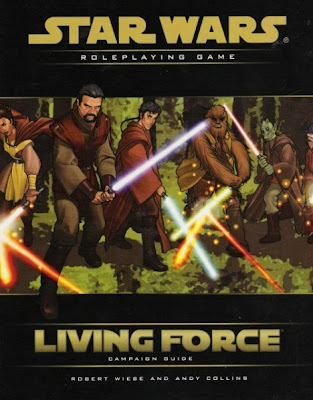
I know I swore off buying Star Wars stuff, but it was a bargain and I was bidding on a bunch of other stuff from the same seller, I figured if I caught this at the minimum bid and got the combined shipping with any of the other stuff it's be like getting a free item almost. This was the only item I won though, but I got it for the minimum bid.
Now, we only really got through the first 18 pages of the book in the last two parts of my Moldvay Basic Observations, but I am confident that we can make it through the rest of the book here in part three because, despite the fact that we still have another 46 pages to go, there really aren't all that many more observations, and most of them are from the next few pages.
Part 4: The Adventure starts on page 19, and is a bunch of useful information for the beginning player and the beginning DM. I was both amused and impressed by the first paragraph, it has the heading beginning the adventure and essentially states that once the players have rolled up their characters and bought their equipment, the DM will tell them what the Adventure is going to be, where they are headed, what they're after, who is with them and what they know about the place. I found this amusing because I have had players over the last three decades that were such a pain in the ass that I wondered why they showed up at the table. I'd drop adventure hooks, usually some sort of hire, and they'd be all "Nope, I'd rather not take your excellent commission to go clear out the Dungeon of Doom, I'd rather sit at the inn doing nothing for the next six hours"; here they pretty much tell you that kind of nonsense doesn't fly.
Next it moves on to optimal party size and composition, pretty standard stuff for old school; it tells you that you should probably have 6-8 characters in the party, that's what pretty much every module said on the cover back in the day; and that you should have a mix of character classes, all the human classes should be represented and, if possible, get some Demi-Humans in the party too for their special skills. The most noteworthy thing here is that it suggests that some players, at the DMs discretion, might be allowed to play multiple characters. I am pretty sure that this was, if not outright forbidden, at least heavily frowned upon in AD&D. It also point's out here that if you don't have enough players you can fill in the ranks with retainers, but I'll get back to them in a bit.
Next we move on to organizing a party; setting your marching order is mentioned first and it mentions having several different marching orders for various tactical situations, which is something I always thought that me and my nerdy friends came up with on our own, but here it is in black and white. Then comes the Caller. Is this where the Caller comes from? I just looked through Holmes and didn't see any reference to a Caller, but I may have missed it, and in AD&D's PH it says that party's should have a leader who will "call" to the DM the party's actions. I never played in a D&D group with a formal Caller and damned few with formal Leaders, although informal leaders often existed. This is the first place I question whether or not people actually played this game with the rules as written.
After the Caller, there is a section on the importance of mapping and how one player should be designated the Mapper, this is a D&D job that I used to see a lot more in the old days than I do now. I can't decide if it's just because every DM on earth got sick and tired of having to describe the room over and over again, or draw sections of map for the "Mapper" to copy or if it was just because D&D moved away from dungeon based adventuring over the last three decades, either way, mapping is practically a lost art and it is frustratingly difficult to reinvent. I do like the way it says here that you maps aren't going to be exactly perfect and not to worry too much about making a perfect, detailed map though.
Next it brings up a controversial subject, use of miniature figures. They are clearly optional, but can enhance play. However, many of us OSR types, no matter how much we loved our old lead miniatures back in the 1980s are still a little gun shy about being slaves to the battle grid. Me, I can go either way, I hated being a slave to the battle grid and it did take me forever to wean my kids off of using miniatures even when we were playing 1st edition AD&D. I haven't used them yet with Moldvay Basic, but I may. I used miniatures pretty much the whole time I played D&D from Holmes through 3e, I only wanted to quit after 3e and now that I have had a break I am OK with them again. The only thing that bugs me is when 3e-isms crop up in an old school game when we're using miniatures, I know it's because we're using miniatures; someone will say something like "Shouldn't I get an attack of opportunity here?" and make me want to smack them.
The last things on the page are Time & Movement, there's not much of note there, except the note at the end that you need a 10 minute break every hour or you'll start getting fatigued and suffer a -1 to hit penalty until you do rest. I don't ever recall seeing that rule anywhere else. The only other fatigue rules I remember seeing in a version of D&D were in Hackmaster 4th edition.
Flipping the page brings us to encumbrance, which fills the entire page and is an optional rule. Sadly encumbrance gives us one of the worst and most enduring game-isms of D&D, the idea that all coins regardless of metal or purity weigh the same, and that the weight of a coin is 1/10 of a pound. Here in Moldvay Basic the basic unit of weight has gone from the Gold Piece (gp) to the more generic Coin (cn). I never really understood why we couldn't just measure weight in pounds, or ounces if necessary, but there you have it. I hear Lamentations of the Flame Princess has a better encumbrance system, and I did buy it in December during their PDF sale, but I haven't gotten around to reading it yet; if it is vastly better I will most likely adopt it for my B/X game.
Page B21 starts us off with Light, points out that most dungeons are dark and tells us how long torches last and how long a flask of oil will last in a lantern, reminds us that you need to pay attention to who is carrying the light sources because you can't fight with a sword & shield if you are the one holding the torch and then talks about how Infravision works. Now, when 3e hit the market and we lost Infravision in favor of Low-Light Vision and Dark Vision, I hated that as much as the next grognard; but over time I have come to actually prefer them to Infravision and I'll tell you why- there is always some jerk trying to screw with Infravision, either a player who has seen the movie predator or a DM that realizes that undead are the same ambient temperature as the air surrounding them. Giving a scientific explanation for how the eyesight of fantasy races work is stupid, plus have you ever looked through an infrared camera? Seeing everything like Geordi LaForge or the Predator isn't really all that helpful, plus why does it only work for X number of feet? An Elf or Dwarf's ordinary eyesight will allow them to see pretty much to the horizon, but their Infravision only works for 60'? Sixty feet of visibility is pretty crappy, especially if you can only see stuff that gives off heat. Realistically, deep enough underground the stone and the air are going to be about the same temperature, so the subterranean dwelling Dwarf is still screwed without a light source; he'll be blind, bumping into cavern walls*.
Next we move on to Doors, which has three sections Normal Doors, Secret Doors and Listening at Doors. Normal doors are pretty interesting in Moldvay Basic, because they kind of have some weird mojo going for them. First, they are usually closed, that's cool, I usually leave my doors closed too; but additionally they are often either stuck or locked. Stuck doors any character can take a shot at, but higher strength characters are better at unsticking them, this is where the "Kick in the Door" meme in D&D comes from. Locked doors have to be picked open by a Thief, and the text here kind of implies that if your party Thief fails here, you are just screwed; which makes sense from the description of the Thief and his lock picking ability, but not from the point of view of a dungeoneering party that probably has at least one axe with them. The other odd, semi-magical qualities of dungeon doors are that they automatically swing shut after you open them unless you specifically jam them open and that they will automatically open for monsters unless you spike them shut; and these are the "Normal" doors.
Secret doors have fewer rules regarding them, but there is the interesting clarification that a Character only gets one chance to find a secret door. I remember playing AD&D and having the party know there must be a secret door in an area and just keep searching forever until they found it, that was annoying. Listening at doors gets a mention at the end of the doors section, I am amused by that because that's another one of those semi-lost dungeoneering skills, like mapping. When I DMed last weekend the party remembered to check for traps about 70% of the time, but only listened at one door. This section also has a rules clarification that a character may only listen once at any given door, and that the undead do not make noise.
The bulk of this page though is taken up by rules regarding Retainers, which brings me to a mini-rant- What is the deal with the inconsistent terminology between editions of D&D for the hired help. That's just confusing, why does every damned edition need to change the name? Here Retainers are, mostly**, what you would call Henchmen in AD&D, in 3e they'd be called Cohorts. Why on earth couldn't they pick a term and stick with it? That said, they are a little more interesting to hire on than they are in other editions, they have their own reaction table, which I assume the PC's Charisma modifier applies to, although it doesn't expressly say so. I also find it interesting that they have to check morale after every adventure to see if they will stick with you. Charisma would not be a dump stat in this version of D&D even if the rules supported stat rearrangement.
Skipping way head to combat, did anyone use the rules as written? The DM rolls all the damage dice? Why? Just because only one set of dice shipped with the boxed set? I like the morale rules, they are simple and easy to use, every monster has a morale value. Would I have preferred it to be on a D20 instead of 2d6? Yes, but Moldvay has a lot of 2d6 tables, so I am getting used to it. AD&D didn't get a decent monster morale system until 2nd edition.
Moving on to the monsters in general, there is more variety in low level monsters than in previous editions of D&D or than in AD&D, even some more mid-level ones than I would have expected; and many that weren't in any previously published D&D. The AD&D Monster Manual was only published four years earlier, so I would not have expected too much deviation from it's list, but there is. All of the standard humanoids are there, as are all the minor undead and a bunch of other "standard" D&D monsters, like Stirges, Rust Monsters and Ochre Jellies. Dragons are here too, surprisingly, since the book only covers levels 1-3. There are a bunch of new monsters and monster variants though that I never saw really until I read through this book, different types of Giant Lizard, Snakes, Giant Spiders and the Thoul to name a few.
What else did I skip over before?
Paralysis can be cured with a Cure Light Wounds spell? Does that happen in AD&D? I never heard of it if it does. Here it gets mentioned in the spell description and in the description of pretty much everything that causes paralysis.
The Monster Reaction Table, not every encounter needs to be a combat encounter and another reason why Charisma wouldn't be a dump stat even if the game rules allowed for it. Sometimes a monster might help you out.
Individual Initiative is an optional rule. I can't decide whether or not to use it, because my current group is less wargamer heavy, and therefore less rules crunchy and combat oriented than most previous D&D groups that I have played with, so I think that it might just be too much of a stress builder on combat and make combats more chaotic and lengthy, but on the other hand I think it really helps open up the combat options for high Dexterity characters like Thieves to be able to maneuver into position for Back Stabs, which is never actually called back-stabbing here, but instead "striking unnoticed from behind", or just getting to go first in combat.
Experience points, you get WAY more of them for treasure than for killing monsters, that kind of sets the tone for what's important here, now doesn't it? I actually noticed this when I was figuring experience points for the game I ran last Sunday, gold piece value is king when it comes to XP, killing not so much, magic not at all. AD&D was kind of like this, except that you got the XP for magic and monsters were worth a little more, Goblins in B/X D&D are worth 5XP each in AD&D they are going to be worth an average of 13XP.
Overall thoughts- There is still a great deal of customizability to Moldvay Basic, like there was in OD&D. The number of rules that are presented as optional is reminiscent of 2nd edition AD&D and the rumors of 5th edition D&D's multi-edition compatibility; for example- if you use none of the optional rules presented in Moldvay you have a game that is more similar to OD&D, if you use them all, it becomes much more distinctly it's own version. As an introduction to D&D, and RPGs in general, I think it does a much better job than Holmes basic did, and I mean no disrespect to Holmes Basic, it had a different design agenda; I am told Mentzer Basic did a better job still, but I haven't seen it to say for myself. What I can say is that all of the rules you need to play D&D are in this book, it's only flaw, and this is by design, is that it tops out at 3rd level and then you have to buy the Expert boxed set to go to level 14; which is past "name" level, the theoretical end game stage of D&D, so you really never needed the Companion boxed set, that never got published, that promised levels 15-36.
Now, I suppose I'll have to do some posts on my observations about the Expert side of the B/X equation too, but at least this will be more mixed with review, I had that set back in the day and I used stuff out of it pretty liberally with my Holmes Basic set and my AD&D until everything was taken over by AD&D eventually. I'll need to finish reading it
* unless the assumption is made that Infravision is very, very good and he can see the heat from his body and breath emanating around him and it outlines the walls and stuff, but then you still have the problem of jerks trying to blind Infravision scientifically because they can.
**They might be a 0-level torchbearer, that dude would be called a hireling in AD&D which has entire classes of standard and expert Hirelings. I looked ahead in the Expert book and some of the Hirelings in there are overlapped with the Hireling types in the AD&D DMG, but it didn't include any of the standard 0-level porters and torchbearers that AD&D parties have available to them.
OK, these EBay items arrived today.
Everyone in the OSR raves about this old Judges Guild stuff, I never had any, so when I saw I could snag some cheap I grabbed these.
I know I swore off buying Star Wars stuff, but it was a bargain and I was bidding on a bunch of other stuff from the same seller, I figured if I caught this at the minimum bid and got the combined shipping with any of the other stuff it's be like getting a free item almost. This was the only item I won though, but I got it for the minimum bid.
Labels:
2nd edition,
3e,
5th edition,
adnd,
B/X,
BECMI,
DnD,
Hackmaster,
Holmes,
Mail Call,
Mentzer,
OSR
Subscribe to:
Comments (Atom)


