I probably should have grabbed the books and looked through them before I wrote my last blog entry since I have not played 2nd edition AD&D in about five years and not regularly since about 2002. There were a few other things that weren't on my mind and were a little fuzzy in my memory.
To start us off- the change to a decimal monetary system was annoying to me. I assume this is because I learned the old system first because a decimal system is obviously easier to use. Less realistic, but easier to learn and use. Changing prices in the Player's Handbook is another one of the things that bugs me. I remember at the time TSR insiders saying it was based on making the prices more reflective of real world medieval prices, but that is clearly BS. Some of the stuff seems to be vaguely based on an English medieval price scale, but the accuracy there might just be coincidental. Mostly it seems to have been done to make better things cost more, despite the fact that when the technology came around to make those better things, like plate armor, the process was actually cheaper and easier than making earlier armors like chain mail, and used fewer raw materials.
Loss of the 1/2 Orc. I don't think anyone I knew really missed the 1/2 Orc, but we could just as easily lost the Gnome if all we were doing was cutting PC races no one really used. I think we all know that the real reason the 1/2 Orc got the axe was because of those Christian housewives that were never going to either play the game themselves or let their kids play; pretty much regardless of how much sanitizing of the D&D image corporate TSR did. What's worse is that the angry mom brigade had already become irrelevant by the time AD&D2 arrived on the scene. I guess they were trying to insulate themselves in case the BADD ladies returned, but most of them had gone on to hating more socially relevant things by then.
When we get to classes we see the Assassin has been done away with, likely for the same reason the 1/2 Orc was; another cowardly move by corporate TSR, but with just as much of the "meh" reaction from me an my gaming buddies. Assassins made good enemies but crappy characters, essentially lousy thieves that were less trustworthy. The Monk said sayonara too, again with about the same reaction, but at least this time it didn't seem to be a reaction to what mom might think. Ditching the Monk may have been the best decision TSR made with 2nd edition, everyone knew he didn't really fit the default medieval European setting. The Druid got messed with kind of like the Ranger, but without the reasoning of making the class cooler, they appear to have been trying to make the Druid fit their new Priest mold.
Mongol Home

Friday, February 18, 2011


2nd edition AD&D retrospective
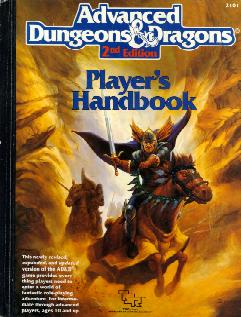
2nd edition AD&D is the red-headed stepchild of the OSR. The last edition of D&D that was easily compatible with it's predecessors, it still doesn't receive the love that 1st edition AD&D does. I know I don't love it like I love 1st edition. I also know that I don't really have a really good reason for not loving it as much, sure it screwed up a couple of things, but it fixed probably more than it broke by an order of magnitude, so it's really just a feeling. To be clear here I am talking about the core books, not the myriad of add-ons that buried TSR under their weight.
My experience with 2nd edition started when it was initially released. I was 20 or 21 years old when they arrived on the scene, so they fall entirely within my adult gaming experience. While I don't remember where I bought those books, I know I bought them as they were released. My first impression, as I recall, was a good one. The Player's Handbook, while I disliked the cover art, was a pretty meaty tome; which I considered a good thing. Pretty much everything a player needed to know was in that book. The DM's Guide had a slightly better cover, but still not good, and was thin. I pretty much did not like the 2nd edition DMG; after the 1st edition DMG set the standard, the 2nd edition one was weak and insubstantial, both in content and page count. The Monstrous Compendium was a lame idea, but I still bought the 1st three and then selected others as they arrived. Ultimately I stopped using them and just used the Monstrous Manual after it's release.
I played 2nd edition for the entirety of it's run as the "official" D&D* and continued playing 2nd edition through the first years of the 3e era**. I still never felt as comfortable with it as I had first edition. I can always find what I am looking for in seconds in the first edition books. The second edition books I still have to look things up in the index. At first I thought it was just a familiarity issue, but I played 2nd edition for as long as I did first, maybe longer, so I don't know.
Second edition was not without it's good points. I liked the way they handled Thief abilities for instance and the books were laid out much more professionally. The interior art mostly sucked and the blue ink would come off on your hands if you were reading on a hot day but the binding was good, compared to the later first edition books I had anyway. The books were sturdy and looked like professional publishers had produced them, I didn't care for the aesthetic of the new edition, but I could ignore it and move on.
My initial discomfort, which never completely left, came when I noticed rules that had slight changes for no apparent reason. Spells mostly got affected there; so to familiarize myself with the changes to the magic system, I made the sacrifice and played a single classed generalist Mage. Old 1st edition weapon specialization rules got changed for no apparent reason too. I could never be sure I'd noticed all the little tweaks they made and occasionally that burned me in play. The big changes were easy to see and mostly made sense, as well as making things run more smoothly and quickly. Good examples of this are the changes to initiative and introduction of THAC0. The little rule changes were mostly hidden and irritating.
The thing that I initially really disliked about second edition though was the new and improved Ranger class. The class had clearly been redesigned to resemble Drizzt, a character I had initially liked then grew to loathe. That stuck in my craw, redesigning an entire core class so that fan boys can more easily emulate their favorite character from D&D fiction? Bah! I could understand standardizing the hit die type to a d10 to put him in line with other fighter types, but why the other stuff?
I also really disliked the cowardice shown by the suits at TSR when they decided to bow to the, by then non-existent, public pressure and disingenuously rename demons and devils. I think the controversy around the demons and devils existing in D&D is half of what made the game such a huge fad in the early 80's and I personally believe it was the only reason most of my generation's metal heads learned to read or do math.
I thought the Bard class was weak and useless and I was essentially proven right when I saw one being played in the fairly long running Oswego Mk. II campaign DMed by Marty. Sorry Nikki, your Bard character was lame. Weak fighter combined with weak Thief combined with weak Mage does not make an awesome character class, the Jack of all trades really is the master of none.
In the end I also came to realize that there was a general across the board power increase, which in retrospect I can see all the way from 0e to 4e and I guess makes sense in the context of when things were published. The 1st edition AD&D Monster Manual was published before the rest of 1st edition, designed so players of Original D&D could use it for their games, most of the monsters that had previously been published got tweaked a bit, usually making them a little tougher. When the PH came out for 1st edition it codified a stronger group of classes than in OD&D. Variable hit dice and variable damage dice meant that the monsters in the MM weren't really as tough as they been designed to be, AD&D's 1st edition was still evolving as it was published. With the 2nd edition they had time to do everything at roughly the same time and got a more consistent product to market (initially, forget the splat-books). The problem is that every edition keeps giving us more and more powerful characters. With the addition of feats and skills pretty much any 3rd edition character will destroy any earlier edition character of the same level without working up a sweat. I do not know from personal experience, but I have been told by people who have played 4e, this is true of 4e characters with regard to 3x characters too.
I can't really hate 2nd edition too much for it's plethora of splat-books because every edition of D&D has had it's dogs. TSR was doing what they thought was best for them at the time. I don't condone their corporate attitude, but TSR with Gary still brought us Unearthed Arcana and that book was a mixed bag at best. The earliest Complete Handbooks weren't bad at all, particularly compared to the late 1st edition stuff. The problems for splat-books come when they start contradicting core rules, arrive without any proper play testing and amp up power levels to ridiculous levels in an attempt to force players to buy the newest best book to keep up with everyone else. That last tactic may work well for collectible card games, but D&D characters develop over long periods of months or years so adding a newer more powerful kit (or prestige class) just pisses off players. You know, the core audience you are marketing to.
I guess in closing I just would like to say that I liked second edition AD&D. It didn't really have the soul of 1st edition, but the corporate stamp of mediocrity didn't completely eliminate the awesome of the core AD&D experience left over from first edition, and the professionalism of it's corporate creators fixed a number of broken or nonsensical rules. I don't really know what it would have been like if it had been my first experience with D&D, we're only virgins once.
*Except for one Luddite DM's campaign for about a year where we played 1st edition because he didn't want to pay the "upgrade" price when he already had all the 1st edition books he needed. That was Steve S. original old schooler. Thanks for showing the way man!
**Itself an annoying story, my 2nd edition group refused the upgrade and only bowed to peer pressure and bought in right before 3.5 came out. I refused 3.5 at first, but the peer pressure got me to buy the 3.5 PH ultimately, and I ran a 3.5 campaign using my 3.0 books and the errata/conversion documents I found on the web at the time. Eventually I had had enough and quit D&D for Hackmaster and played it as a "straight" game. Much more rewarding then any version of 3.x from my point of view.
Thursday, February 17, 2011
Old school games I never played.
Back in the 80's I was a teenager in a rural area of upstate New York. My friends and I were big fans of D&D starting in about 1980. However, since we were teens, we didn't have an unlimited cash supply to buy new games or gaming supplements. We focused on getting D&D stuff and tried to avoid too much replication of items in our collective gaming inventory.
Slight rant here- Why don't kids these days work? I never knew anyone in the 1980's that just got money for nothing from their parents. I mean, sure, birthdays occasionally visits with grandparents and maybe Christmas netted some free cash, but mostly we worked for our gaming dollars. Farm work, apple picking at the orchards, odd jobs when people needed some help. I used to get paid like five dollars for taking care of my neighbor's pets when they were on vacation. Splitting and stacking firewood, along with a variety of household chores was how I earned my allowance of five dollars a week as a teenager. Seeking out other opportunities to make money was pretty common for us teens at the time. If we wanted something we earned the money to purchase it or we went without. Except for Christmas and birthdays, but those are always iffy on whether or not you are going to get what you asked for. Rarely one of our parents would buy an item and then let you work it off with extra chores. We also walked or rode our bikes places. Now I see kids needing a ride everywhere. I never got a ride for anything less than an hour's walk away. My parent's time was important, it had value of it's own and us kids would never have dreamed of asking them to drop whatever they were doing so we could have a ride to our friend's house on the spur of the moment.
Now get off my lawn! -end rant here
The nearest city to us was Oswego, NY (famous now mostly for SUNY Oswego, alma mater of Al Roker and Star Trek actress Robin Curtis. Jerry Seinfeld also briefly attended) at roughly 12 miles from my house. Oswego did not have any place that had D&D stuff, beyond the Basic set, for most of the 1980's. There was a place called "The Book Cellar" in Fulton, NY (11 miles south of Oswego) that had some D&D stuff, including many of the "Gold Box" sets of Grenadier's official AD&D line of miniatures. I bought several sets there before the place closed.
Other than that you had to go to Syracuse (40+ miles south) to find D&D stuff, which I found in various malls in the Syracuse area and eventually at the nerd mecca of New York state "Twilight Book and Game Emporium". Twilight is sadly closed now, but in the 80's it was awesome, a combination Science Fiction bookstore/Comic shop/Wargame and RPG store. With lots of miniatures. Plus, it was literally around the corner from the pretty awesome "1/2 Price Book Warehouse" which, unsurprisingly, was literally an old warehouse chock full of books on pretty much every topic sold at 1/2 price or less. At the height of awesome in the late 1980's there was also, on the next block over, "Midway Hobbies" which kind of took Twilight's wargame and wargaming section and expanded it into an entire other store.
I am sad to see Twilight gone, but at least it didn't have to exist long enough to be associated with that literary abortion of the same name. So that's good I suppose. I also would not really want to keep trekking into that neighborhood anymore, it has gone dramatically downhill. It's successor stores aren't nearly as cool though.
Anyway, enough setting the scene here, it was a giant pain in the ass to get game stuff and our hard earned gaming dollars were largely spent on D&D and stuff for D&D, mostly miniatures and Dragon Magazines. Some modules. Most of us didn't have all of the books. Some of us didn't even have Player's Handbooks of our own. Kaybee toys filled up my D&D inventory when they would periodically purge the D&D stuff they had from the shelves and I'd buy old modules for like fifty cents a piece and boxed sets for like two dollars, this continued through the 2nd edition era. I also sometimes got Avalon Hill or SPI games there really cheap.
What I wanted to talk about was the rest of the games out there that I never had a chance to play. In many cases I was aware of these other games. I made my first (and only) Traveller character in the cafeteria at lunch time when I was in 7th grade. I never got to play him, but at least I got to check out the classic Traveller game a little. Some games from the early days weren't so lucky. My first Superhero game was Marvel Super Heroes from TSR. I was aware of Champions and Villains and Vigilantes, mostly from ads in the Dragon, but I never got to play them. Or see them really. Not until much later, when my friends and I started purchasing "old" games that we'd missed out on.
Some old games I got to see or read or make characters for only because my friend Darryl's dad, Big Darryl, was a gamer himself and had an adult's spending money for his hobby. He preferred wargames, but in the interest of having a common interest with his sons and their friends and considering that the wargamer/RPGer split wasn't really there yet, he bought and played a wide variety of games. Usually we'd play any given game once with him, then it'd just go into the library. We had full access to the library though and played some games repeatedly regardless of whether or not we really "got" the game. Pendragon is a great example of us playing a game the way it wasn't really intended to be played. We played it as if it were D&D with a variant combat system. Sorry Pendragon, you deserved better.
Superheroes were not Big Darryl's thing though so we never got any of those games added to the library. There was a great flowering of RPGs in the mid-1980's and most of them never got seen or played by me or my buddies. Science fiction games suffered there, except for FASA's Star Trek RPG (Big Darryl was a Star Trek fan from the dawn of time, so pretty much that entire line made it into his library.) and TSR's Star Frontiers which me and my poor teen-aged friends bought into for some Sci-Fi fun and only played a couple of times. West End's Star Wars game doesn't really make the cut-off for early games in my estimation because it was released in 1987 and I graduated from high school that year along with most of my gaming buddies, so we entered the world of "adult gamer" there. We did get pretty much every fantasy RPG that was commonly available though, except RuneQuest, and several that were less than common, like DragonQuest.
Getting back on topic, I never played much else besides D&D, even if we bought it, except Dawn Patrol, we played the hell out of that game and we played it as an RPG. Darryl lived 16 miles from my house and his dad lived a few miles further away (after he moved back to the area, before that he lived in Plattsburgh, then Utica; I really didn't get to know him until he moved back to area though) so his library wasn't always immediately available.
If I keep getting ramble-ey and off topic it's because my elderly mastiff keeps wandering in and demanding attention, she's a good girl. I also stopped for lunch and a phone call from my mom.
We kids bought most of what TSR had to offer Gamma World being the chief exception there and it doesn't really make sense because there were conversion rules for Gamma World in the DM's Guide. We bought and played Boot Hill, not very much, but we had fun with it. Darryl even ran a cross-over to AD&D with it. Actually it was AD&D characters crossing over to Boot Hill. I bought Marvel Super Heroes when it came out and only Darryl and I played it at the time really. My wife likes it though, due to her having had an awesome campaign of it when she was in college before I met her. We tried playing in the early 90's, before she was my girlfriend even, and it wasn't that great. Some games only work because of the group you are playing with or the time period in which you played it. Playing MSH in the 90's with our D&D group just wasn't the same as it had been in the past for either of us. Star Frontiers was Tim's baby, he bought both boxed sets and kind of jealously guarded them. He ran just one adventure for me and Lance. I played it maybe twice with Darryl and that crew, his dad GMing. We did play some starship combats with it though as an alternative to Star Fleet Battles.
I guess my point here is that, with rare exceptions, if it wasn't made by TSR we didn't buy it. TSR was the king of game companies and had a proven track record. Most of their early role playing games are somewhat compatible, so they had play value with D&D too. That made sense to us because our budgets didn't allow for a lot of "useless" gaming stuff. As we got older we were in a position to change this somewhat, we could better afford other game company's things. We bought into more game types too. Board wargames mostly, ranging from "Axis and Allies" and "Conquest of the Empire" to more unusual and exotic choices like SPI's "China War" (which I loved) or West End's "Air Cav" (which Tim bought solely because he knew he was going to be an army helicopter pilot, a dream he achieved). Star Fleet Battles makes the list here too.
Wednesday, February 16, 2011
Dinosaurs and AD&D
When I started playing D&D in the early 1980's dinosaurs were regular fixtures. Now we rarely ever see them. I got to thinking about this when I read through Lands of Ara today and I think it's because we got older and quit using toys for minis. Now maybe as teenagers we didn't want to be seen playing with little kids toys, but I am not sure there. We used to ride triceratops's like horses all the time in Tim's campaign. A concept that became AD&D canon with this picture:

There were certainly modules that supported the idea of Dinosaurs and D&D, X1 The Isle of Dread, an old favorite of mine has a Godzilla looking Tyrannosaurus Rex on the cover. See:

Later replaced by the less awesome, but more T-Rex looking, 2nd cover pictured here:

Why did we all seem to stop using dinosaurs at roughly the same time? I am thinking circa 1986, but that is probably because it coincides with Tim going into the army and us losing access to his large collection of plastic dinosaurs that we used with our miniatures. It's odd though really, considering the Dinosaurs get their own section in the Monster Manual. Maybe we had become miniature snobs and there weren't enough cool dinosaur minis out there. I don't know, but I do know that I can change this trend in my campaign. I vow to make an adventure that features dinosaurs prominently. Maybe I'll even stat out some that didn't make it into the Monster Manual. Do any of you use dinosaurs in your D&D games?
Monday, February 14, 2011
Wizards and armor.
Why can't Magic-Users wear armor? Because they can't that's why. I have read articles, most recently in the new issue of Footprints, that postulate that M-Us can't wear armor because of the restrictiveness of movement while in armor. This is often accompanied by the rationalization that you need to be trained to wear armor. D&D players ALWAYS get this wrong. I have been a heavy armored fighter in the SCA* for a long time and I can tell you that I have had clothing more restrictive than my armor. Armor is designed so that you can fight in it. It is not complex to get in and out of. I have never liked the idea that, say, Platemail makes you slow. It doesn't. It's not hard to move in. I have seen a guy do cartwheels wearing full plate. Plate is articulated to bend where the human body bends and it's weight is so well distributed across the body you barely feel it.
Learning to fight isn't easy, not being good at it anyway. Wearing armor is. I get the rationalization that M-Us can't use various weapons. I think they should suck more with the weapons they do get honestly, because learning to be good with a weapon takes time and time is what M-Us use to learn magic. I can understand the restrictions against shields. In a realistic game I wouldn't ban anyone from picking a shield up, but honestly, until you learn to use it, your shield is not your friend. Properly trained in the use of a shield it can become the keystone of your defense. I have not thought the shield was given it's due in any RPG I have ever played (or read, or heard about) but that's not the point here**.
Magic-Users should be weak fighters, they spend all their time in bookish pursuits. That they get any weapon skills at all is pretty unrealistic, it's like saying every M-U's hobby is a martial art, that's where they picked up the skill with the dagger (or staff or dart or whatever), they spent all their free time learning that. That's like saying every computer nerd has as his primary (or sole) hobby Kung-Fu. Simply unrealistic, but we allow it for the sake of the game. The armor restriction, whether it was placed for the sake of balance or just to differentiate the classes needs to be accepted for the same reason. Realistically, strapping on armor is simpler than learning the basics of fighting with a quarter staff, particularly since M-Us are pretty bright guys and they'd only need to be shown how to do it once, or if no one was around to show them they'd probably be able to figure it out on their own pretty quick. They are all geniuses after all.
Now somebody will be thinking that maybe it should just be because magic and iron can't be used together (actually that's a theme in Robin Hobb's Soldier Son trilogy, which I recently read), then it'll be rebutted with the fact that M-U's use iron daggers and iron tipped darts and, sometimes, iron shod staves. Then the argument will come forth that that's a small amount of iron and therefore no big deal to the magic. Then the proximity of the rest of the iron encased party members will be called into the debate, followed by the reasoning that they aren't actually touching the chainmail clad fighter while casting spells. This will be followed by someone suggesting that if this is the case then M-Us should be able to wear leather or bronze armor (and use shields), so it must be based on the freedom of movement necessary to cast spells being restricted by the armor, which isn't true. If anything I would think the voluminous robes and cloaks and large floppy hats would be restrictive to movement.
Accept that somebody, probably Gary Gygax, made it a rule for gamist reasons, not realistic ones. It probably had something to do with trying to enforce the wizard archetype, wanting the M-U to look and act more like Merlin or Gandalf than Lancelot or Conan. There are a lot of gamist decisions in D&D dating back to Chainmail; Gary was a history buff and a sword and sorcery genre fan, he got lots of little things wrong but we still revere his memory because he invented the hobby we love.
* I know, everyone hates an “expert”, they ruin the gamey goodness by bringing in their expert opinions on what-ever topic. I am worse then most that way as a D&D player when you get me going, because I am a trained medievalist, living historian and SCAdian.
** I could rant about shields for a long time. My favorite style of fighting is sword and shield and I believe that the shield, when properly employed, is probably the single most important part of your defense. Much more important than body armor; right up there with the helmet, which also gets no love from D&D. SCAdians get some wrong impressions about combat too, since our safety rules have made our shields invincible and ruled out certain less honorable, less chivalrous actions, but I stand by my love of shields and now have a new D&D house rule that takes their importance into effect. Hackmaster basic actually has the best shield rules going that I have read in an RPG, but I have a few issues with the gamism in combat there too.
Friday, February 11, 2011
I'll hop on the hireling bandwagon too.
Henchmen and Hirelings.
Since everyone else is writing about them I'll throw my hat into the ring and talk about my experiences with them too. I had an unusual experience with playing D&D as a kid in the 80's. I had more than one group I played D&D with because I didn't (after 6th grade) go to school with the people that I lived near, and I had a couple of different overlapping groups that I played with both “at home” and “at school”. Both of those are in quotes because I actually didn't play much at my house or in the school.
My “Home” game was played mostly at my buddy Lance's, either in one of the cabins on his parent's property or in the barn, or at Tim's house or in one of the sheds there. In winter or at night we played inside Tim's house, since the cabins and sheds had neither heat nor electricity and Lance's barn only had one bare light bulb for light. That sets the scene enough I guess- on to the game!
Tim usually DMed, as I have reported before, and in his group we always had a bunch of hired help, mostly thieves. Our core party consisted of my Human Fighter Mandark, Lance's Paladin Bordan and Tim's Dwarven Thief Andemon. Paul F. was a pretty regular player in that group and usually played a Halfling Thief whose name I don't recall. Occasionally we had visitors come to the game Jim B. was a campaign regular before I joined and sometimes came back to play and he had a cousin from Rochester that we played with a couple of times. By about 1984 it was mostly just me, Tim, Paul and Lance playing there, so the hirelings were pretty important to us. Torchbearers and pack-mules they mostly served as.
My other “Home” game was mostly a one-on-one game with my neighbor Scott W. Scott played a Halfling Thief named Thorik and had an entire party of NPCs with him based on my personal miniature collection they were a Human Magic-User, 2 Human Druids (brother and sister), a Human Ranger (the twin sister of the female Druid) and 2 Halfling Fighters. They also had a bunch of hirelings used as light sources, treasure haulers and camp guards. Rarely Lance would show up to play too. Scott is Lance's nephew, which always kind of amused me since they are so close in age and Scott's sister Chris is actually older than Lance by about 7 months. Oddly enough, Scott never played in the games that Tim DMed; and when I started DMing that group (Dempster Mk. I) he only rarely played there.
The point there is that my home games always had a bunch of hirelings in them.
The “School” games, hereafter referred to as “Away” games simply because I like the sports comparison., are also divided into two groups (and one subgroup). The actual “School” group consisted of a variety of guys that were in the D&D club (which I founded) and we rarely ever actually played. Sometimes we'd play in the library before school started or in the cafeteria during lunch and maybe twice during our D&D club meetings. Despite being president of the junior high D&D club, I actually played more D&D with the high school D&D club. They were cooler. They kept inviting me to the game. They used awesome unofficial stuff like Arduin Grimoire and the 30-sided die book. None of these games really ever had any hirelings or henchmen added.
Then we have the Darryl “Away” games. I used to spend about half of my weekends at Darryl's house, either at his mom's or his dad's. His dad's house was cooler to go to because his dad was a gamer. Big Darryl was mostly a wargamer, but we managed to get him to play a large number of RPGs anyway. He bought even more of them. His gaming library is why I have such an extensive knowledge of 1980's era RPGs. He hated D&D because of it's abstraction and randomness and a host of other reasons. Like passionately, as though Gary Gygax had boned his wife or something. So he spent a lot of time, effort and money trying to come up with the perfect simulationist RPG. He was a huge fan of Harn. His favorite RPG, as written, was DragonQuest. Not really surprising since it was an SPI product and he was a wargamer. He was an early GURPS adopter. Mostly he was interested in finding the Holy Grail of RPGs, a quest that I am sure he continues to this day. But, he ran/played in a long running D&D campaign with his sons Darryl and Keith. I was eventually added to this cast, as were his step-sons Rusty and Pete along with a bunch of kids that lived in the neighborhood at the time, most of whom I have only a foggy memory of. That campaign had a lot of actual henchmen in it and not too terribly many hirelings, but some. Every major character in that game had at least on henchman.
Big Darryl's character was Prince Royce Cea-Thor, he was a Human Fighter, but acted like a Paladin. Royce had a Human Thief henchman named Napoleon, who I think was a family retainer. He also had a Human Cleric henchman whose name I don't remember. Royce was certainly the prima donna there. I remember a couple of his other Henchmen by name, Greena and Glendan, but I don't remember much else about them. I am pretty sure Glendan was a cleric.
Little Darryl (AKA Darryl Jr or just Darryl) played a Human Fighter named Aimendale Sebastian Borgstrine Delarive (Borg) who had two henchmen. The first was a Human Fighter named Khan (inexplicably pronounced Han, like Han Chinese or Han Solo), he was pretty bad-ass in his own right and occasionally Darryl just played him and left Borg home. The second was a Human Magic-User named Elisha (pronounced Lisa, which is more inexplicable than Khan's name's pronunciation) and he occasionally soloed her too.
I don't remember Keith's character at all. He pretty much stopped playing D&D when he discovered girls and weed. Quite surprisingly to everyone that knew him, he cleaned up his act, married a good woman and became a minister.
I played a couple of different characters there. When I first started playing in that game they just had me play one of the NPCs. After a while I got to bring my own character in. My Elf F/M-U from junior high, Lodor, eventually found a permanent home in that campaign, although by then Big Darryl had sworn off D&D completely and Darryl and I were trading DMing duties back and forth.
Oddly I don't remember any of the other PCs in that game to speak of at all.
Over the years group memberships changed pretty drastically. I put a cut off/ change point in the Dempster game when only Lance and I were still playing from the original group and I was the only DM. Lance was the only original member from Dempster still playing, since I had joined the campaign already in progress, having come from my earlier D&D group where I played with Chris G. and his crowd, which kind of imploded.
Dempster Mk. 2 was interesting in that it was the last 1st edition game I DMed until after 3rd edition sent me back to my roots. It also is the only game we played with no (or at least a bare minimum) NPC help. Lance had come to despise henchmen as XP/treasure leaches. I was DM. All the other players were younger than us and had no previous D&D experience, so I guess it just didn't occur to them that they could bring in hirelings or recruit henchmen.
The last 1st edition game I played in was Oswego Mk. Ia (the a is because my first Oswego D&D group was under the same DM, Steve S. , but I only played there twice before that group broke up, I joined late, apparently at the end). 2nd edition AD&D had already hit the street, a year or so before, but Steve didn't feel like investing in new books since he had a perfectly serviceable game already. Smart man. We were almost all strangers to each other there. I honestly don't know how most of the group got together. I got a call from Steve saying he was putting a group together. I called Lance, after receiving permission from Steve, since he was looking for a new game, Dempster Mk. II having ended when he moved into Oswego after his mom died. Danny N. heard that I had a new game and begged Steve to let him in, which he did only because he thought he was a different Danny when he called, Steve never much cared for Danny N. Jamie W. was there because he and Steve had been neighbors and D&D buddies for years before Steve's parents moved into Oswego, they stayed in touch because of D&D. Jamie is how I met Steve. I knew Jamie from when I was a little kid, his mom and dad had been active with Cub Scouts, but re-met him because of Danny. Weird little circle there, eh? The other guys were Mike F. and Marty Van B. Where Steve met them I couldn't tell you. Mike was not a local, but an import come to work our nuclear power plants. Marty was local but older enough than us that none of us knew him really; he was an electrician working at one of the nuke plants.
When this all started, I had played with Lance regularly before then and Danny, Jamie and Steve only a couple of times each and not all together, although they had some history plaing with each other. Mike was old school and had been playing since the 70's. Marty had never played anything but the Gold Box series of AD&D games from SSI on his computer and wanted to try table-top with other people.
Lance played a Dwarven Fighter/Thief (eventually replaced after his untimely death with a Dwarven Thief, then when he died, a Human Druid). I played a Human Fighter named Brennos (originally supposed to be a Ranger, but Steve and I disagreed on the ethics of Thor worshiping Rangers and we thought it best to make him a fighter instead). I eventually got a glowing blue enchanted axe that I named babe. Mike played an Elf F/M-U named, I kid you not, Drizzt. Marty played a Cleric whose name I forget. Jamie and Danny I don't remember really at all. Jamie was eventually booted from the group because of his feuding with Steve, the cause of which I was never privy to. I tried to add Darryl to the group, but he didn't take, he played twice with a Fighter named Ogotai then dropped out and eventually moved to Florida.
We never used NPC hirelings or henchmen at all here.
My 2nd edition groups almost never had any hirelings or henchmen. Usually they might have an NPC Cleric or Thief (sorry, Rogue) join them as needed for short periods of time.
My 3.x games went the same way, no helpers, but none were really needed. Characters were tougher there and advanced pretty damned quick.
My Hackmaster campaign never lasted long enough to see any NPC help and had more than enough players so it wasn't really necessary. I had 2 people driving to Oswego from Albany every other weekend to play. I had nine PCs in that game. Too bad we only had five sessions before bad weather set in and pretty much ended it. Odd grouping of people in it too.
So, my early years of gaming, the AD&D years, were generally pretty NPC friendly, whether they were henchmen or hirelings, we considered them, more or less, necessary. Later on, with later editions of the game, PC power levels rose to the point where they stopped being important and we dropped them. We went from being squad leaders to commandos I guess, which is kind of ironic when you consider that the game has become more like a wargame in it's later incarnations. They have more of an emphasis on tactical battles and use of miniatures and all.
Thursday, February 10, 2011
Wilderness Survival Guide Review
TSR's AD&D 1st edition Wilderness Survival Guide.
In a word- boring.
Adding to that- pointless.
Everything about this late 1st edition entry into AD&D seems either rushed and incomplete or lifted from elsewhere. Kim Mohan states in the preface to the book that it is essentially his Journal. It seems more like the notes he took while he was preparing to write the book. I was really hoping that this book would be awesome, it is a 1st edition AD&D book that I had never read, an opportunity to rediscover the greatness of AD&D. What I got was just sad. I had to quit reading it through cover-to-cover because after about half a page my eyes would start to glaze over with descriptions of climate or terrain features or non-weapon proficiencies.
Part of the book is about the non-weapon proficiency system that was introduced in the Oriental Adventures book and, apparently, expanded into “standard” AD&D by the Dungeoneer's Survival Guide. While it is presented as an optional system much of the rest of the book rather depends on it's use. This NWP system is pretty much the same as the 2nd edition AD&D NWP system, except less stream-lined. I have always had kind of a love-hate relationship with proficiency/skill systems. On the one hand it's nice to have a coherent set of things that a character can do and a measurement of how well he can do them. On the other hand I always feel that PCs get cheated by their small number of skills. I also dislike the relative power levels of various skills and their relationships to each other. I mean sure it's nice to quantify them, but is, for example, blind-fighting worth three times as much as weaving? Who decides this? Why is weaving even on the list? Aren't we adventurers?
I always liked the secondary skills, with a couple of caveats*, better than NWPs anyway. A secondary skill roll gave you a bit of character background. It also gave you an array of skills without the rules crunch. If your secondary skill is sailor you can just assume a number of related skills, boating, sailing, weather forecasting, knot tying, etc. Like a real sailor would have. Otherwise I just assume, within reason, that if you can do it so can your character. I grew up in a rural area at the east end of lake Ontario, myself and nearly all of my peers have at least basic skills in swimming, fishing (with hook and line), hunting and any snow or ice related activity. Most of us had familiarity with boats, vegetable gardening and dairy farming. That's before you add the schooling.
Most of the rules about wilderness stuff in there are stuff that I would either look up roughly as needed during game prep or just rule on the fly. Too much fiddly nonsense about attack penalties in high winds or AC bonuses for cold weather gear or fighting while climbing. Honestly I hate that kind of stuff. That's why I swore off of 3.x. I like ruling rather than rules, stuff that makes sense at the time we do it.
A lot of the other stuff is stuff we were already doing, like ability checks. Where we got it from I couldn't tell you, but dex and strength checks were pretty common in my AD&D games before this book came out.
Even the art in this book felt rushed to me. Artists that I usually like, like Jim Holloway and Larry Elmore turned out bland and uninspired pieces. It's like the art director handed out assignments and told them to come back tomorrow with finished pieces. Good art needs time for inspiration even when it's assigned a direction to go. The cover isn't bad though. Not great, just not bad.
I think the only part of this book I really liked was the world creation stuff at the end, but even that looked like something I'd seen before. I thin what happened here was that all the good stuff (and some of the iffy stuff) got recycled into 2nd edition, so anything that was new to me in the entire book was the chaff that got separated from the wheat of 2nd edition; useless, boring crap. Everything else I had already seen from earlier or later products which is too bad because I like Kim Mohan. All told the WSG is a really weak book.
*The Secondary Skills list in the DMG pretty much assumes Human characters, a late medieval to early modern technology and society and roughly middle social class. Obviously this can either be tailored to race or campaign or you could just reroll results you find inappropriate to your setting or race, but most people don't bother in my experience and just ignore their secondary skill if it turns out to be something they don't care about. You know, until the DM makes a ruling about, say, the value of a fur dropping if it's not properly removed and cured; then the party's Halfling Thief remembers that his secondary skill is furrier.
Wednesday, February 9, 2011
10th follower
I just noticed I have a 10th follower. That means I have leveled up! According to this anyway.
Thanks for your support!
Thanks for your support!
This week
It's been a busy week. I don't recommend having 3 teen-agers at once, it can be rather taxing. I have begun reading the WSG, but only barely. I saw the community D&D episode. I liked it. My eldest daughter and I had a philosophical discussion about D&D that ended with her saying that, essentially, D&D is just a template and you can bolt on whatever flavor you want for a campaign. I said "exactly", which was probably not the reaction she was expecting. I still can't figure out why more realistic high medieval settings elude D&D players. I guess there is something in the medieval attitude that is just alien to modern thought, I suspect it is the emphasis on religion.
Friday, February 4, 2011
DMs and NPCs
DMPCs.
Ever seen them? I have seen a number of different types of DMPCs ranging from the DM admitting he is playing his character while he DMs to a super NPC the DM is running just because he thinks the NPC will be an asset to the party.
The first variety of DMPC is probably the rarest nowadays, but is more honest. We used to see them more when we had a semi-rotating DM seat and the current DM didn't want his character losing out on XP or for the party to lose his abilities for the duration of the adventure. My friend Tim McD. used his Dwarven Thief extensively during the campaign he ran when I was in high school. There are still problems with this style of DMPC though. He will consciously or unconsciously favor his PC, while at the same time giving him the benefits of NPC-hood, like not being targeted during most combats because he hangs back like a good specialist NPC.
The second type of DMPC is where they are dishonestly promoting an NPC (or designing one specifically for the purpose) to essentially be their own PC. Usually they do this to fill in a specified niche or a perceived hole in the party. Sometimes they do it for the express purpose of making sure certain story lines get followed. In my experience players universally hate them.
Now, I have had NPCs that filled specific roles, often a party cleric's role has fallen to me as DM. Occasionally party mage, though more often they just make due without. I try not to, but sometimes the party needs a hint because they failed to pick up a bit of information I dropped so I will re-hint using a wise party NPC. I had one campaign where the party had a powerful wizard as a patron and he saved their bacon on more than one occasion. I have also run my own PC as an NPC back during the rotating DM slot days. So, as a DM, I am not completely immune to the very things I am complaining about here.
My problem is the abuses. I have three stories that show the worst examples I have ever witnessed. The first is a story of Tim's DMPC (and occasional PC) the Dwarven Thief Andemon. Andemon, in his NPC guise, was the head of the thieves guild in Specularum, the port town we used as a base of operations in his campaign. Andemon also was the owner of Andemon's Armory, the only place in town where you could purchase magic items, or sell them for that matter. Andemon also was a regular adventuring companion and kind of served as a kind of foreman for the large number of NPC thieves that we regularly took on as our hirelings. The NPC thieves were more loyal to their guildmaster than to their employers. This turned to my distinct disadvantage once.
I brought in a character I usually didn't play in this campaign, but my PC Lodor (an Elven F/M-U) was in need to replenish his fortunes after a failed expedition that nearly bankrupted him in another campaign I played in. Jumping from one DM's campaign to another DM's was fairly common in those days, you just usually had the DM check out your sheet and make sure your PC was compatible with his campaign, by which I mean of course that you were neither an egregious cheater nor coming in from a Monty Haul situation. It was the DM's judgment in those days, no treasure quotas or point buy builds.
Anyway, Lodor had been pretty well screwed over in another campaign and needed to make some money and get some swag, so I asked Tim if it would be OK if I played him the next time he DMed. He said sure and I thought things would be all right. I could not have been more wrong. Lodor had to hock his on valuable thing he had left to finance himself for this expedition. No one had been willing to extend credit to him, despite the fact that I had played with these guys for a couple of years at this point, they didn't know my character. Fair enough. However, I was also subjected to the most racism I have ever seen in a D&D game. I have mentioned before that Tim's campaign was Dwarf heavy and Elf shy based on our limited selection of miniatures. These Dwarves made no bones about the fact that they hated Elves. I have to say I hadn't seen it coming. No one had ever tried to play an Elf in Tim's game previously.
So, to finance getting new armor and weapons and a few basic adventuring supplies, I had to pawn my 97,000 GP value necklace, to the guild master thief so I could buy some gear from his shop at inflated prices. In addition to paying him back the paltry 1500 GP he gave me for the necklace, with interest, I had to give him one pick of my treasure items as payment. As surety for the "loan" he and a few of his guild thieves were going to go adventuring with us, which was not unusual, just bad under the circumstances.
Over the course of the adventure the Dwarves and Thieves in the party made sure I knew they didn't like Elves. One of the other players implied to me that he knew my character wasn't going to make it out of the dungeon alive. I got more and more uncomfortable playing in this game. Then Andemon took me, alone, to go scout away from the rest of the party. We encountered a neo-otyugh while we were separated from the rest. I got the feeling like this was where Andemon was going to make his move, so I made a move first. When he advanced to attack, moving before me due to his higher initiative roll, I retreated and wizard locked the door behind me. I figured if he survived the encounter I would be strong enough to take him out and then blame his death on the dangers of the dungeon and never bring my Elf PC back to this DM's game.
What happened was, he used a ring of dimension door and popped out in the hallway behind me. He then shot me with his repeating crossbow in the back 4 times using bolts poisoned with the most toxic type of contact poison. He was pissed that I had tried to take out his DMPC. He also never admitted that he had been planning to take out my "stupid elf character", although one of the other players admitted that had been the case.
Lodor, eventually, was revived to life by my buddy Darryl C's character Borg only to perish, along with Borg, in the Mines of Bloodstone (module H2). He really should never have been there, but he was still working off his debt to Borg and Elisha for resurrection, re-equipping and new spell books.
But, before you start thinking Darryl is too awesome, the next two examples come from games he ran. They don't get as much detail, because the games were one-shots. The first was a Boot Hill game that he ran for his brother Keith and I. Our Boot Hill games nearly always devolve into us "riding the outlaw trail" so to speak. Keith especially liked brawling in Boot Hill, so their were plenty of saloon brawls and we both like gunfighting and bank robbing in most of our games, but Darryl had a different plan this time. We would be Lawmen. He had us get word that the combined Wild Bunch and James gangs were headed to our town to bob the bank. We deputized as many men as we could and layed an ambush.
That's where things went wrong for us. Darryl made a "special" NPC to help us out against these super-awesome bad guys that were coming our way. I don't remember the guy's name, but Keith and I both hated him. He was a tall skinny guy with a buffalo rifle. He was faster with that long gun than I was with my quick-draw revolver and way more accurate. When the bad guys showed up he could almost have fought them alone. He was a wild west super hero. He never missed and he hit harder, one shot- one kill, every time. He only needed us there so the bad guys would have someone else to shoot at.
When the combat was over the mayor and his men came out to congratulate Mr. Awesome. That was the straw that broke the camel's back for both me and Keith. We opened fire simultaneously, shooting Awesome in the back repeatedly until we were sure he was dead. I think I reloaded and rolled his corpes over so I could empty my revolver into his face too, just to make double sure. Darryl was both pissed and flabbergasted. Then we had to flee town, killing several townsfolk in our attempt to escape and getting grievously wounded in the process. He never understood why we killed that guy.
His other example comes from a Twilight 2000 (1st edition) game he decided to run for us one night. There were like five or six of us and we killed a couple of hours making characters while Darryl read the rules and the introductory adventure for inspiration. None of us was familiar with the rules, the game had just come out. He and I had previously made characters and his dad was going to GM a campaign for us (although we never got much past the first session of that one either).
Anyway, Darryl gives us a situation report and we start heading for Krakow, like we are supposed to. He eventually decides we need to do something besides creep across the landscape from camp to camp and take days gathering supplies to make more ethanol, so he essentially give us a random encounter with a Soviet mechanized company. Our scouts spotted them and they were headed right for us, so we camouflaged our camp as best we could, then set ourselves an ambush in case they spotted us. Our ambushers got spotted piecemeal though and either bugged out or got captured. At this point, in retrospect, I am pretty sure he was just faking it because he didn't understand the combat rules and had kind of backed himself into a corner.
The room full of teenage boys he was GMing for wanted some combat action and he wasn't sure how to deliver. We were all combat monster PCs armed to the teeth, he was trying to bluff us into fleeing so he could convey the idea that we needed to fear contact with the enemy and how dangerous the world was. We could not have cared less. We didn't care about how dangerous the setting was we were bored with searching for junk. All of us were aching to lay down some serious ass-kicking. We had grenade launchers and ATGMs and sniper rifles and machine guns. We craved action. So of course he captured us all using overwhelming force and we got to spend an hour or so of game time as Soviet prisoners. Nothing we did to escape or negotiate our release even started to work before ultimately failing.
At that point I think he realized he had lost us all. So he did the worst thing he could have done under the circumstances. He brought in a super team of allied commandos to rescue us, which was bad enough, but then they took command of our unit because they outranked us too. Shortly after our rescue we realized that they were immune to everything. If a combat broke out they didn't roll any dice, Darryl just described the effects of their actions. My character, a well trained martial artist, got his ass kicked by their team pansy in a fight over some spoils on the battlefield. I maintain that my PC needed the ammo more because I actually expended ammo on to-hit rolls. We all quit playing after that; calling an early night that night. Then we just played Dawn Patrol for the rest of the weekend. Yes, Darryl made a group of teenage boys from the 80's think that Twilight 2000 sucked.
I guess what I am trying to say here, in my typical long-winded conversational style, is that NPCs need to know their place in a party and DMs need to keep them there. Otherwise we get Elminster of Shadowdale or Drizzt Do'Urden showing up and grabbing all the glory. Everyone over a certain age hates the Forgotten Realms and 2nd edition AD&D for just this reason. I don't think that most people play RPGs so they can be second fiddle to some super NPC. Beware the impulse to play a character in your own games. Tim comes off looking pretty bad here and he wasn't usually, the story about him is an exception to how he usually was as a DM. Darryl comes off looking pretty bad too I guess, but both of the stories about him are just the worst examples of how he typically DMed. He was always long on good adventure ideas, but seemed to want to play the starring role himself too.
Thursday, February 3, 2011
Today's Mail
I got a couple of things in the mail today.
First is Star Fleet Battles volume III. I previously have never owned this so I am looking forward to checking it out, despite the fact that many SFB fans consider this to be the straw that broke the camel's back rules-wise. I bought it opened but unpunched really cheap on Ebay. It also inexplicably contained the map for the 1981 edition of Federation Space, a game I never owned or played, but I am familiar with it's successor game Federation and Empire, although I never played it either. I'll be perusing the SFB v. III rules tonight if I finish last book of the Soldier's Son trilogy as quick as I think I will.
The other thing that came in the mail was a package containing 2 AD&D books I won cheap on Ebay. One was a copy of the Fiend Folio. I didn't need another copy of the Fiend Folio, but it was in a package deal with the Wilderness Survival Guide. I have never owned or read the Wilderness Survival Guide, or it's counterpart the Dungeoneer's Survival Guide for that matter. By the time TSR was pumping them out I was pretty much done with TSR, first edition anyway; when second edition came along I jumped back on board briefly.
I have heard some bad things about the WSG (and the DSG), but I am looking forward to reading a first edition AD&D book that will be new to me. Plus, both of those books and the SFB boxed set are in absolutely pristine condition. It's like for less than $20.00 (including shipping!) I got a time machine to a mid-1980's gaming experience.
Curiously, now that I am in my forties, I am starting to rebuild and expand upon the gaming library that I had when I was a teenager. I'd like to blame the loss of so much stuff solely on my mom, but I know I had a hand in this too. My nomadic ways in my twenties lost stuff along the way, I sold a bunch of it because I either needed the money, needed the space or just figured I'd never play again. That was short sighted, I knew I'd eventually have kids and those kids would most likely share at least some of the geeky interests of their parents.
Tuesday, February 1, 2011
A Short Note
I am still somewhat busy here. I have both armor and garb projects going this week so that I can debut Ashli at tournament this weekend and I have got to try to work through the mountain of books I have gotten over the last month or so. Gaming books and fiction and history and other non-fiction. My lady wife Mona is also working on the garb project and painting minis.
Sunday, January 30, 2011
Knights and Dragons?
My friend Darryl C's dad, Big Darryl, used to say I went to college and majored in D&D. I'd laugh because he was kind of right. I was a history major with a concentration on the European middle ages and a medieval and renaissance studies minor. Even for my non-concentration courses I kind of cheated the system and took stuff that enhanced my D&D verisimilitude skills, like ancient history courses, anthropology, ancient philosophy and feudal Japan. I didn't actually play a lot of D&D at the time, although for part of the time when I was in college I regularly played in a 2nd edition AD&D game on Sundays.
My time in college did give me a great appreciation for the real medieval period though (and the ancient world) and it made me a little dissatisfied with “standard” D&D campaigns. I started my long period of trying to make my D&D game settings more realistic with regard to customs and cultures and laws. My style of campaign setting has annoyed some players in the past, and my wife has occasionally remarked that my D&D games come with homework assignments for the players. Having said that, my games have pretty much always been popular with a variety of players whether they were short mini-series style campaigns or one-shots or planned as long-running campaign settings. I have run them all, using the TSR 2nd edition HR series, GURPS setting books and my own library as references or just based on my own fairly extensive knowledge.
What I haven't been able to do is run a “real” medieval/feudal setting. I think that it's because that is the default fantasy gaming setting and the default gets too much wrong. When the culture is very different players approach it differently than they do the pseudo-medieval regular D&D setting. Oriental Adventures means that the players have to make the effort to pretend to be Asian (usually feudal Japanese). My Celtic games or my Viking games or my Roman games get the same kind of effort, if not at the same level. You get the same thing with other genres, Star Trek or Star Wars games make the players think and act like characters from their respective universes for instance. For some reason though, it just does not play with a Feudal European setting and I have to blame the tropes of D&D for that.
In a standard D&D world we have all of the expected medievalisms, knights and castles and what-not. But the players play their characters as, more or less, modern people; even when they are a different race. They don't try to alter their mind set for the campaign setting. The player's mind set for the faux-medieval world of D&D is more like the wild west than the middle ages (which is odd when you think about it because wild west games have never been all that successful) or an Indiana Jones movie. There are no social, political or legal ties for most characters, monsters are commonplace rather than fantastic and religion has relatively little significance in everyday life for the average adventurer even when it is ostensibly their job. Yes, I am looking at you Cleric and Druid. Very often standard D&D games remind me of the movie “A Knight's Tale” with Magic and monsters added. This is probably why most D&D games are set on a frontier of civilization I guess.
I don't really know how to fix this, or even if it's a problem for anyone but me. I have occasionally had my players, singly or in groups, ask me to run a “regular” D&D game next time around. I don't hate it either. I have had a great deal of enjoyment from playing in and DM-ing for “standard” or “regular” D&D games. I just think that maybe it could be fun to play D&D in an actual fantasy medieval setting.
The exception to this rule is, almost exclusively, Pendragon; which is of course an entirely different game from D&D, I just felt I needed to acknowledge that it was possible to get modern Americans to think more medievally. I have considered using the Pendragon setting for a D&D campaign, but I go back and forth on that. On the one hand it would very likely work, making the players fall into the proper mind-set and all, but, on the other hand, there is a lot of work to do there to convert and the Arthurian setting isn't exactly what I am looking for.
Friday, January 28, 2011
Dammit! Kind of.
I just realized my son John turns 16 on Sunday. While that is really cool for him, that means no game this Sunday either. Sorry everyone.
On the plus side, my oldest daughter Ashli will be fighting in her first SCA heavy weapons tourney the following Saturday in the dominion of Myrkfaelinn, so that should be fun to report on. I will also be competing. It's a holmgang tourney, so I hope to do well in it. The holmgang format plays to my strengths as I am large and strong and there is not a lot of maneuver room. Thanks Vikings!
In an odd synchronicity, I also authorized and fought my first heavy weapons tourney in the dominion of Myrkfaelinn and they were holding a holmgang that day too. I haven't seen them hold one since then, but I haven't been to every Myrkfaelinn event so I might have missed it.
Legend of the Five Rings
Legend of the five rings RPG. Anyone ever play it? My only knowledge of it is peripheral, I know it is set in the same world as the CCG of the same name and I loathe CCGs. I am also aware that it shares a common world with the Clan War miniature battle game, which I have never played but have bought a number of minis for and I am looking forward to maybe playing if I can find nearby opponents. I have the rule book headed my way from a recent Ebay purchase anyway. The RPG intrigued me because I have always liked Samurai related RPGs; though, except for Oriental Adventures, I have never had a chance to play any. I blame seeing the TV miniseries Shogun as a youth, roughly coinciding with me starting to play D&D.
Now I have to admit I have held what I can only describe as a hateful grudge against the L5R RPG because of the inclusion of Rokugan as the default setting for OA 3.0. I was a big fan of Kara-Tur and the 1st edition OA, 3.0's version was like a slap in the face to loyal OA fans. They altered everything to make it more compatible with L5R's Rokugan, gone were the classes I expected. I also wasn't particularly thrilled with the decision to make the katana just a masterwork bastard sword. That smacked of design laziness to me.
So, while I had been intrigued by the L5R RPG before OA 3.0 came out, I refused to check it out for quite a while. In fact I still haven't really. I have heard though that L5R fans were annoyed with the D20 treatment of their system too, and they made a ton of WotC licensed OA/L5R books that maybe fixed the issues with OA being squeezed into Rokugan but I am certain didn't fix the problem of Rokugan being squeezed into OA.
Opinions on Rokugan and L5R?
Subscribe to:
Posts (Atom)